
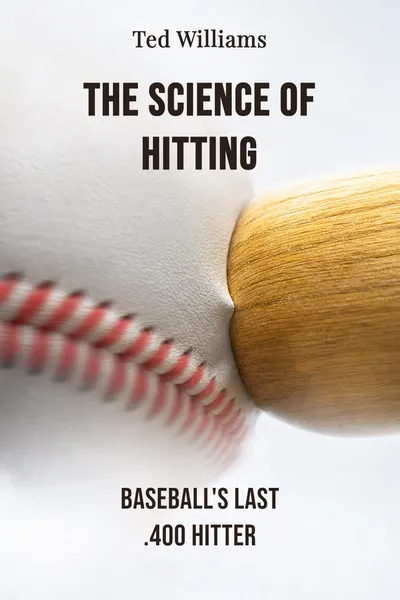
The Science of Hitting
Baseball's last .400 hitter
Description
In the fall of 1941, Ted Williams walked into the last day of the season hitting .3996 — which rounds up to .400, and which his manager offered to let him protect by sitting out a doubleheader against the Philadelphia Athletics. Williams refused. He played both games, went six for eight, and finished at .406. No major-league hitter has reached .400 over a full season since. More than eighty years later, the number sits there like a locked door, and the man who last walked through it spent the rest of his life explaining exactly how he did it.
That explanation became a book. "The Science of Hitting," first published in 1970 with the writer John Underwood, is not a memoir and not a highlight reel. It's a manual — diagrams of the strike zone, charts of batting averages by pitch location, a hitter breaking down his own craft with the patience of an engineer describing a machine he built. Decades after it appeared, it remains the primer coaches hand to players at every level, from Little League fields to the majors. Few athletes have ever tried to make their genius this teachable.
What's striking is how little of it is about talent. Williams had extraordinary eyesight and reflexes, and he says so. But the book spends its energy elsewhere — on discipline, on patience, on a way of thinking about a moment that lasts a fraction of a second. He believed hitting a baseball was the single hardest act in sport, and that the men who did it best were not the most gifted but the most exacting. His life's argument was that a craft this hard could still be broken down, studied, and passed on.
The question we’re asking : How did baseball's last .400 hitter turn the hardest act in sport into something he could actually teach?What we’ll see : The habits of mind, the mechanics of the swing, and the case for treating hitting as a discipline rather than a gift.
Table of contents
01Chapter 1 — The last man to hit .400
Williams called hitting a round ball with a round bat, squarely, the hardest single thing to do in sport, and he meant it as a measured claim rather than a boast. A pitch arrives in roughly four-tenths of a second. The hitter has to decide, in a slice of that, whether to swing and where. Fail seven times out of ten and you're an All-Star; fail six and a half and you're one of the best who ever lived. The .400 season sits at the far edge of what the numbers allow, which is exactly why nobody has matched it since.
His own path to it ran through obsession more than ease. Growing up in San Diego, he swung until his hands blistered and then swung more, hunting for pitchers who would throw to him after school. He questioned every hitter he respected and every pitcher who got him out, gathering intelligence the way a scholar gathers sources. By the time he reached the Boston Red Sox in 1939, he already carried a working theory of his trade in his head, and the 1941 season was that theory paying off in full.

02Chapter 2 — Wait for your pitch
If "The Science of Hitting" has a single commandment, it's this: get a good ball to hit. Williams believed most hitters beat themselves by swinging at pitches they had no business swinging at — balls off the corners, balls low and away, pitches a hitter could reach but never really drive. The discipline to lay off those, even with two strikes looming, was for him the dividing line between the merely talented and the genuinely great.
To make the point concrete, he built the diagram the book is famous for: the strike zone drawn as a grid of seventy-seven baseballs, each one marked with the average he believed he could hit if he swung only at pitches in that spot. In the heart of the zone, waist-high and over the plate, the numbers climb toward .400. Down and away, at the corners, they collapse into the low .200s. The chart makes visible a thing hitters usually only feel — that the same swing produces wildly different results depending on where the ball is.
03Chapter 3 — The swing is a system
Once the right pitch arrives, the swing has to deliver, and here Williams turns from strategy to mechanics with the same exactitude. He rejected the coaching cliché of his era that told hitters to swing down and "chop" at the ball. His swing had a slight upward tilt, roughly matching the downward path of the pitch, because a level-to-slightly-up plane kept the bat in the hitting zone longer and drove the ball with backspin and carry. He was arguing for a version of the uppercut decades before hitting analytics would vindicate it.
The power, he insisted, came from the hips, not the arms. Williams described the swing as a rotation that began in the lower body — hips leading, then the torso, then the hands whipping through last — so that the whole body's mass arrived at the ball rather than just the strength of the wrists. He compared it to the way a cracking whip transfers energy from handle to tip. The hands finished the motion, but they were the end of a chain, not the source of the force.
04Chapter 4 — Thinking along with the pitcher
The deepest layer of the book isn't in the arms or the hips — it's between the ears. Williams treated every at-bat as a contest of information. He studied pitchers relentlessly: what they threw on which counts, how they behaved when behind, the tell in a grip or a windup that gave away the next pitch. He wanted to walk to the plate already guessing, narrowing the possibilities so that his split-second decision was really the last step of a longer calculation he'd started innings earlier.
This is what lifts "The Science of Hitting" above a how-to. What Williams is really describing is a method for mastering any craft under extreme time pressure: gather knowledge before the moment arrives, so that when there's no time to think, you've already thought. The four-tenths of a second a hitter gets is far too short for reasoning. So the reasoning has to happen beforehand — in the film room, in the memory of past at-bats, in the running theory a hitter builds about the man on the mound.
05Conclusion
Ted Williams played his last game in 1960, homering in his final at-bat, and spent his later years managing, fishing, and returning again and again to the subject he never tired of. No hitter has reached .400 since 1941, and the longer the drought runs, the more his account of how he did it reads less like reminiscence and more like a standing challenge. The book is his answer to the question everyone asks: how?