
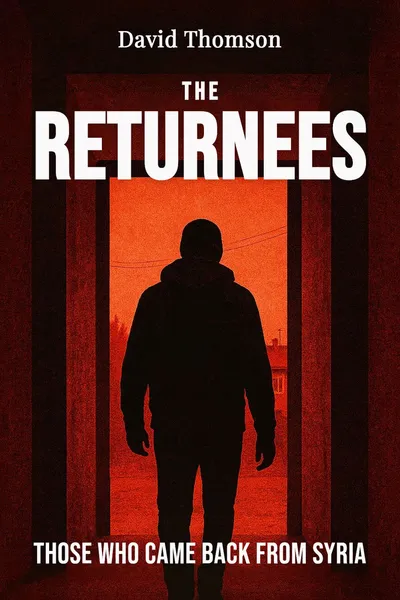
The Returnees
Those who came back from Syria
Description
Between 2012 and 2017, somewhere around 1,900 people left France for Syria and Iraq to join the ranks of jihadist groups, most of them the Islamic State. They were young, often very young, sometimes converts, sometimes radicalized online in a matter of months. Many died there. Some are still detained in Kurdish-run camps and prisons in the northeast of Syria. And some came back — slipping across the Turkish border, turning themselves in, or arriving home before the caliphate collapsed and the doors closed behind them. David Thomson, a journalist who had followed French volunteers since the early days of the war, spent years talking to this last group. The returnees.
What he found was not a clean story of repentance or of unrepentant menace. It was messier than either. Some of the people he met had come home disillusioned, horrified by what they had witnessed, desperate to be left alone. Others had returned without renouncing anything, waiting, biding time. Many sat somewhere in between, their own feelings unresolved, shifting from one conversation to the next. Thomson listened without flinching and without absolving, which is what makes the book hard to put down and harder to forget.
Behind each of these individual trajectories sits a question the French state has never fully answered, because there may be no satisfying answer to give. A person who left to wage war against their own country, and then returned, is neither simply a criminal nor simply a lost child. The law can imprison them for a time. It cannot read their minds, and it cannot hold them forever. At some point the cell door opens again.
The question we’re asking : What happens to the people who went to Syria to fight and then came back — and what is a democracy supposed to do with them?What we’ll see : The trajectories of returning jihadists in Thomson's reporting, the machinery of prison and surveillance built to contain them, and the bind it leaves the state in.
Table of contents
01 Chapter 1 — The ones who came home
Thomson's subjects are not an abstraction. They have names, faces, phone numbers he can call. Over the years of reporting that produced his earlier book on departing fighters and then this one on their return, he built a kind of long-running correspondence with people most of society would prefer never to meet. Some he first spoke to when they were still in Syria, sending voice messages from inside the caliphate. He kept talking to them after they got out. That continuity is the book's spine: we see the same person believe, then doubt, then flee, then try to explain themselves from a cramped apartment back in France.
The portraits refuse to settle into a single type. There is the young man who went full of righteous certainty and came back hollowed out, unable to square the propaganda he had swallowed with the executions and infighting he actually saw. There is the one who talks the language of regret fluently, perhaps too fluently, and leaves Thomson unsure how much to believe. There is the convert who still speaks of the group's project without visible shame. What unites them is less ideology than the fact of having gone and returned, carrying something home that nobody around them can quite see.

02 Chapter 2 — Between prison and surveillance
For the French state, a returnee is first a legal problem. Almost everyone who comes back from the Syrian-Iraqi zone and is identified faces prosecution — the charge is association de malfaiteurs terroriste, criminal terrorist conspiracy, a broad instrument that lets prosecutors act on the fact of having joined the group even when no specific attack can be pinned to the person. Sentences have climbed over the years as the courts hardened their stance. What began, early on, as relatively short terms for some returnees became multi-year prison sentences as the full scale of the Islamic State's crimes came into view.
Prison, though, solves the problem only by postponing it. The French penal system found itself holding a growing population of people convicted of terrorism offenses, and faced a second anxiety: radicalization behind bars. The worry cut both ways — that returnees would recruit other inmates, and that the prisons themselves were incubators. The administration experimented with dedicated units to isolate the most committed, then wrestled with whether concentrating them was containment or a training camp. There was no settled doctrine, only a series of adjustments made under pressure.
03 Chapter 3 — What the women carry back
The men who went to fight get most of the public attention, but a large share of the French contingent in Syria was women, and their returns pose their own tangle of questions. Many left as teenagers or young adults, married quickly into the group, bore children in the war zone. For years the dominant assumption treated them as passive — lured, groomed, following a husband. Thomson's reporting complicates that comfortable picture. Some of the women he follows were committed participants, enforcers of the group's order, as ideologically invested as any man, even if they did not carry weapons on a battlefield.
Their legal treatment lagged behind this reality. For a long time the courts tended to see women as less culpable, handing down lighter sentences on the premise that they had played supporting roles. That assumption eroded as evidence accumulated of women who had policed other women, incited violence, run households that were cogs in the war machine. The reassessment was uncomfortable precisely because it demanded seeing young French women not as victims to be recovered but as agents to be judged.
04 Chapter 4 — A state with no good options
Step back from the individual stories and the returnee question becomes a sharp test of what a democracy can actually do with people it cannot trust but cannot disappear. These are, for the most part, French citizens. The state cannot deport its own nationals to nowhere, cannot hold them indefinitely without conviction, cannot execute a thought. Whatever it does operates inside the constraints of a legal order these very people took up arms against — which is, in a way, the point. The rule of law is tested precisely by the cases that tempt us to suspend it.
Every available policy carries a cost the next one would avoid. Long sentences incapacitate, but they end, and they may deepen the grievance rather than dissolve it. Surveillance tracks, but it cannot read a heart and cannot run forever. Programs to disengage and reintegrate returnees — to loosen the hold of the ideology rather than merely lock the body away — are slow, uncertain, and politically fragile, easy to denounce the moment a single graduate reoffends. Leaving people in the Syrian camps outsources the problem but creates a stateless, radicalizing limbo that may breed the next wave. There is no door that does not lead to another risk.
05 Conclusion
The returnees Thomson followed did not vanish when the caliphate fell. They live in French towns and cities, some in prison, some out, some watched, some drifting beyond the reach of any file. The war they went to fight is over as a territory; it is not over inside the people who came home from it. That is the quiet, uncomfortable fact the book leaves sitting in the room long after the last page — these trajectories have no neat ending, only a continuation that nobody chose and nobody controls.
Related books











