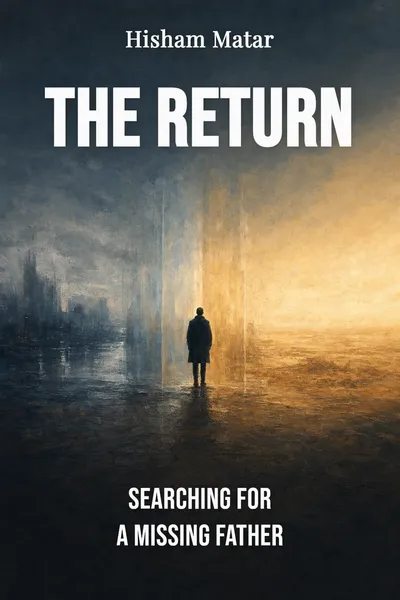
The Return
Searching for a missing father
Description
In March 2012, Hisham Matar walked through the arrivals hall of Benghazi airport for the first time in thirty-three years. He was forty-one, a novelist living in London, and he had spent most of his adult life avoiding the country he was now returning to. Libya had just come out of a revolution that toppled Muammar Gaddafi after forty-two years. The regime that had shaped, exiled, and finally swallowed his family was gone. Matar had come back for one reason: to find out what had happened to his father, Jaballa Matar, a prominent dissident who had been abducted in Cairo in 1990 and delivered to a Tripoli prison, and who had then vanished so completely that no one could say, with any certainty, whether he was alive or dead.
For twenty-two years the family had lived inside that uncertainty. A few smuggled letters in the early 1990s proved Jaballa had reached the notorious Abu Salim prison. Then nothing. No release, no body, no confirmation. In 1996 the regime carried out a massacre there — some 1,270 prisoners killed in a single day — and it was never clear which side of that day Jaballa had been on. Hisham grew up, wrote books, married, built a life in exile, all while holding open a door he could not bring himself to close.
The Return is his account of going back to look. It is a book about a son and a father, but it refuses the shape of tidy grief. Matar writes as someone who knows that not-knowing can be its own kind of imprisonment, and that a search for a person is never only about that person.
The question we’re asking : What does it do to a family, and to a country, when a man is not killed but simply made to disappear?What we’ll see : How a single abduction reaches across decades and continents, and what a son finds when he finally goes back to look.
Table of contents
01Chapter 1 — The phone call and the silence that followed
Jaballa Matar was one of the most visible figures in the Libyan opposition. A former diplomat turned businessman, he had put his fortune behind armed resistance to Gaddafi, funding and helping to organize dissidents from abroad. The family had left Libya in 1979, when Hisham was eight, and settled first in Cairo. Egypt felt like a haven — close enough to home to keep the cause alive, far enough to be safe. That safety turned out to be an illusion.
In March 1990, Egyptian secret police seized Jaballa from the family's Cairo apartment. It later became clear that Egypt had handed him over to the Libyan regime, delivering a wanted opponent to the man who wanted him most. Hisham was nineteen, studying in England. The news reached him as news of that kind always does — sideways, incomplete, impossible to fully absorb. His father, the fixed point of his world, had been taken, and the country holding him would say nothing.

02Chapter 2 — Cairo, Geneva, and a family scattered by fear
Exile is not one thing in Matar's telling; it is a slow rearrangement of a life around a wound. After Cairo, the family dispersed. Hisham studied and then stayed in England, becoming a writer in a language that was not his mother tongue. His mother, his brother, relatives across the diaspora — each carried the disappearance differently, and the effort of not talking about it was as constant as the effort of talking about it. A missing man does not only take himself when he goes. He takes the ordinary future the family had assumed they would share.
The regime understood this arithmetic. Uncertainty was not an accident of Jaballa's case; it was a tool. A dead dissident becomes a martyr, a name to organize around. A vanished one becomes a haunting, a private terror distributed among everyone who loved him. By refusing to confirm anything, Gaddafi's state kept the Matars, and thousands of families like them, suspended — too hopeful to grieve, too frightened to act freely, forever waiting on a word that never came.
03Chapter 3 — A father who would not be small
When Matar finally returns in 2012, the book becomes a portrait of a homeland and a family reunion at once. He meets uncles and cousins imprisoned for years in the same system that took his father — some held in Abu Salim, some released only after the fall of the regime. Their memories become his only new source of information. He interviews former prisoners, sifts testimony, tries to place his father in the geography of a prison he will walk through himself. Everyone has a fragment; no one has the whole.
Alongside the search runs a recovery of who Jaballa actually was. Matar resists letting the disappearance define his father, and instead reconstructs a full man: cultured, funny, a lover of poetry who could recite verse for hours, physically imposing, morally certain in a way that made him dangerous to a dictatorship and sometimes difficult as a parent. Jaballa had refused every offer that would have required him to be quiet. That refusal is what got him taken. It is also, the book suggests, what made him worth searching for — not a victim to be pitied but a person who chose, at great cost, not to be made small.
04Chapter 4 — What a country does to the people who wait
Matar's private search opens onto something larger than one family. The disappeared are a category, not an anomaly — a technique of rule practiced by authoritarian states because it works. To kill an opponent is to make a martyr and admit a crime. To make him vanish is to commit the crime while denying it happened, and to shift the burden of proof onto the very people least able to carry it. The families become unwitting collaborators in the state's silence, because their hope keeps them hoping rather than accusing.
The Return dwells on this transfer of weight. The regime that took Jaballa never had to account for him. Instead his wife and sons spent decades doing the regime's bookkeeping for it, chasing rumors, decoding letters, learning to live in the conditional tense. Matar shows that a disappearance is not a single event but an ongoing act, renewed every day the answer is withheld. The absence keeps working long after the man is gone, and possibly long after he is dead.
05Conclusion
Matar never learns what happened to his father. He walks through the ruins of Abu Salim, gathers the testimony of survivors, exhausts the channels a fallen regime leaves behind, and comes away with fragments that will not resolve into a single answer. The door he could never bring himself to close stays open, not out of hope now, but because no one has the authority or the honesty to close it for him. That, in the end, is the shape of the wound: not grief, which has an object, but suspension, which has none.
Related books