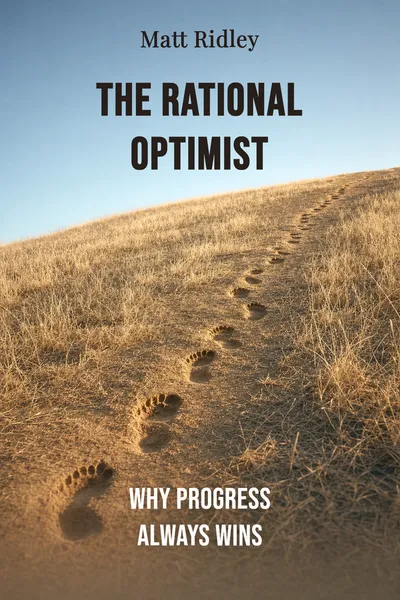
The Rational Optimist
Why progress always wins
Description
In 2010, a British science writer named Matt Ridley published a book with a title that sounded almost like a provocation: The Rational Optimist. The mood of the moment ran the other way. Financial systems had just cracked, climate reports were grim, and the shelves were full of books explaining how it might all end. Into that Ridley dropped a claim that struck a lot of readers as either naive or reckless — that by almost every measure that matters, human life has been getting better for a very long time, and there is good reason to expect it to keep doing so.
His case wasn't a mood. It was an argument built on numbers and a mechanism. Over two centuries, average life expectancy roughly doubled, real income per head climbed many times over, and the share of people living in extreme poverty fell even as the population grew from around one billion to seven. Ridley's point was not that everything is fine — plenty isn't — but that the long trend line is unmistakable, and that pessimism, however sophisticated it sounds, keeps losing its bets. The interesting question is why.
Because optimism on its own is just temperament. What makes Ridley's version rational, in his telling, is that it rests on a specific engine — one that has been running quietly since before we were fully human, and that most of us have never actually looked at. He wants to name it, show how it works, and explain why the people who forecast collapse keep getting the direction of history wrong.
The question we’re asking : If human life keeps improving against all the warnings, what is the actual engine driving it — and why do the pessimists keep losing their bets?What we’ll see : How one overlooked habit of our species turned scarcity into abundance, and why Ridley thinks the smart money is still on us.
Table of contents
01 Chapter 1 — The idea that has sex
Ridley's whole book turns on a single hinge, and he puts it early: the thing that sets humans apart is not intelligence, or language, or tool-making on their own. Chimpanzees are clever, crows use tools, other animals communicate. What no other species does is exchange — swap one thing for a different thing with a stranger, on the expectation that both come out ahead. Somewhere in our deep past, roughly a hundred thousand years ago on his reading, our ancestors started trading, and that habit did something no biology could.
The metaphor he reaches for is deliberately cheeky. Exchange, he says, lets ideas have sex. When one person's way of making a fishhook meets another person's way of curing a hide, the two can combine into something neither had alone. A culture that trades is a culture whose knowledge can breed, recombine, and improve across generations without any single mind having to hold it all. Innovation stops being the rare flash of a lone genius and becomes a collective process — the offspring of ideas meeting other ideas.

02 Chapter 2 — The specialist who forgot how to make anything
If exchange is the engine, its fuel is specialization. The moment two people can trade, neither has to be self-sufficient. One can get very good at making arrowheads and terrible at everything else, because the arrowheads buy the rest. Adam Smith saw this in 1776 with his famous pin factory, where breaking pin-making into separate tasks multiplied output enormously. Ridley extends the observation into a sweeping claim: prosperity just is the extent to which we've divided our labor and pooled the results.
His favorite illustration is almost domestic. Consider how many people it takes to make a single ordinary object — a pencil, a shirt, a cup of coffee. Nobody on Earth knows how to do all of it. The miner, the shipper, the grower, the roaster, the machinist have never met and never will, yet the coffee appears on the counter every morning. We each know almost nothing, and collectively we can do almost anything. That gap between individual ignorance and collective competence is, in his telling, the real measure of how rich a society has become.
03 Chapter 3 — The pessimists have always been wrong
The hardest part of Ridley's case is not the history but the future, and he knows it. Every generation, he argues, produces confident prophets of imminent collapse, and every generation has watched those prophets miss. He lines them up almost gleefully. Thomas Malthus, at the end of the eighteenth century, warned that population would outrun food and starvation would follow; instead farm yields exploded and the world fed billions more. In 1968, Paul Ehrlich's The Population Bomb predicted mass famine in the 1970s and 1980s; the Green Revolution arrived instead. Peak oil, resource exhaustion, the exhaustion of ideas themselves — the doom keeps getting revised and the date keeps slipping.
The reason the pessimists err, in his diagnosis, is a consistent error of imagination. They project current trends forward while holding human ingenuity frozen. They count the mouths but not the minds. Every doom scenario assumes we go on behaving exactly as we do now while the problem grows — but that is never what happens. Prices rise, people substitute, inventors invent, and the feared scarcity dissolves into a new abundance nobody forecast. A resource, Ridley likes to say, is defined not by nature but by knowledge; oil was useless black goo until someone learned what to do with it.
04 Chapter 4 — Why bet on the open door
Step back from the numbers and it becomes clear that The Rational Optimist is not really a book about optimism at all. It's a book about a mechanism, and about who gets to run it. The engine Ridley describes — exchange, specialization, recombining ideas — has one defining feature: it works from the bottom up. Nobody is in charge of it. It emerges from millions of ordinary transactions between people pursuing their own ends, and it produces order and improvement that no authority could have designed. That is the real claim, and everything cheerful in the book follows from it.
This is why his optimism carries a sharp political edge, and why it has drawn sharp critics. If progress comes from decentralized, self-organizing exchange, then the great danger is anything that clogs the channel — monopolies, yes, but above all top-down control that presumes to steer the whole system from a single vantage point. Ridley's history of setbacks is a history of that presumption: empires that taxed trade into the ground, planners who commanded harvests and got famines, priesthoods and bureaucracies that froze the flow of ideas. Collapse, in his telling, is usually not the market failing but someone shutting the door on it.
05 Conclusion
Ridley began with a title that read like a dare and spent the book turning it into an argument. The optimism was never a personality trait; it was a conclusion drawn from a long trend and a mechanism that explains it. Human life keeps improving, he claims, because our species does something no other does — it exchanges, specializes, and lets ideas recombine faster than any problem can outrun them. The prophets of collapse keep losing because they count the difficulties and forget the minds that will meet them.
Related books