

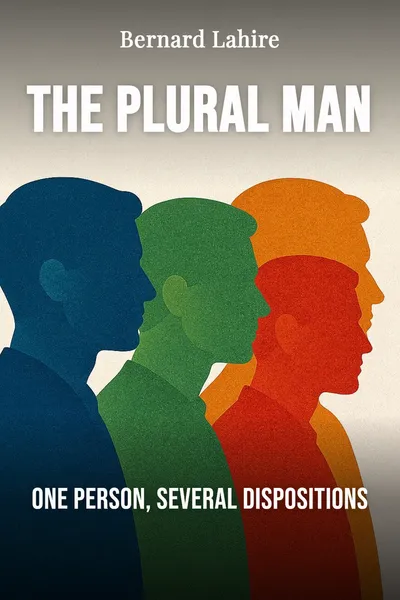
The Plural Man
One person, several dispositions
Description
Here is someone we all know. At the office, meticulous, punctual, almost rigid about deadlines — then at home, the laundry piles up and the dishes wait three days. Tender with one child, impatient with another. Generous with strangers, petty with a sibling. Disciplined at the gym on Tuesday, incapable of opening a book that same evening. We tend to explain this away: a bad day, a lapse, the real self slipping through the cracks. Bernard Lahire, a French sociologist writing in the late 1990s, took the opposite view. The contradictions aren't noise around a stable core. They are the person.
His book, published in French in 1998 as L'Homme pluriel and translated as The Plural Man, is an argument with a ghost — the ghost of Pierre Bourdieu, under whom a whole generation of French sociology had learned to think. Bourdieu had given the discipline a powerful tool: the habitus, a set of dispositions laid down by one's upbringing and social position, carried around like a second nature that quietly governs taste, posture, ambition. Lahire had used it himself. Then he noticed it didn't quite fit what he saw in actual lives.
The trouble was coherence. Bourdieu's habitus tends to imply a person who is, deep down, of a piece — whose breakfast and whose politics flow from the same source. But real people, Lahire argued, are stitched together from incompatible experiences, and they carry all of them at once. The question wasn't how we become coherent. It was how we live without being.
The question we’re asking : If we're so often inconsistent across the situations of a single day, what exactly is holding a person together — and does anything need to?What we’ll see : How a quiet quarrel inside French sociology turned into a different picture of what a person is.
Table of contents
01 Chapter 1 — The man who contradicts himself
Lahire starts not with theory but with the sheer familiarity of inconsistency. We hold ourselves to an ideal of character — a person should be recognizably themselves across settings — and then we spend our lives failing it. The colleague who is a natural leader in meetings goes silent at family dinners. The friend who reads philosophy for pleasure watches reality television without irony. We experience these shifts as small betrayals of some truer self, and we reach for a hierarchy: one of these is the real me, the others are masks, moods, concessions.
Lahire refuses the hierarchy. None of these is the mask and none is the face. A person is the whole repertoire, including the parts that don't talk to each other. What looks like contradiction from the outside is, from the inside, simply a different situation calling up a different competence. The office wakes certain reflexes; the kitchen wakes others, or fails to wake any. We don't carry one program that runs everywhere. We carry many, and most of them sit dormant most of the time.

02 Chapter 2 — Bourdieu's unified self, and where it cracks
To see what Lahire is pushing against, we need Bourdieu's great idea. The habitus was his answer to an old puzzle: how does society get inside us without feeling like coercion? Why do people from a given background tend to share tastes, gestures, ways of speaking, even without being told to? Bourdieu's answer was that our early environment deposits a system of durable dispositions in us — a feel for the game, learned so young it feels like instinct rather than rule. The habitus explains how structure reproduces itself quietly, through bodies that already want what their position offers them.
It is a magnificent tool, and Lahire never denies its power. His quarrel is with a tendency built into it: the tendency to treat the habitus as unified and transposable. In Bourdieu's strongest formulations, the dispositions acquired in one domain carry over coherently into all others, so that a person's whole conduct springs from a single generative principle. Taste in music, choice of partner, parenting style, political leaning — all legible as expressions of one underlying disposition. The self becomes a theme with variations.
03 Chapter 3 — The folds of a single person
If we are not one habitus but many deposits, how are they stored? Lahire's image is the fold. We carry our past experiences folded away, like memories that aren't being thought right now. At any given moment most of what we are stays folded, inactive, invisible even to us. A situation reaches in and unfolds the relevant part — and only that part. The rest keeps sleeping. We are, almost always, far less than the sum of what we contain.
This reframes the stakes. The question is no longer which dispositions a person has acquired, but which ones a given context actually activates, and in what order of priority. Two people with nearly identical pasts can behave in opposite ways because their current situations are summoning different stores. And one person can hold flatly contradictory dispositions without strain, because the two are never called up at the same time. Contradiction requires simultaneity. Folded away in separate situations, opposites coexist in perfect peace.
04 Chapter 4 — What a self made of contexts asks of us
Step back from the quarrel with Bourdieu and a larger unease comes into view. Almost everything around us is built to assume a unified individual. The law punishes a person as a single responsible agent, as if the one who committed the act and the one standing trial were seamlessly the same. Moral judgment runs on character: we call someone generous or cruel as though the label held across every room they enter. Even our own self-talk assumes a stable protagonist whose choices express who we are. If Lahire is right, all of this rests on a convenient simplification.
That doesn't mean the simplification is useless. A society needs to treat people as accountable units, and we need to experience ourselves as continuous or we couldn't make plans. Lahire's point is not that the unified self is a lie to be exposed, but that it is an achievement rather than a given — something produced, with effort, out of material that is naturally plural. We become relatively coherent to the degree that our situations stay stable and reinforce the same dispositions. When life is varied, so are we; when it narrows, we harden into a type. Coherence is a function of circumstance, not proof of depth.
05 Conclusion
We began with the ordinary figure who is strict at work and lax at home, tender here and sharp there, and who we kept trying to reduce to one true layer underneath. Lahire's answer is that there is no underneath — or rather, that the layers are the person, stored as folds and unfolded one at a time by the situations we pass through. The inconsistency we apologize for is not a flaw in our character. It is the most honest evidence of what character actually is: plural, uneven, triggered from outside as much as governed from within.
Related books











