

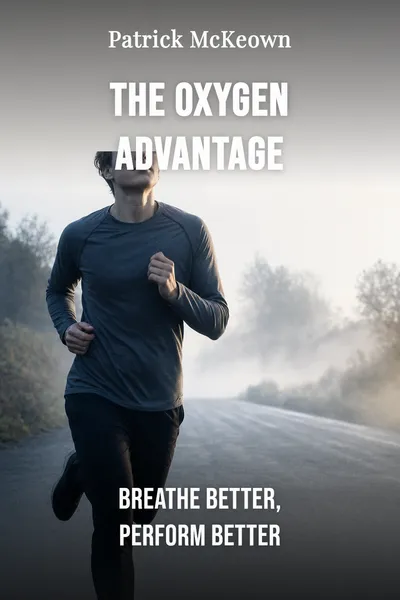
The Oxygen Advantage
Breathe better, perform better
Description
Take a deep breath. The instruction sounds like health itself — the thing a doctor says, a yoga teacher says, a friend says when we're panicking on a platform waiting for a train that won't come. Fill the chest, pull in as much air as possible, and something in us relaxes. It feels obviously good. That is exactly where Patrick McKeown, an Irish breathing coach trained in the Buteyko method, plants his flag in The Oxygen Advantage: the deep, gulping, mouth-open breath we treat as the picture of vitality is, for a lot of people, most of the time, working against them.
McKeown's claim is counterintuitive enough to sound like a gimmick, except the physiology under it is old and settled. We assume that breathing more means taking in more oxygen, and that more oxygen means better everything — sharper mind, faster legs, healthier body. The book spends its pages taking that chain of assumptions apart, link by link, and it does so with a single unglamorous measurement it asks the reader to take within the first few chapters: how long you can comfortably hold your breath after a normal exhale. That number, McKeown argues, tells you more about your fitness than almost anything you'd find on a treadmill.
What makes the book more than a curiosity is who it's aimed at. Not just the wheezing weekend jogger, but Olympic athletes and Ironman competitors — people whose margins are already thin, who have squeezed everything they can from training and are looking for the last hidden percent. McKeown's wager is that the percent is sitting in plain sight, in a function we perform some twenty thousand times a day without a thought.
The question we’re asking : If breathing more feels good and seems healthy, why would breathing less make the body work better?What we’ll see : How a simple breath-hold test, a much-misunderstood gas, and the humble nose add up to a trainable edge in health and performance.
Table of contents
01Chapter 1 — The problem hiding in a big breath
The everyday habit McKeown targets is one most of us don't know we have: chronic over-breathing. Not the dramatic hyperventilation of a panic attack, but a quiet, low-grade version — breathing a little too much, a little too often, mostly through the mouth, mostly without noticing. The signs are ordinary enough to blame on other things: sighing, yawning, a stuffy nose, waking up with a dry mouth, feeling winded on a flight of stairs. We file these under stress or age. McKeown files them under a breathing pattern that has slowly drifted out of tune.
The reason it matters comes down to a trade the body is quietly making. When we breathe more air than our metabolism actually needs, we don't load up on extra oxygen — the blood is already close to fully saturated at rest, so there's little room to add more. What over-breathing does instead is flush out a gas we've been trained to think of as pure waste: carbon dioxide. And that, in McKeown's telling, is where the trouble starts, because the body needs a certain baseline of CO2 far more than we ever appreciated.

02Chapter 2 — The gas we spent a century misreading
Carbon dioxide has an image problem. It's the thing we breathe out, the by-product, the exhaust. School biology draws the arrow cleanly: oxygen in, carbon dioxide out, the used-up remainder of the deal. That framing isn't wrong so much as it's dangerously incomplete, and correcting it is the intellectual heart of The Oxygen Advantage.
The correction rests on a piece of physiology named after the Danish scientist Christian Bohr, who described it in 1904. The Bohr effect explains how oxygen actually gets from the blood into the tissues that need it. Oxygen rides through the bloodstream bound to hemoglobin, and hemoglobin doesn't let go of that oxygen easily. What loosens its grip is the presence of carbon dioxide. Where CO2 is concentrated — in a hard-working muscle, say — hemoglobin releases more oxygen. So carbon dioxide isn't just waste on its way out. It's the signal that tells the blood where to unload its cargo.
03Chapter 3 — The nose knows things the mouth forgot
If carbon dioxide is the misunderstood molecule, the mouth is the misunderstood habit. A large share of over-breathing, in McKeown's account, comes down to a single unexamined default: breathing through the mouth rather than the nose. It's faster, it's easier, it's what we drift into during exercise, sleep and concentration — and it's the mechanism by which most of us quietly blow off too much air.
The nose, by contrast, is built for the job in ways the mouth simply isn't. It's narrower, so it slows and paces the breath. It warms and filters incoming air. And it produces something the mouth cannot: nitric oxide, a gas generated in the sinuses that widens blood vessels and airways and helps oxygen move into the blood. McKeown leans on the work of researchers who established nitric oxide's role in the body — it was important enough that its discovery won a Nobel Prize in 1998 — to make a plain point. Breathe through the nose and you fold this vessel-opening gas into every inhale. Breathe through the mouth and you skip it entirely.
04Chapter 4 — Training the body to want less air
Step back from the individual tips and the shape of McKeown's argument becomes clear: he's treating oxygen efficiency as a trainable variable rather than a fixed endowment. We tend to think of aerobic capacity as something we either have or build slowly through sheer volume of exercise — bigger lungs, stronger heart, faster legs. The Oxygen Advantage adds a different axis entirely. Not how much air you can move, but how little you need to move to do the same work. That efficiency, McKeown insists, can be raised deliberately, and the BOLT score is the dial we watch to see it climb.
The method that follows is essentially tolerance training. Light breathing exercises that create a mild, comfortable air hunger. Breath-holds after a normal exhale, walked out over increasing steps. For athletes, holding the breath during exercise to simulate the thin-air stress of altitude. The common thread is teaching the body to stay calm as carbon dioxide rises, to stop hitting the panic button so early. Over weeks, the breathing rate at rest drops, the breath-hold time lengthens, and the sensation of breathlessness during effort arrives later and softer.
05Conclusion
Take a deep breath. By the end of The Oxygen Advantage, the instruction we started with has quietly inverted. The vitality we associate with a big, chest-filling gulp is, in McKeown's telling, closer to the symptom than the cure — and the healthier move is smaller, slower, and routed through the nose. The measure of a well-tuned system isn't how much air we can pull in, but how little we need and how calmly we sit with the urge to breathe. A number as humble as a breath-hold becomes the readout of a body that has stopped over-spending.