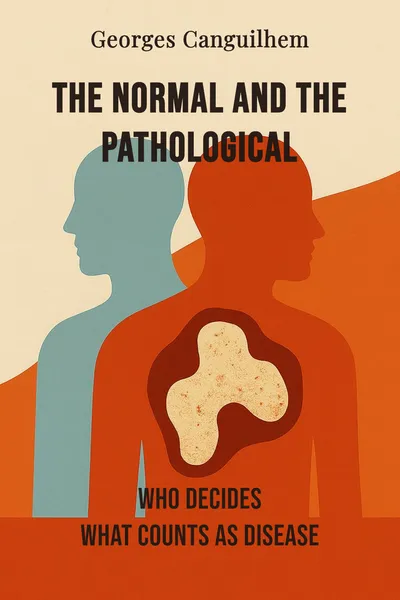
The Normal and the Pathological
Who decides what counts as disease
Description
In 1943, in occupied France, a physician defended a medical thesis in Strasbourg that had nothing reassuring about it. His name was Georges Canguilhem, and he had come to medicine late, after years teaching philosophy — a detour that shaped everything. The thesis asked a question doctors rarely stop to ask, because they are too busy answering it every day: what exactly separates a healthy body from a sick one? Not which disease a patient has, but how we know, in the first place, that a state counts as disease at all. Behind the bedside routine, Canguilhem found an assumption nobody had examined.
The reigning answer, at the time, was mathematical. Sickness was a matter of quantity. Too much sugar in the blood, too little thyroid, a pulse too fast or too slow — the pathological was just the normal pushed past a threshold, more or less of the same thing. Nineteenth-century physiology had built its authority on this idea: measure the healthy body, average the readings, and disease becomes any deviation from the mean. Clean, objective, apparently free of judgment. Canguilhem spent the book taking it apart, and later, in 1966, added a second set of reflections that sharpened the knife.
What he was really contesting was who gets to hold the ruler. If disease is defined by numbers, then a lab decides. But a fever, a limp, a shortness of breath — these announce themselves as suffering before any measurement, and a value slips in through the back door under the cover of pure fact. Canguilhem wanted to bring that value into the open, and see whether medicine could survive the honesty.
The question we’re asking : When we call a body sick, are we reading a measurement or making a judgment — and who is entitled to make it?What we’ll see : How a doctor's philosophical thesis dismantled the idea that disease is just health minus a threshold, and where that leaves us.
Table of contents
01Chapter 1 — A thesis rejected, a doctor turned philosopher
Canguilhem's path to the question was itself unusual. Born in 1904, he trained as a philosopher at the École normale supérieure alongside Jean-Paul Sartre and Raymond Aron, and taught the subject for years in provincial lycées. Philosophy, though, kept running up against bodies it could not explain from the armchair. So in his late thirties he enrolled in medical school — not to practice, but to think about medicine from the inside, with the instruments and the vocabulary of the people who actually treat the sick.
The result was his 1943 thesis, later published as an essay on some problems concerning the normal and the pathological. It reads less like a doctor's dissertation than like an ambush. Canguilhem takes the most respectable position in physiology and asks it to justify itself. The position had a distinguished pedigree: the physiologist Claude Bernard, in the nineteenth century, had argued that disease and health obey the same laws, differing only in degree. Diabetes was not a foreign invasion but normal sugar metabolism gone quantitatively astray.

02Chapter 2 — The pathological is not the normal shrunk down
The heart of Canguilhem's argument is that a diseased body is not a healthy body running the same processes at a different intensity. It is a body living differently — under new rules of its own. Bernard's picture imagines the sick organism as a healthy one with the dials turned up or down. Canguilhem answers that disease often introduces phenomena that simply do not exist in health at all, and abolishes others that health cannot do without. The difference is qualitative, not a matter of more or less.
Take the diabetic body. It is not merely a normal body with elevated sugar, as if the same machine were idling too fast. Beyond a certain point, sugar appears in the urine, tissues starve amid abundance, and the organism reorganizes its entire economy around a shortage it cannot fix. New behaviors emerge; old regulations collapse. What the physiologist charts as a single variable crossing a line is, lived from inside, a body that has become another kind of body, with a different way of holding itself together.
03Chapter 3 — The norm is not the average
From here Canguilhem turns on the word doing all the quiet work: normal. In science, normal usually means average — the typical value across a population, the peak of the bell curve. Measure a thousand people, and the middle of the spread becomes the standard against which each individual is judged. It sounds neutral, a mere description of what most bodies do. Canguilhem argues it is nothing of the kind.
The statistical average, he points out, cannot by itself tell you that anything is good or desirable. Suppose that in a given region nearly everyone carries a certain parasite, or that most workers in an industry share the same lung damage. The condition is statistically normal — it is what the average body there displays — yet no one would call it healthy. The frequency of a state and its value are two different things, and physiology keeps sliding from one to the other without noticing. To be normal in the sense of common is not to be normal in the sense of right.
04Chapter 4 — Health is the room to fail and recover
Step back from the clinic and Canguilhem's real claim comes into view: norms are not measurements the living submit to, but things the living produce. An organism is not a stable machine defending fixed settings against disturbance. It is an activity that continually establishes what will count, for it, as an acceptable way of being in its environment. To be alive is already to be normative — to sort the world into what sustains and what threatens, and to organize oneself accordingly. Health and disease are two modes of that same restless norm-setting.
On this view, health is not the absence of disease or a perfect set of readings. It is something more like abundance — a margin, a reserve of possibility. The healthy body is one that can afford to be thrown off, to fall ill, to break a rule, and still find its way to a new stable arrangement. Canguilhem's word for this is normativity: the capacity not just to follow norms but to institute new ones when circumstances change. Health is the luxury of being able to get sick and get better, to tolerate the unforeseen.
05Conclusion
The physician who defended that thesis in 1943 never intended to make doctors distrust their instruments. Canguilhem respected measurement; he simply refused to let it pretend it had no author. When we call a body sick, we are not merely reading a value that crossed a line. We are registering that a living thing has lost some of its capacity to cope, to compensate, to keep its balance under strain — and that judgment, quantify it as we may, comes from life before it comes from the laboratory.
Related books