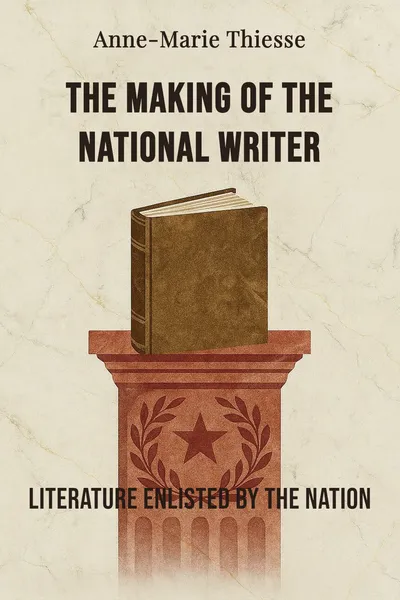
The Making of the National Writer
Literature enlisted by the nation
Description
Sometime in the nineteenth century, across most of Europe, a curious idea took hold and never quite let go: that every nation has its writers, and that those writers express something essential about the people who speak the language. Germany had Goethe and Schiller. France had a lineage running back through Racine and Molière to Rabelais. England had Shakespeare, promoted from popular playwright to national soul. The pairing felt so obvious that it stopped looking like an idea at all. A country, a language, a body of great books that supposedly grew out of the national temperament — the arrangement seemed as natural as the landscape.
In her book The Making of the National Writer, the historian Anne-Marie Thiesse takes that obviousness and pulls it apart. Her argument is that the national writer is not a fact one discovers but a figure one constructs. The great author bound to his country did not emerge on his own from the soil of a shared culture. He was assembled — through anniversaries, monuments, school curricula, scholarly editions, and a whole machinery of commemoration that ran in parallel across borders, often with the same tools and the same timing. What looked like a spontaneous flowering of genius was, on closer inspection, an organized enterprise.
That reframing matters because the national writer was never only a literary matter. Thiesse follows the figure into the places where nations were being built and legitimized, where a canon of names could do political work that armies and constitutions could not. The writer became proof that a people existed, that it had depth, that it deserved a state of its own. Once we see how the figure was made, the familiar list of a country's great authors starts to look less like an inheritance and more like a construction with an author of its own.
The question we’re asking : How did the idea of a national writer — a genius who expresses the soul of a people — come to seem so natural, and who actually built it?What we’ll see : How a European-wide machinery turned authors into national emblems, and what a state gains when literature answers to the nation.
Table of contents
01Chapter 1 — The writer who belonged to a country
Before the nineteenth century, the notion that a writer belonged to a nation would have puzzled most people. Educated Europeans read in Latin, moved between courts, and thought of literature as a shared possession of the learned rather than the expression of a particular people. A poet served a patron, a genre, a tradition — not a fatherland. Thiesse's starting point is that the tight bond we now assume between an author and his country is historically recent. It had to be invented, and the invention happened almost everywhere at once.
The shift came with the Romantic idea, spreading from German thinkers like Herder, that each people carried a distinct spirit, a Volksgeist, and that this spirit found its truest voice in language and literature. If a nation was defined by its culture rather than by its rulers, then its writers became its evidence. A people that could point to great authors could claim to be a real nation, with a soul worth preserving and a right to political existence. Literature stopped being ornament and became identity.

02Chapter 2 — How a canon gets built
If the national writer was constructed, the obvious question is how. Thiesse's answer is concrete and almost technical: a canon is built through a set of repeatable operations that any national movement could perform. The first was selection. Out of the mass of authors a language had produced, a handful were chosen and elevated, while the rest receded into specialist obscurity. This choosing was rarely the work of readers alone. Critics, professors, editors and officials decided who counted, and their decisions hardened into what came to feel like natural consensus.
The second operation was biography. A national writer needed a life that matched his role, so lives were shaped into exemplary narratives: humble origins, struggle, dedication to the people, a body of work that expressed the nation's essence. Inconvenient facts were softened or dropped. The messy, cosmopolitan, often opportunistic realities of literary careers were smoothed into stories of destiny. The writer's biography became a small national myth, teachable and inspiring.
03Chapter 3 — The apparatus behind the myth
Behind the myth of the solitary genius stood a visible apparatus, and Thiesse's book is largely a tour of it. The most spectacular pieces were the public celebrations. Anniversaries of a writer's birth or death became mass events — the centenaries of Schiller, of Shakespeare, of others — with processions, speeches, wreaths and crowds. These were not private acts of admiration but civic rituals, staged to bind a population to its literary ancestor and, through him, to the nation. Commemoration turned reading into belonging.
Monuments made the bond permanent and physical. Statues rose in public squares, birthplaces became shrines, tombs were relocated to national pantheons where writers could rest among the great. The writer's house was preserved as a place of pilgrimage, its objects treated as relics. Thiesse reads this quasi-religious vocabulary carefully: the national writer inherited some of the emotional machinery of sacred cults, offering a secular object of devotion around which a people could gather.
04Chapter 4 — Literature as a nation-building instrument
Step back from the individual authors and a larger pattern emerges, which is really the heart of Thiesse's argument. The national writer was one instrument among several in the vast enterprise of nineteenth-century nation-building. States and aspiring states needed to persuade populations that they formed a single people with a shared past and a common destiny. Flags, anthems, folklore, national histories, standardized languages — and canons of literature — were all part of the same toolkit, and Thiesse studies literature as one of these deliberately fashioned emblems rather than as a spontaneous cultural fact.
What literature offered that a flag could not was depth and legitimacy. A body of celebrated writers gave a nation an ancestry, a proof that it had existed as a cultural community long before it existed as a state, that it possessed a soul refined enough to have produced beauty. For peoples without independence — Poles under partition, Czechs within an empire, Norwegians seeking to detach their culture from Danish tutelage — the national writer could carry the claim to nationhood when no government would. Literature became a passport to political existence.
05Conclusion
The national writer, then, arrives at us fully formed, with his statue, his birthplace, his complete works and his place in the curriculum, looking for all the world like something a country simply has. Thiesse's book undoes that appearance by showing the seams — the selections, the biographies rewritten, the centenaries planned, the ministries and societies at work. The figure who was supposed to spring from the soil of a shared culture turns out to have been assembled, across Europe, by people who knew exactly what they were doing and often did it in coordination.
Related books