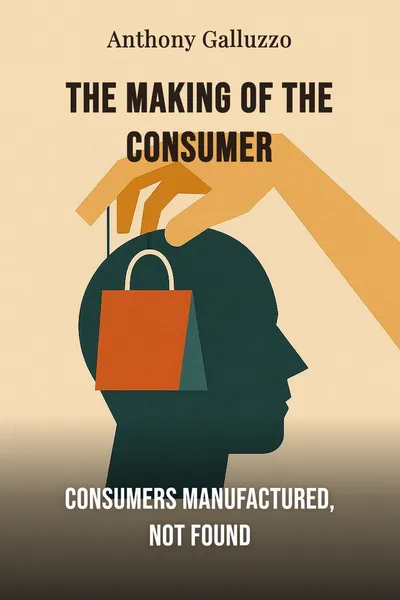
The Making of the Consumer
Consumers manufactured, not found
Description
We tend to think of the consumer as a natural creature — someone who has always wanted things, compared prices, succumbed to a sale. Buying feels as old as hunger. But if we look at the word itself, something odd surfaces. For most of its life, "consume" meant to use up, to waste, to destroy — tuberculosis was "consumption" because it devoured the body. The person we now call a consumer, the one who shops as a form of self-expression and finds identity in a cart, is a surprisingly recent invention. And Anthony Galluzzo's argument, in The Making of the Consumer, is that invention is exactly the right word.
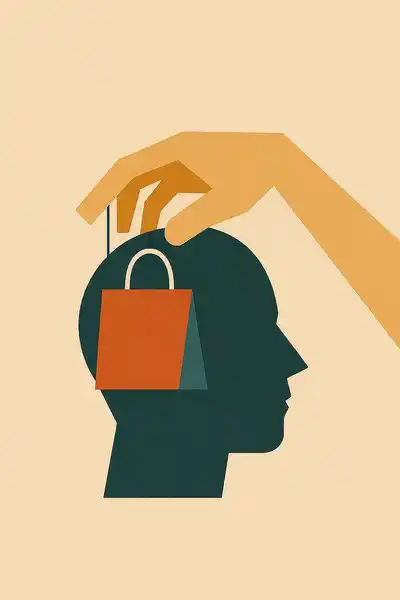
Galluzzo, a French marketing scholar, tells the story of how this figure was assembled over roughly two centuries — not discovered lying in human nature, waiting to be served, but manufactured by merchants, advertisers, economists, and engineers who needed it to exist. The consumer wasn't a demand that supply rushed to meet. It was, more often, a product that had to be produced alongside the goods. Someone had to be taught to want, taught to want more, and taught to feel that wanting was who they were.
The claim lands differently than the usual lament about materialism, because Galluzzo isn't moralizing about greedy shoppers. He's tracking the deliberate, documented labor that went into shaping a way of living. Behind every "natural" impulse to buy sits a history of people who worked, patiently, to make that impulse feel natural.
The question we’re asking : Where did the consumer actually come from — and who did the making?What we’ll see : How a figure once absent from human life was assembled, trained, and eventually installed inside us, through methods that still run today.
Table of contents
01Chapter 1 — The figure that had to be built
Before the nineteenth century, in most of Europe, there was no consumer in our sense — there were producers, households, subjects, parishioners. People bought things, of course, but buying was episodic, functional, hemmed in by scarcity and by moral suspicion of excess. Galluzzo reminds us that for centuries the dominant attitude toward wanting too much was outright hostility: luxury was a vice, novelty was dangerous, and thrift was a virtue preached from pulpits. A whole culture had to be dismantled before shopping could become a pleasure rather than a confession.
The shift Galluzzo traces is less a sudden revolution than a long construction project. The Industrial Revolution produced goods at a scale that had never existed — factories could now make far more than traditional buyers knew how to want. The problem flipped. For most of history the scarce thing had been goods; now the scarce thing became demand. Mountains of manufactured objects needed someone to absorb them, and that someone did not yet exist in sufficient numbers or with sufficient appetite.

02Chapter 2 — Desire, taught in department stores
The classroom, for the first lessons, was the department store. When places like the Bon Marché opened in Paris in the second half of the nineteenth century, they did something no shop had done before: they let you wander. Entry was free, browsing was encouraged, and there was no obligation to buy. Goods were piled high, lit, arranged, and labeled with fixed prices so no haggling stood between the eye and the object. Galluzzo describes these spaces as machines built to produce desire, cathedrals where the religion being taught was wanting.
The genius was spatial and theatrical. Staircases forced you to pass through departments you hadn't come for. Displays staged everyday objects as spectacle, surrounding a dress or a lamp with a small fantasy of the life it promised. Mirrors, abundance, and the sheer accumulation of things made the act of looking intoxicating. You arrived needing nothing in particular and left having discovered needs you didn't know you had — which was precisely the design. The store manufactured the gap between who you were and who you might be, then sold you the bridge.
03Chapter 3 — The science of needing more
By the early twentieth century, the making of the consumer stopped relying on architecture alone and recruited expertise. Advertising professionalized. The men who sold selling began borrowing from the new science of psychology, and the goal shifted from describing a product to reaching the person who might buy it. Galluzzo tracks how the pitch moved from the object to the self: stop telling people what the soap does, start telling them what the soap will make them become. Fear, status, love, shame — these became the real levers, far stronger than any list of features.
The theorists of this period said the quiet part openly. Figures in American advertising and public relations argued that the mass of people had wants that could be shaped, channeled, even created, and that the health of an industrial economy depended on keeping those wants perpetually unsatisfied. A contented consumer was a commercial dead end. The engineered dissatisfaction that follows every purchase — the sense that the next thing will finally complete you — was not a side effect. It was the business model, dressed up as the pursuit of happiness.
04Chapter 4 — The techniques that outlived the salesman
If we step back from the stores and the ad men, what Galluzzo has really assembled is a toolkit — a set of transferable techniques for making consumers that outlived the particular settings where they were invented. The free browse, the staged display, the fixed price that removes friction, the appeal to identity over function, the manufactured gap between who you are and what you lack, the schedule of obsolescence that keeps desire moving. None of these depended on marble halls or printed catalogs. They were portable, and so they traveled.
Where they traveled, of course, is into the devices we carry. The endless scroll is the staircase that routes you past things you didn't come for. The personalized feed is the catalog, except it now watches which pages you linger on and rearranges itself accordingly. One-click purchase is the fixed price taken to its logical end — all friction between eye and object removed. The techniques Galluzzo traces to the nineteenth century didn't fade; they were coded. What a whole department store once did to a crowd, an app now does to one person at a time, continuously, with far better information.
05Conclusion
We started with a word that once meant to use up, to waste, to be devoured — and with a figure who, for most of human history, simply wasn't there. Galluzzo's achievement in The Making of the Consumer is to return that figure to its history, to show the consumer not as a fact of our nature but as a long, deliberate construction. The stores were built, the desires were taught, the dissatisfaction was engineered, the theory of the insatiable self was written. None of it was waiting inside us to be released. It was produced.
Related books