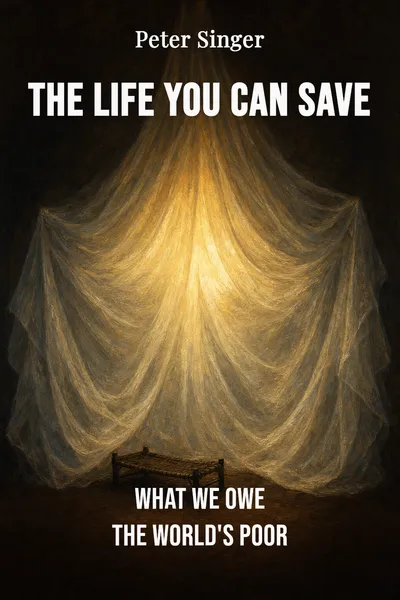
The Life You Can Save
What we owe the world's poor
Description
You are walking past a shallow pond and you see a small child face-down in the water, drowning. No one else is around. You could wade in and pull the child out, but you are wearing new shoes and good clothes, and the mud would ruin them. Do you keep walking? Almost nobody says yes. The shoes are nothing against a child's life, and everyone senses it instantly. That scene, which the Australian philosopher Peter Singer first sketched in 1972 and rebuilt in his 2009 book The Life You Can Save, is the trapdoor under a great deal of comfortable moral reasoning.
Because the pond is not really about the pond. Right now, a child on the other side of the world is dying of something a few dollars would prevent: diarrhea, measles, malaria, a birth without a trained attendant. In the year Singer wrote, roughly nine to ten million children under five were dying annually from causes we know how to stop. The tools exist. The money to buy them exists, sitting in the current accounts of people who will not miss it. The distance feels like it changes everything. Singer's whole project is to ask, coldly and patiently, whether it changes anything at all.
He is not writing a guilt trip, though it can read like one. He is writing something closer to an argument you have to actively refuse rather than merely disagree with. And having built the argument, he does something most philosophers don't bother with: he tells us, in concrete numbers, what he thinks we should actually do about it.
The question we’re asking : If we would ruin our shoes to save a drowning child, why do we let far cheaper deaths happen every day on the other side of the world?What we’ll see : How one thought experiment turns ordinary comfort into a moral problem, and what Singer proposes we do once we can't unsee it.
Table of contents
01 Chapter 1 — The child in the pond
Singer builds his case from a premise almost no one rejects: if we can prevent something very bad from happening, without sacrificing anything of comparable moral importance, we ought to do it. Ruined shoes are not comparable to a dead child. So we pull the child out. Fine. The uncomfortable part is what follows. A donation of a few hundred dollars to the right organization can, on reasonable estimates, save a child's life just as surely as wading into the pond. The cost to us is trivial by comparison. By the logic we already accept, we are obligated to give.
The power of the pond lies in how it strips away the noise. There is no ambiguity about who is responsible, no crowd to hide in, no doubt that our small effort will work. Singer's argument is that these features feel decisive but are morally beside the point. The child dying of malaria is just as real as the child in the water. Our money reaches her just as reliably through a competent charity as our arms reach across a pond. What differs is distance, visibility, and the presence of other bystanders, none of which, Singer insists, actually lessens what one person's life is worth.

02 Chapter 2 — Why the excuses don't hold
Once the pond has done its work, the objections arrive, and Singer takes them one by one. The most common is that charity doesn't work: the money is stolen, wasted, or swallowed by corruption. He concedes that some aid is badly spent, and that untargeted government-to-government transfers have a mixed record at best. But he distinguishes sharply between that and effective, well-run interventions delivering measles vaccines, bed nets, or vitamin A. These have measurable results, and pretending otherwise is often a way of protecting ourselves rather than the poor.
Then there is the worry about dependency, the fear that giving fosters helplessness. Singer's reply is that a child cured of a preventable illness, or a mother who survives childbirth, is not made dependent; she is given the chance to live at all. He also faces the harder philosophical objection raised by thinkers like Garrett Hardin, that saving lives now only enlarges future suffering. He points out that, historically, the surest way populations stabilize is not through withheld aid but through falling child mortality, better health, and rising security, the very things effective giving supports.
03 Chapter 3 — Where the money actually goes
Having cleared the excuses, Singer turns practical, which is what separates this book from a sermon. He wants to know which giving actually works, and he is willing to talk about cost per life saved in a way that can feel almost clinical. That bluntness is deliberate. If we accept that distant lives count, then choosing where to give is not a matter of warm feeling but of doing the most good with what we part with. A dollar directed to a highly effective program does more than the same dollar spread thin.
He points to interventions with strong evidence behind them: oral rehydration for diarrhea, which costs almost nothing and saves enormous numbers of children; insecticide-treated bed nets against malaria; deworming, which quietly improves school attendance and later earnings; vitamin A supplements; and the funding of trained birth attendants. These are unglamorous. No one names a wing of a hospital after a shipment of bed nets. But Singer's case is that unglamorous and effective beats visible and vague every time.
04 Chapter 4 — A standard almost nobody meets
Step back from the numbers and the case studies, and the deeper move in Singer's book is a quiet redefinition of what it means to be a decent person. For most of us, being good is a matter of not doing harm: don't cheat, don't steal, don't lie, pay your taxes, be kind to those nearby. Singer's argument dissolves the comfortable line between that ordinary decency and the heroic self-sacrifice we reserve for saints. If letting a child die when you could cheaply save her is wrong, then the average affluent life, lived entirely within the law and within convention, is failing a test it never knew it was taking.
This is unsettling precisely because it is not extreme. Singer is not asking us to abandon our own children, sell our homes, or renounce every pleasure. He explicitly worries that setting the bar impossibly high just makes people give up and give nothing. So the seven-point program he offers, giving a defined share, telling others, pressing governments to aim aid at the poorest, is calibrated to be livable. The radicalism is not in the size of the ask. It is in the reframing: generosity is recast not as a bonus that earns admiration, but as something closer to a debt that not paying should earn a shrug of disapproval.
05 Conclusion
The book ends more or less where it began, at the edge of the pond, except that by now we can no longer pretend the pond is the only one. Singer has spent his pages closing off every exit: the doubt about whether charity works, the worry about dependency, the comfort of thinking others should go first, the numbness we feel before a statistic. What remains is a simple, stubborn proposition.
Related books