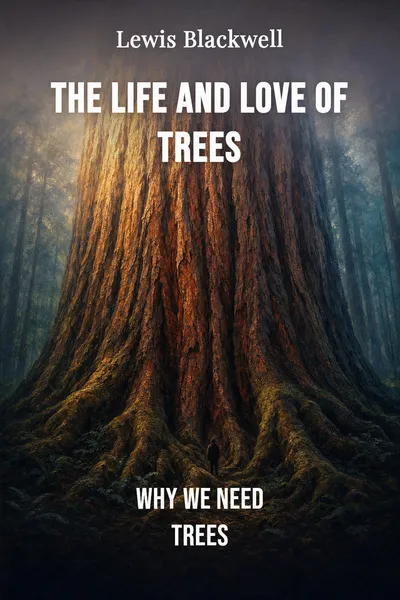
The Life and Love of Trees
Why we need trees
Description
There is a bristlecone pine in the White Mountains of California, at about 3,000 metres, that has been alive for more than 4,800 years. It was already ancient when the pyramids were new. It is not tall, not lush, not the kind of tree anyone photographs for a calendar — a gnarled, half-dead survivor bent by wind and cold. And most of us, if we walked past it, would keep walking. This is the quiet provocation at the centre of Lewis Blackwell's The Life and Love of Trees: the oldest, largest, most patient living organisms on the planet are the ones we notice least.
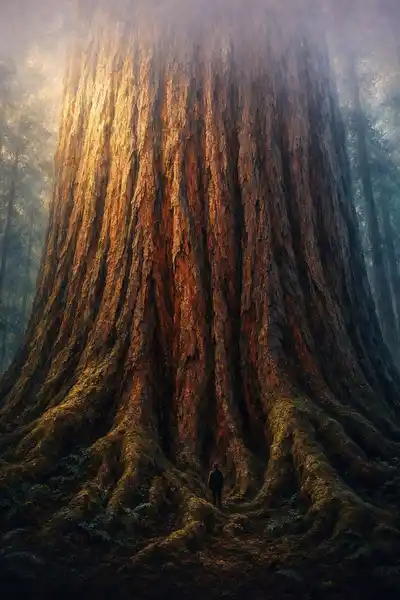
Blackwell is a writer and image-maker, and the book he made is unusual — part photographic tribute, part meditation, built to make us stop. The photographs are extravagant: redwoods shot from the base looking up into vertigo, bare winter branches like nervous systems, forests dissolving into fog. But the argument underneath the images is not really about beauty. It is about how thoroughly trees hold up the world we live in, and how easily we forget it, because trees do their work slowly and without asking for anything.
That forgetting is the real subject. We treat trees as scenery, as the green blur behind the things we care about. Blackwell wants to reverse the figure and the ground — to move the tree from backdrop to protagonist, and to ask what changes when we do. Not through alarm or statistics alone, but through a kind of sustained looking that the book itself performs on every page.
The question we’re asking : What do we owe to organisms that quietly keep us alive while we barely register them?What we’ll see : How Blackwell moves the tree from the edge of the frame to the centre — as living thing, as ecological engine, as something we've always dreamed about.
Table of contents
01Chapter 1 — The oldest living things we walk past
Blackwell opens by insisting on a fact that sounds obvious and turns out not to be: trees are alive, in the full, strange sense of the word. Not decoration, not architecture, not a renewable resource — living beings with lifespans that dwarf our own. The bristlecone pines of the American West run past 4,000 and even 4,800 years. A single coast redwood can climb well over 100 metres, the tallest living thing on Earth. And beneath the soil, some organisms Blackwell touches on are stranger still — a clonal aspen colony in Utah, known as Pando, that is genetically one tree spread across many trunks and thought to be tens of thousands of years old.
What the book does with these numbers is not brag about records. It uses scale — of time, of size — to dislodge our sense of proportion. We tend to measure the world against a human lifespan, and on that scale a tree looks static, almost like furniture. Stretch the clock and the tree becomes the fast-moving thing and we become the blur. A creature that was a seedling before writing existed is not a backdrop to human history; human history is a brief episode inside its life.

02Chapter 2 — What a tree actually does all day
If the first move is to see the tree as alive, the second is to grasp what that life accomplishes. A tree, Blackwell reminds us, is an extraordinary piece of engineering that runs on almost nothing — light, water, air, and a slow patience we have no instinct for. Through photosynthesis it pulls carbon dioxide out of the atmosphere and builds itself out of thin air, storing carbon in wood that can stand for a thousand years. In the same motion it releases the oxygen we breathe. The bargain is so old and so quiet that we have stopped noticing we depend on it entirely.
But the book resists reducing trees to their usefulness. The temptation, when we finally pay attention, is to talk only in services — carbon, oxygen, timber, shade. Blackwell lets those facts stand, then keeps going, because a tree is also a whole community that we mistake for a single object. Its canopy shelters birds and insects; its roots trade nutrients with fungi in the soil; its fallen leaves feed the ground it grows from. A forest is less a collection of trees than a single slow conversation, most of it happening out of sight.
03Chapter 3 — The forest we carry in our heads
The book's third movement leaves biology for imagination, and this is where Blackwell's argument becomes most human. Trees, he notes, are not only physically everywhere; they are everywhere in our minds. Every culture that ever lived among trees made stories out of them. The tree of life and the tree of knowledge, the sacred groves of antiquity, the world-tree Yggdrasil holding up the Norse cosmos, the Bodhi tree beneath which the Buddha is said to have found enlightenment — the forest has always doubled as a place of meaning.
There is a reason the same image keeps recurring, Blackwell suggests. A tree is a natural metaphor for time and continuity — roots below, growth above, the visible present standing on an unseen past. It is where we lodge ideas about family (the family tree), about branching choices, about origins and inheritance. When we want to picture how things connect and grow, we reach almost automatically for the shape of a tree. It is one of the oldest pictures the human mind carries.
04Chapter 4 — A book that asks us to look up
Step back from the photographs and the wonder, and The Life and Love of Trees turns out to be an argument about attention. Its real complaint is not that we cut trees down — though it registers the losses — but that we stopped seeing them at all. A tree becomes furniture in the visual field, the green nothing between the things we look at. Blackwell's whole method, the tilting cameras and the lingering close-ups, is designed to break that habit of not-looking. The book is less a guide to species than a training in noticing.
This matters because the way we treat the living world tends to follow the way we perceive it. What registers as backdrop gets managed as backdrop — spent, cleared, and replaced without much thought, because backdrops are interchangeable. Blackwell's wager is that if a tree stops being scenery and becomes a specific, ancient, living presence, our sense of what is at stake changes with it. You cannot casually erase what you have actually seen. The looking is not separate from the caring; it is the first form of it.
05Conclusion
Back to the bristlecone on its cold ridge — the ugly, ancient survivor most of us would pass without a glance. Blackwell's book spends its pages trying to make that glance impossible: to slow the eye, widen the clock, and let the tree stand forward as the living, world-shaping, story-bearing thing it has always been. The photographs are the argument. Each is an act of looking long enough to see, and an invitation to do the same.
Related books