

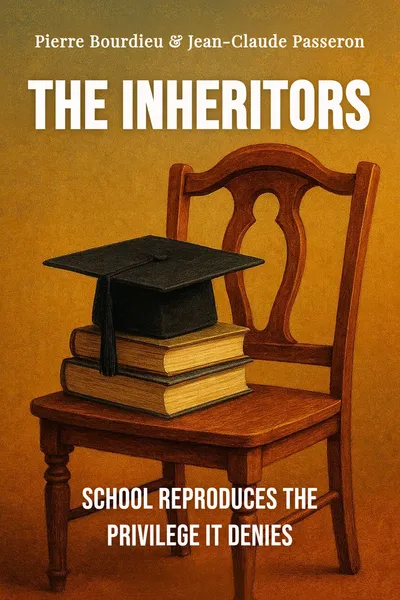
The Inheritors
School reproduces the privilege it denies
Description
In the early 1960s, two sociologists went looking at French universities for something everyone assumed they already understood: who gets to study, and why. Pierre Bourdieu and Jean-Claude Passeron pulled the enrollment figures for the faculties of arts and humanities, and the numbers were blunt. A child of a senior manager or a professional had a vastly better chance of reaching university than a child of a farm worker or a factory hand — on the order of tens of times better. Higher education, meant to be the most open institution in the Republic, turned out to be one of the most sorted.
The obvious answer was money, and money was part of it. But the two men noticed something the economic story could not cover. The students from cultured homes were not just present in greater numbers. They moved differently. They spoke a certain way, referenced films and books nobody had assigned, treated the whole apparatus of exams and lectures as a familiar house rather than a foreign country. They seemed, quite simply, more at ease — and that ease kept getting scored as intelligence. In 1964 the two published a slim, sharp book about it, Les Héritiers — The Inheritors.
Their claim was uncomfortable then and stays uncomfortable now. The school does not correct the head start that some children arrive with; it ratifies it, and then hands out the credential as if it had been earned from a neutral starting line. What looks like a fair race is a machine for laundering advantage into achievement — and the students who win rarely suspect the game was tilted before the first bell.
The question we’re asking : If school is supposed to level the field, why does it so reliably reward the children who were already ahead?What we’ll see : How a French university system meant to be open turned an inherited relationship to culture into something that could be called, with a clear conscience, merit.
Table of contents
01 Chapter 1 — The students who never had to try
Bourdieu and Passeron started from a scene any student recognizes. In a seminar, some people talk with an ease that seems to come from nowhere. They drop a reference to a painter, an obscure novel, a piece of music, and the room reads it as brilliance. Others sit with the assigned reading done cover to cover and still feel a step behind, as if everyone else got a briefing they missed. The book's first move is to ask where that ease actually comes from — and to refuse the flattering answer that it comes from within.
The data pointed elsewhere. Children of the educated classes arrived at university already fluent in the codes the university rewarded: how to hold a conversation about culture, how to write with a certain lightness, what to admire and how to admire it without seeming to try. None of this had been taught in any classroom. It had been absorbed at home, over years, at the dinner table and in front of bookshelves, the way a first language is absorbed rather than studied. By the time these students sat an exam, the exam was testing something they had been living for eighteen years.

02 Chapter 2 — The hidden syllabus nobody teaches
A university, in theory, teaches everything a student needs to succeed in it. Bourdieu and Passeron argued that the most important things it demands are exactly the things it never teaches. The syllabus lists Latin, philosophy, literary history. It does not list the tone in which one is supposed to discuss them, the offhand knowingness, the ability to have an opinion about a play without visible strain. Yet that unlisted material is what separates the strong candidates from the weak ones, and it is available only to those who picked it up somewhere else.
The classic case was language. The academic French expected in essays and oral exams — its abstraction, its allusiveness, its horror of the too-obvious — was much closer to the speech of cultivated homes than to any dialect a school could impart. A student raised on that register wrote in it as if breathing. A student raised elsewhere had to translate every thought into a foreign key, losing time and confidence in the process. Examiners, reading blind, called one style clear and the other clumsy, never suspecting they were grading a birthright.
03 Chapter 3 — Gifts, tastes, and the alibi of merit
The word that did the heaviest lifting in this whole arrangement was gift. Some students, everyone agreed, were simply gifted — quick, cultured, at home with ideas. Bourdieu and Passeron took this comforting word apart. What gets called a gift, they argued, is almost always a socially produced advantage that has forgotten its own origins. The gifted student is the one whose home did the invisible teaching so early and so thoroughly that the learning left no trace, and so looks like nature.
The ideology of the gift is convenient for everyone. It flatters the winners, who get to feel their success is theirs alone. It consoles the institution, which can present itself as a fair detector of talent rather than a sorter of backgrounds. And it disarms the losers, who accept their exclusion as a verdict on their own ability rather than as an outcome that was structured in advance. A more honest system, one that admitted its standards were arbitrary and inherited, would be harder to live with than one that speaks the reassuring language of merit.
04 Chapter 4 — When inheritance learns to call itself talent
The deep argument of The Inheritors is not really about French universities in 1964. It is about a particular kind of capital that most economic accounts never register. Alongside the money families pass down, Bourdieu was beginning to name what he would later call cultural capital: the accumulated fluency, references, dispositions, and ease that a certain upbringing deposits in a child. It cannot be seen on a payslip and it does not appear in a will, but it is transmitted just as reliably, and the school is the institution that converts it into the hard currency of the diploma.
This is why the book cuts deeper than a simple complaint about unequal access. Widening access — more scholarships, more open doors — does not touch cultural capital, because the disadvantaged student arrives with less of exactly the thing the examinations secretly test. You can put everyone in the same room and the sorting continues, now wearing the face of aptitude. The genius of the arrangement is that it needs no gatekeeper conspiring to keep people out. It only needs a standard that mistakes one group's inheritance for a universal measure of worth.
05 Conclusion
Bourdieu and Passeron came back from the enrollment figures with a claim that has aged uncomfortably well: the school takes children who arrive unequal and hands them credentials that make the inequality look earned. The ease of the cultivated student, mistaken for intelligence; the academic language that only certain homes speak; the tastes and references that pass for a finer mind — all of it feeds a single machine that turns background into diploma and calls the result merit.
Related books











