
The French Archipelago
A society coming apart into islands
Description
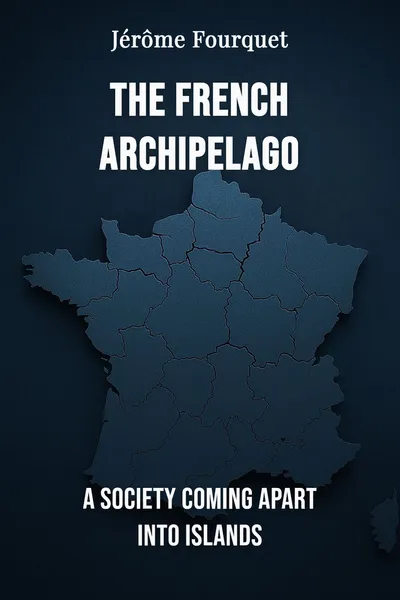
In 2016, the pollster Jérôme Fourquet noticed something in the numbers that kept recurring across otherwise unrelated surveys. The France that showed up in his data was no longer moving as one body. On questions of religion, food, names, schooling, values, geography, the country was splitting into groups that barely overlapped — and, more strikingly, groups that no longer seemed to notice each other. He set out to map this, and the result, published in 2019, was a book that put a word into wide circulation: France had become an archipelago.
The image is precise, and Fourquet chose it carefully. An archipelago is not a country broken into warring camps. It is a scatter of islands, each with its own climate and customs, separated by water nobody bothers to cross. The old France he described had a mainland — a shared Catholic culture, a common school, a small set of first names, a national television that everyone watched at eight o'clock. That mainland, his figures suggest, has been slowly submerged, and what remains are the peaks poking above the surface, each inhabited by people who assume everyone else lives more or less as they do.
What makes the argument hold is that Fourquet builds it from ordinary data — baptism rates, baby names, cremation figures, private-school enrollment, purchasing habits. Nothing exotic. He reads the census the way a geologist reads rock, looking for the moment the ground shifted. And the France that emerges is not simply divided by income or politics, the way we usually talk about it. It is divided by the quiet fact that its inhabitants no longer share the references that used to make them recognizable to one another.
The question we’re asking : What happens to a country when its people stop sharing the culture that let them assume they belonged together?What we’ll see : How a pollster read baptisms, first names and cremations to trace a nation drifting apart into islands that no longer meet.
Table of contents
01 Chapter 1 — The end of the Catholic matrix
Fourquet begins where French sociology rarely dares to look anymore: the collapse of the Catholic frame. For centuries, Catholicism was not just a faith in France but a shared operating system — it set the calendar, the rites of passage, the names, the moral vocabulary, even the geography of villages built around a church. You could be a devout believer, a lukewarm churchgoer or a militant anti-clerical, and still be shaped by the same matrix. That common ground, his numbers show, has genuinely dissolved.
The figures are stark. In the early 1960s, roughly nine in ten French children were baptized. By the mid-2010s, the share had fallen to about a third. Church weddings followed the same curve down. What Fourquet finds interesting is not just the decline of belief — that story is old — but the disappearance of the cultural residue. A generation ago, even non-believers married in church and buried their dead with a priest, out of habit and social expectation. That habit is gone.

02 Chapter 2 — A nation of first names
Fourquet's most quietly devastating chapter reads the country through its baby names. It sounds trivial. It is not. A first name is the first cultural signal a family sends — it announces a milieu, a set of references, an idea of who the child is meant to become. And when Fourquet lines up the naming data across decades, the mainland of shared names visibly breaks apart.
For most of the twentieth century, France drew from a small, stable pool. A handful of names — Jean, Marie, Pierre, Michel — covered a huge share of births, and they crossed class lines. A worker's son and a notary's son might well share a name. That common stock, rooted in the Catholic calendar of saints, gave the country a kind of onomastic unity: your name did not, by itself, sort you.
03 Chapter 3 — Enclaves, high and low
If the first fractures were cultural, Fourquet's next move is to show them hardening into geography and daily life. Fragmentation, in his reading, does not stay abstract. People sort themselves into physical spaces and consumption bubbles, and once sorted, they stop crossing paths. The archipelago acquires coastlines.
At the top, he traces the secession of the well-off. The affluent increasingly live among themselves, in neighborhoods and towns priced to filter, and — crucially — school their children among themselves. Private-school enrollment climbed toward roughly one in five pupils, but the figure hides the real dynamic: an educational avoidance strategy, families steering away from schools they consider socially unpredictable. The result is that the classroom, once the great mixing chamber of the Republic, mixes less and less.
04 Chapter 4 — The archipelago that no longer meets
Step back from the individual figures — the baptisms, the names, the schools — and what Fourquet is really describing is the erosion of a common reference frame. Not a common opinion, which France never had, but a common world of shared signals: the same saints, the same television, the same rites, the same songs, the same handful of experiences that let strangers assume they were reading from the same book even when they disagreed about the plot.
That shared book is what has thinned out. The old France was held together less by consensus than by a set of institutions that everyone passed through — the Church, the school, the army, national broadcasting, a small consumer market. Those institutions manufactured commonality as a by-product. Their decline removes not the agreements but the ground on which disagreement used to be legible. When two people no longer share references, they don't argue; they simply fail to recognize each other.
05 Conclusion
Fourquet's archipelago began as a metaphor and ended as a method. By reading the country through its baptisms, its first names, its funerals and its supermarkets, he showed that the fault lines everyone senses are not primarily about wealth or politics but about a slow loss of shared references — the quiet disappearance of the mainland that once made very different French people recognizable to one another. The islands were always there; what changed is that the sea between them stopped being crossed.
Related books











