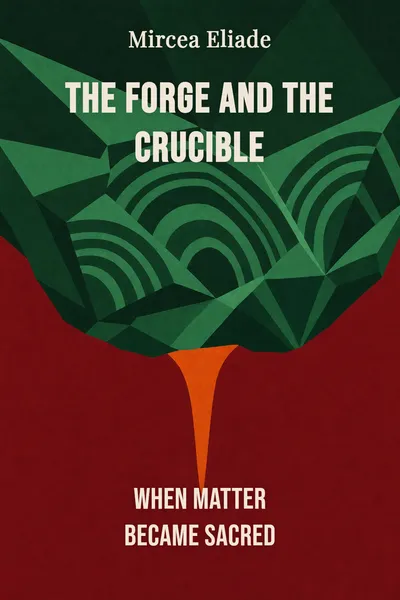
The Forge and the Crucible
When matter became sacred
Description
Somewhere in the ancient Near East, roughly seven thousand years ago, someone held a lump of green rock over a fire hot enough to make it weep. What ran out was not rock. It was copper — bright, heavy, alive-looking, a substance that had been hidden inside the stone the way a seed is hidden inside a fruit. The person who first watched this happen was not conducting an experiment in the modern sense. They were witnessing a transformation that felt, by every measure available to them, like a violation of the natural order. Matter had changed state. And whoever caused it had done something the gods usually reserved for themselves.
Mircea Eliade, the Romanian historian of religions, spent much of his career reconstructing what that moment meant — not chemically, but spiritually. In The Forge and the Crucible, first published in 1956, he traces a single thread across mining cultures, Bronze Age smiths, and medieval alchemists: the conviction that changing matter is a sacred act, one that borrows the power of creation itself. Before it was a technology, metallurgy was a mystery religion, complete with fasting, taboos, secret initiations, and the sense that the operator was meddling with forces that could bless or destroy.
What Eliade offers is not a history of metals but a history of a feeling — the awe of a species that had just realized it could remake the world's substance with its own hands. Follow that feeling far enough, and it runs straight through the alchemist's furnace and into the assumptions of the modern laboratory, where we still speak, without noticing, of mastering nature.
The question we’re asking : Why did the discovery that matter could be transformed change how humans understood the sacred — and themselves?What we’ll see : How the furnace turned into an altar, and why that ancient awe never entirely left us.
Table of contents
01 Chapter 1 — Ore that grows in the belly of the earth
Long before anyone smelted anything, Eliade argues, humans already related to minerals as living things. Across the mining cultures he surveys — from the Near East to central Africa to the folklore of European miners — the earth is imagined as a womb, and ores are embryos slowly ripening inside it. Metals were not inert deposits waiting to be dug up. They grew. Left alone, a vein of lead would, over centuries, mature into silver, and silver into gold, the way an unborn creature moves toward its finished form. The mountain was pregnant, and mining was a kind of premature delivery.
This changes everything about how the work felt. If the earth is a living body, then breaking into it is an intrusion that demands justification and care. Eliade collects the rituals that surrounded the descent: fasts, prayers, purifications, offerings to the spirits of the underground. The miner entered a sacred and dangerous zone, closer to the powers of gestation and death than ordinary people were meant to go. Accidents were not misfortunes but punishments — evidence that a threshold had been crossed without the proper respect.

02 Chapter 2 — The smith who steals fire from the gods
If the miner extracts the embryo, the smith completes what the earth left unfinished — and this makes him, in Eliade's reading, one of the most ambiguous figures in the archaic world. The smith commands fire, the element that undoes and remakes, and fire is everywhere associated with the sacred and the dangerous at once. To change ore into a blade or a tool is to master a power that belongs, by rights, to the gods of creation. The smith is both revered and feared, welcomed and kept at a distance, and Eliade documents how many cultures place him slightly outside ordinary society, marked as someone who traffics with forces others cannot touch.
The mythologies bear this out with striking consistency. Divine smiths appear across the ancient world — figures who forge the weapons of the gods, who craft thunderbolts, who build the tools of cosmic order. They are often lame, or ugly, or exiled, as though the mastery of transformation exacts a physical price, a wound that marks the one who has come too close to the fire. The smith's power is real, but it is never quite clean. He has taken something that was not freely given.
03 Chapter 3 — Alchemy was never about gold
The popular picture of the alchemist is a greedy fraud hunched over a furnace, trying to turn lead into gold and going broke doing it. Eliade spends much of the book dismantling this cartoon. Gold, in the alchemical texts he reads, is rarely the point. It is a symbol of perfection, the ripe and finished state toward which all metals are slowly growing in the earth. When the alchemist speaks of making gold, he means completing nature's work — bringing base matter to the maturity it would eventually reach on its own, but doing it in a laboratory, in years rather than in ages.
This is why the alchemist adopts the old belief in ores as embryos and turns it into a working program. The furnace becomes an artificial womb, the vessel a place of gestation, and the sequence of operations a controlled acceleration of what the mountain does in the dark. The alchemist is not cheating nature so much as apprenticing himself to it — learning its secret rhythm in order to compress it. Eliade insists on this framing because it explains the strange religious intensity of texts that, read literally, look like failed chemistry.
04 Chapter 4 — The rush that made us modern
Here is where Eliade takes his largest step. The alchemist failed at chemistry, but he succeeded at something else: he handed the modern world an assumption so basic that we no longer notice we are holding it. The assumption is that nature is raw material to be perfected by human operation, that its slow processes can and should be accelerated, and that the proper role of the knowledgeable person is to master and hasten matter toward a better state. Strip away the sacred language, and that is also the founding creed of industry and applied science.
The alchemist's dream was to do in the crucible what the earth did in the mountain, only faster. The modern factory does exactly this, at a scale and speed the alchemist could not have imagined, and without any of his rituals or restraints. Eliade's provocative suggestion is that science did not defeat alchemy by proving it wrong. It absorbed alchemy's central ambition — the impatient mastery of matter — while quietly discarding everything that once held that ambition in check: the sense that the earth is alive, that transformation is dangerous, that the operator is meddling with powers that demand respect.
05 Conclusion
Return to the green stone weeping copper into the fire. Eliade's whole book is an attempt to recover what that sight meant to the person who first caused it: not a chemical curiosity, but a glimpse of a power that reshaped how humans understood their place in the order of things. To transform matter was to do what creation did — to hasten, complete, and perfect the substance of the world. Around that discovery grew an entire architecture of ritual, taboo, and initiation, from the miner descending into the pregnant earth to the alchemist purifying metal and self in the same slow fire.
Related books