
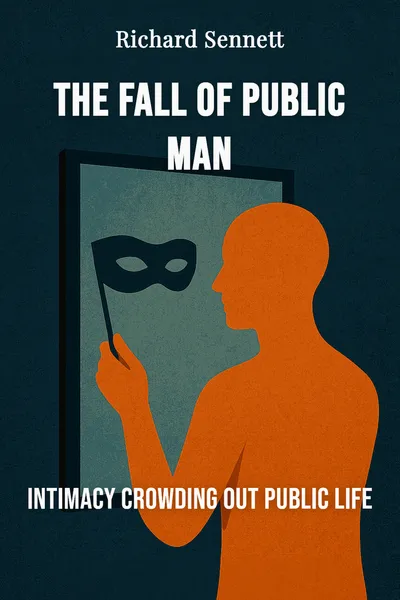
The Fall of Public Man
Intimacy crowding out public life
Description
In 1977, the sociologist Richard Sennett published a book with a title that sounded like an obituary: The Fall of Public Man. The public man he had in mind was not a politician or a celebrity. He was the ordinary eighteenth-century city dweller who could walk into a London coffeehouse or a Paris café, sit among people he had never met, and hold a conversation with them as equals — because nobody was expected to reveal who they really were. Rank was suspended at the door. What mattered was the exchange itself, the wit, the argument, the performance. Strangers were not a threat to be decoded. They were an audience, and everyone was also an actor.
Two centuries later, Sennett argued, that ease had drained away. We had learned to distrust anything that felt like performance, to read every gesture as a clue to the private self behind it, and to measure public figures by whether they seemed sincere rather than by what they actually did. The café had become the therapy session. The question we now bring to a stranger, a politician, a colleague, is no longer what do you think but who are you, really. And that shift, Sennett claimed, had quietly wrecked something we barely noticed we had.
Sennett was writing before the internet made the whole thing louder, which is part of why the book keeps getting rediscovered. He was describing a culture that had come to believe intimacy was the highest form of human contact — and had let that belief eat away at the capacity to be among strangers at all. His diagnosis was less about privacy than about what happens to public life when we stop performing for one another and start demanding that everyone be genuine instead.
The question we’re asking : How did the belief that closeness and sincerity are always better quietly hollow out our ability to live among strangers?What we’ll see : A trip through the vanished world of the public actor, and Sennett's uncomfortable case that authenticity became a kind of tyranny.
Table of contents
01 Chapter 1 — The theater that made strangers bearable
To understand what Sennett thinks we lost, you have to picture the eighteenth-century city he treats as his baseline — London and Paris in roughly the 1750s, boom towns swelling with newcomers who had no idea who anyone was. This was, on paper, a nightmare of strangers. And yet, Sennett argues, people navigated it with a confidence we would envy. The trick was that public life was understood, openly, as a kind of theater. You dressed for a role. You spoke in conventions everyone recognized. Your job was not to be yourself but to play your part well.
The clothes make the point vivid. Sennett spends real time on eighteenth-century dress, because urban clothing worked like stage costume: it signaled a social type at a glance, and everyone read it fluently without mistaking it for the soul underneath. A wig, a coat, a particular cut told you how to address a person and what the encounter would be. Nobody assumed the costume revealed anything private. It was a code for handling contact, not a confession.

02 Chapter 2 — When the self became the thing to reveal
The nineteenth century, Sennett argues, is where the masks start to slip — and where feeling begins to leak into public life in ways nobody quite chose. Industrial capitalism reorganized the city, and with it the way people read one another in the street. The old confident codes of dress and speech gave way to a new and anxious project: reading the stranger for signs of who he secretly was. Personality, not role, became the object of attention. A man's clothes were now scanned not for his social type but for clues to his inner character, and, crucially, people grew afraid of giving themselves away involuntarily.
This is the great reversal. In the eighteenth century you performed a role on purpose and revealed nothing you didn't intend to. In the nineteenth, appearance came to be seen as an involuntary leak of the self, so people fell silent in public to avoid betraying feelings they couldn't control. Sennett tracks this in small, telling shifts — the audience that once talked and heckled through a concert learning to sit in reverent silence, the theatergoer becoming a spectator rather than a participant. Public expression curdled into public watchfulness.
03 Chapter 3 — The tyranny of feeling authentic
By the twentieth century, Sennett argues, the ideology of intimacy had hardened into what he bluntly calls a tyranny — the tyranny of intimacy. Not a political tyranny, but a standard so pervasive that it reorganized what people even want. We began to demand that all our relationships be close, and to treat any experience that is not warm and personal as somehow deficient. Community came to mean a group of people who feel the same things. And politics came to mean the search for leaders who feel authentically, whatever they actually do.
This is where the book turns from history to a diagnosis of our own reflexes. Sennett's point about political charisma is unsettling because it still holds. When intimacy becomes the measure of everything, we stop asking of a public figure what will his policies accomplish and start asking is he sincere, is he the real thing, does he feel our pain. The politician's private character, his believability as a person, crowds out the substance of what he proposes. We vote on personality because we have lost the habit of judging public action on its own impersonal terms.
04 Chapter 4 — Civility as a form we let go of
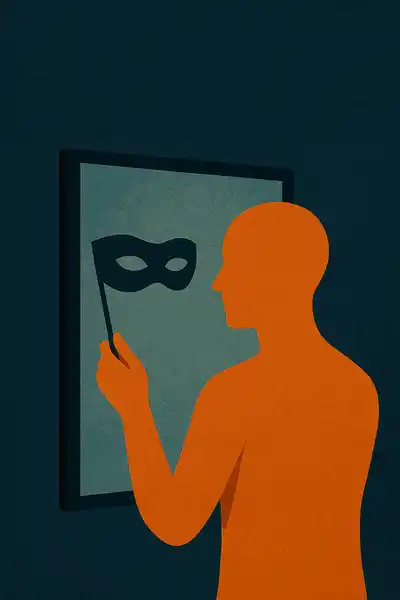
Step back from the historical machinery and Sennett's real subject comes into focus: he is defending the mask. Not the mask that deceives, but the mask that protects — the set of forms and conventions that let people treat one another decently without first having to know one another intimately. This is what he means by civility, and it is why the book reads less like nostalgia and more like an argument about what a form is for. A convention, in this view, is not a barrier to real contact. It is the enabling condition of contact among people who will always remain, to some degree, strangers.
The wager underneath the whole book is that impersonality has been badly misunderstood. We tend to hear it as coldness, distance, alienation — the opposite of connection. Sennett insists it is closer to the opposite: a discipline that spares other people the full weight of our inner lives and thereby makes shared space livable. When you play a role toward a stranger, you are extending them a courtesy. You are agreeing that this encounter need not require either of you to be exposed. The mask is an act of consideration, not concealment.
05 Conclusion
The book ends where the coffeehouse began: with the strange idea that distance can be generous. Sennett does not ask us to return to wigs and formal conventions, and he is not sentimental about a hierarchical past. What he wants preserved is the underlying competence — the sense that public life is a stage, that playing a role toward a stranger is a form of respect, and that not everything worth doing together requires that we first bare our souls. The public man he mourns was, at bottom, someone who knew how to act.
Related books











