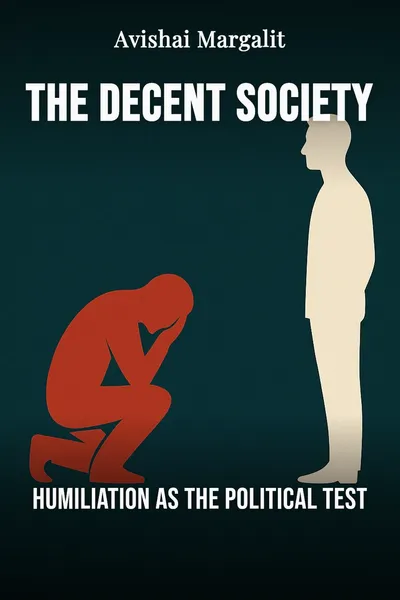
The Decent Society
Humiliation as the political test
Description
In 1996, the Israeli philosopher Avishaï Margalit published a slim book with a modest-sounding title, The Decent Society, and a claim that quietly rearranged the furniture of political thought. Most philosophy since John Rawls had been busy asking what a just society would look like — how to distribute income, rights, opportunities, so that the arrangement could be defended to everyone. Margalit did not reject that question. He just noticed that it starts too high up. Before we argue about whether a society is fair, he suggested, there is a rougher, more urgent thing to check: whether its institutions humiliate the people who live under them.
The move sounds small and turns out to be enormous. Justice is a positive ideal, something we build toward and rarely reach. Non-humiliation is negative — a matter of what institutions must not do. And Margalit argues that the negative bar is both more reachable and, in a sense, more binding. We may disagree forever about the fair share. We recognize humiliation almost instantly, in the body, when a clerk treats a citizen as less than human, when a welfare office makes a person beg, when a system is built so that some are made to feel they do not fully count.
What Margalit is really proposing is a change in where we set the political test — and in what we measure a society against when we want to know whether it is any good. Not its constitution on paper, not its GDP, but the way its institutions make people feel about their standing as human beings. That relocation of the standard, downward and inward, is the whole argument.
The question we’re asking : What if the first thing to ask of a society is not whether it is just, but whether it refrains from humiliating the people it governs?What we’ll see : How Margalit builds a whole political standard out of a single negative rule, and where he decides to set the bar.
Table of contents
01Chapter 1 — The test that comes before fairness
Margalit opens with a distinction that carries the book. A just society, he says, is one whose institutions treat people justly — fairly, according to some defensible principle of distribution. A decent society is one whose institutions do not humiliate people. The two are not the same, and the gap between them is where his argument lives. A society could in principle be just and still humiliating, or fall short of full justice while remaining decent. Decency is the lower, prior condition.
Why start lower? Partly because it is honest. Justice, in the grand Rawlsian sense, is a horizon; no actual society has arrived there, and reasonable people disagree about the route. Non-humiliation is different. It does not require agreement on the correct theory of the good or the right formula for distribution. It requires only that institutions stop doing a particular, recognizable kind of harm. That makes it a standard we can actually apply, here, to the society we already have.

02Chapter 2 — What an institution does when it humiliates
Everything now depends on what humiliation actually is, and Margalit is careful here. Humiliation, in his definition, is any behavior or condition that gives a person sound reason to consider their self-respect injured. The word sound is doing work. He is not talking about hurt feelings, or the ordinary sensitivity of someone who takes offence too easily. He means treatment that any reasonable person would experience as an attack on their standing as a human being.
The book distinguishes several forms this can take. The most direct is treating a person as though they were not human at all — as a thing, an animal, a mere instance of a category rather than an individual. A subtler form is treating a human being as though they lacked the capacities that make humans distinctive: as if they could not reason, could not choose, could not be trusted with their own life. There is also the humiliation of rejection — being cast out of the human commonwealth, told in effect that one does not belong among persons who count.
03Chapter 3 — Poverty, unemployment, and the machinery of shame
Margalit's argument turns sharp when it reaches the welfare state, because this is where a well-meaning society most often humiliates. Helping the poor is a decent aim. But the manner of the help can undo the decency of the aim. A system that relieves need while forcing recipients to prove their unworthiness, to expose their private circumstances, to accept aid as charity dispensed to the pitiable rather than as a right owed to a citizen, humiliates even as it feeds. The gift that must be begged for injures the one who receives it.
This gives him a lever against a certain kind of paternalism. Institutions often justify intrusive, degrading procedures in the name of caring for people — checking, monitoring, deciding on their behalf what they truly need. Margalit's point is that treating adults as incapable of managing their own lives is itself a form of humiliation, however benign the motive. Snooping into someone's life to confirm their poverty says something about their standing, and what it says is corrosive.
04Chapter 4 — A floor, not a ceiling
Step back, and what Margalit has really done is argue for a different kind of political standard — a floor rather than a ceiling. Most political philosophy reaches upward, describing the ideal arrangement we should aspire to. Margalit reaches downward, marking the line beneath which no society should be allowed to fall. Non-humiliation is not the summit of political achievement. It is the minimum below which a society forfeits the right to call itself decent at all.
There is a deliberate modesty in this, and Margalit knows it can look like settling for too little. Why aim only at not degrading people when we could aim at treating them justly? His answer is that a reachable minimum, actually met, is worth more than a magnificent ideal endlessly deferred. Decency is not a lowering of ambition so much as a refusal to let the perfect excuse the intolerable. A society can be forgiven for not yet being just. It cannot be forgiven for humiliating the people it governs.
05Conclusion
Margalit's book has aged into something more pointed than its quiet tone first suggested. Written just as liberal political philosophy was at its most confident about justice, it insisted that the confident question was the second one. The first is whether institutions humiliate — and by that test, plenty of wealthy, formally just societies come up short, degrading the poor, the sick, the jobless, and the stranger through the ordinary operation of systems designed to help them.
Related books