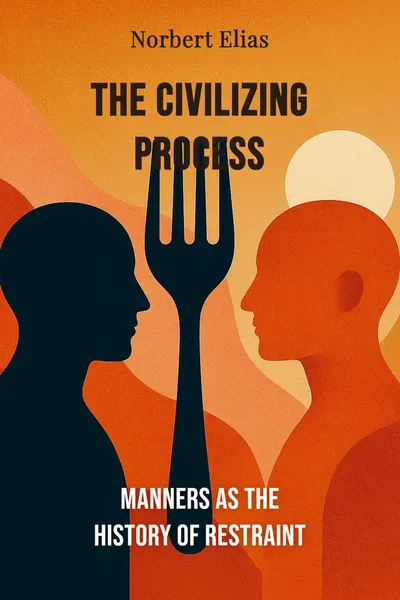
The Civilizing Process
Manners as the history of restraint
Description
In 1939, a German-Jewish sociologist named Norbert Elias published a two-volume study, in German, from exile in England. He had fled the Nazis; his mother would later die in Auschwitz. The book was called Über den Prozess der Zivilisation — The Civilizing Process — and it did something odd for a work of social theory. It quoted, at length, medieval and Renaissance etiquette manuals: instructions on where to spit, how to blow your nose, whether to relieve yourself in front of guests, how to handle meat at a shared table. From these small, almost comic sources, Elias built one of the most ambitious arguments of the century.
Almost nobody noticed. The timing could hardly have been worse — a book about the long, patient softening of European manners, published the same year Europe collapsed into its most organised barbarism. The volumes sat unread for three decades. Then, in the late 1960s, a new generation rediscovered them, and Elias, by then in his seventies, became one of the most cited sociologists alive. What they found was a claim that connected the fork in your hand to the rise of kings.
Elias's wager was that the way we eat, wash, and control our bodies is not manners in the trivial sense. It is history that has sunk so deep it feels like nature — the visible edge of a transformation in how humans govern themselves, and how they came to be governed.
The question we’re asking : How did squeamishness about spitting, eating, and the body turn out to be the same story as the rise of the modern state?What we’ll see : How Elias reads centuries of etiquette manuals to show that outward compulsion slowly became an inner reflex we now mistake for our own character.
Table of contents
01Chapter 1 — A book nobody read for thirty years
Elias was not an obvious candidate to write a landmark. Born in Breslau in 1897, he trained in medicine and philosophy before drifting into the young discipline of sociology, working alongside Karl Mannheim in Frankfurt. When the Nazis came to power he lost his post and left, first for Paris, then for London, where he assembled The Civilizing Process largely alone, reading old conduct books in the British Museum. He had no institutional home and no reputation to protect the work once it appeared.
The argument arrives in two movements. The first volume tracks changes in everyday behaviour — table manners, bodily functions, aggression, sexuality — across roughly the twelfth to the eighteenth centuries, using the etiquette manuals as evidence. The second volume asks the harder question: what social change could possibly have produced this slow, one-directional shift in how people carried their own bodies? Elias refuses to treat the two as separate. The manners and the politics, he insists, are one process seen from two angles.

02Chapter 2 — The fork, the handkerchief, and the slow arrival of disgust
The evidence Elias assembles is disarmingly concrete. He leans heavily on Erasmus, whose 1530 treatise on the manners of children, De civilitate morum puerilium, was a bestseller of its age and instructed readers on matters we now consider unmentionable. Do not gnaw bones and put them back in the shared dish. Do not blow your nose into your hand and then reach for the food. Do not stare at what comes out of your own nose in the handkerchief as if pearls had fallen from your brain. That these things had to be said tells us they were still routinely done.
Trace the manuals across the centuries and a pattern emerges. Practices that were once ordinary, mentioned without embarrassment, gradually become things one does not speak of, then things one does not do in company, then things that provoke visceral disgust. The fork arrives slowly, first as an oddity, then as a requirement — a small instrument that puts distance between the hand and the food, and between one diner and another. Spitting migrates from the floor to a cloth to somewhere hidden entirely. The bedroom and the bathroom acquire walls.
03Chapter 3 — Why the knights had to sit still
Here Elias makes his boldest move: he refuses to explain manners by manners. Refinement did not spread because people simply grew more sensitive on their own. Something in the structure of society had to change to make the new sensitivity necessary — and that something, he argues, is the long consolidation of political power. The story of the fork is, underneath, the story of the state.
In the fragmented world of the early Middle Ages, the warrior nobility lived by force. A knight who could not defend his land lost it; violence was a normal instrument of daily life, and emotional life was correspondingly volatile — swings between rage, piety, and appetite that later ages would find alarming. There was little need for delicate self-control because there was little advantage in it. Power came from the sword arm, not from the ability to sit patiently through a dinner.
04Chapter 4 — The state on the inside
Step back and Elias's real subject comes into view. He is describing a transfer of the source of control — from outside the person to inside. In the world of the knight, restraint was imposed from without, by the immediate threat of another man's violence. In the pacified space the state creates, that external threat recedes; you are no longer likely to be killed at dinner. But the constraint does not disappear. It moves inward, becoming a permanent, largely unconscious apparatus of self-monitoring that Elias calls self-restraint — a watchman installed in each individual who never goes off duty.
This is the hinge of the whole book. The pacification of society by the state and the pacification of the individual by conscience are the same event, described at two scales. The monopoly on violence outside produces the monopoly of control inside. What we experience as our own delicacy, our own sense of shame, our own automatic revulsion at cruelty or filth, is the psychological deposit of a political achievement. The state did not merely take away our swords; it rewired what happens in us before we ever reach for one.
05Conclusion
So the fork in Erasmus's manual and the courtier at Versailles turn out to belong to the same story after all. The small squeamishness that makes us wince at what medieval diners did without a thought is not a sign that we are finer people. It is the trace of a slow migration — of restraint moving from the point of a sword, to the eyes of a watching court, to a place so deep inside us that we mistake it for our own nature. Elias read centuries of etiquette books and found, folded into them, the biography of the modern self.
Related books