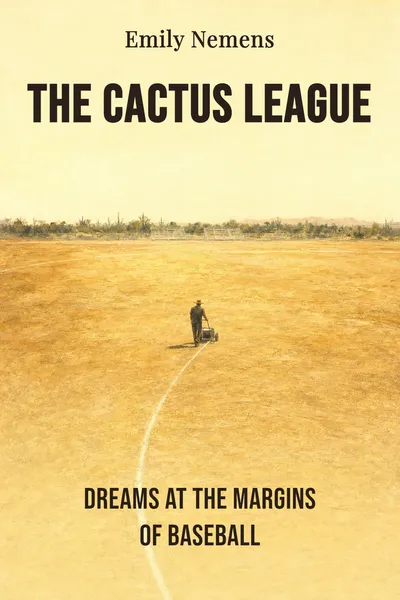
The Cactus League
Dreams at the margins of baseball
Description
Every February, a strange migration reaches the Arizona desert. Fifteen major-league baseball teams pack up and settle into a cluster of small stadiums around Phoenix and Scottsdale, and for six weeks the sport does something it does nowhere else: it slows down. This is spring training, the Cactus League, and it is where careers begin, resume, and quietly end, all under the same dry heat. Emily Nemens set her 2020 debut novel here, in the flat light and cheap motels of a season that hasn't officially started yet. Nothing counts in the standings. Everything counts for the people living it.
The book doesn't follow a hero. It follows a whole ecosystem. There is Jason Goodyear, the Los Angeles Lions' star outfielder, handsome and beloved and hiding something. But Nemens keeps pulling the camera away from him, toward the coach nursing an old grudge, the aging groundskeeper, the wives in the stands, the agent working the phones, the young player who may never make it, the woman selling herself at the edge of the parking lot. The star is the sun; the novel is interested in the planets.
What accumulates is a portrait of a place most fans never think about, told through the people the sport rarely names. Spring training is where hope is cheapest and most fragile, where a good six weeks can save a life and a bad one can end a dream. Nemens treats it as a stage for something larger than baseball.
The question we’re asking : What does a season that doesn't count yet reveal about the people whose whole lives depend on it?What we’ll see : A polyphonic novel that reads the American dream through the dust and heat of a sport's unofficial beginning.
Table of contents
01Chapter 1 — The desert as a waiting room
The Cactus League is a real thing, and Nemens uses its geography as scaffolding. Half the major leagues gather in Arizona each spring — the other half go to Florida, the Grapefruit League — and the compressed proximity of the desert camps gives the novel its density. Teams share the same handful of towns, the same restaurants, the same golf courses. Fans wander from one back field to another. The players are close enough to touch, which is the whole appeal and the whole cruelty of the place. Everyone is on display before anything has been decided.
Nemens structures the book around the physical fact of Arizona itself. Between chapters she inserts short interludes on the landscape — the geology, the wildlife, the way the desert was engineered into livability with dammed rivers and imported grass. These aren't decoration. They set the tone: a hard, ancient place made temporarily hospitable, where nothing native belongs and everything green is borrowed. A baseball diamond in the Sonoran Desert is an act of will, watered against the odds. So is a career at the margin of the majors.

02Chapter 2 — A story told by everyone but the star
The formal choice that defines the novel is its chorus. Nemens moves the narration from person to person, chapter by chapter, building the world through a rotating cast rather than a single perspective. We hear from Michael Taylor, the elderly hitting coach whose long memory holds the club's history and its slights. We hear from a sports agent, a stadium organist, a player's wife, a groundskeeper, a woman named Liana whose life brushes against the players in ways the game would rather not see.
At the center — but almost never in his own voice — is Jason Goodyear, the franchise's golden outfielder. He is the reason everyone is here, the face on the billboard, the contract the team is built around. But Nemens refuses to let us inside him for most of the book. We learn about Jason the way the people around him do: through rumor, worry, admiration, and slowly gathering alarm. Something is wrong with him, and the collective narration means we assemble the truth in pieces, the way a locker room does.
03Chapter 3 — Money, age, and the arithmetic of a career
Underneath the sunburned romance, The Cactus League is a book about money and time. Baseball is a business, and Nemens never lets the reader forget the ledgers running beneath the dream. Jason Goodyear's crisis, when it finally comes into focus, is financial — a gambling problem that has hollowed out a fortune that looked, from the billboards, untouchable. The novel is unsparing about how quickly a life at the top can drain, and how the machinery around a star keeps smiling while it does. The public image and the private balance sheet tell opposite stories.
Age is the other clock ticking in every chapter. Spring training is where the young arrive and the old are measured for the exit. The veteran coach carries decades of accumulated resentment and knowledge, aware that his usefulness is a wasting asset. A player past his prime does the math on how many springs he has left. Even the groundskeeper and the organist feel the seasons turning against them. Nemens treats aging in sport not as tragedy exactly, but as arithmetic — the body and the contract both counting down toward the same zero.
04Chapter 4 — What the margins know that the center doesn't
Step back from the diamond and the novel's larger claim comes into view. This is a book about how the American dream looks from just outside it. The people Nemens gives voice to — the coach, the wife, the groundskeeper, the woman in the parking lot — are the ones the story of baseball usually leaves out, and they are precisely the ones who see the whole thing most clearly. The star chasing glory is often the last to understand what it's costing him. The margins keep the honest books.
That reversal is Nemens's real subject. A culture organizes itself around its winners and tells their story as if it were the only one. But the winner is surrounded by a supporting cast who absorb the risk, do the maintenance, and know the truth. Spring training makes this literal: the whole apparatus of a season is being assembled in plain sight, and the people assembling it can see every crack the finished product will hide. Watching Jason from the outside, they understand his fall before he does, because distance is its own kind of clarity.
05Conclusion
By the end, spring has done what spring always does. The rosters are set, some dreams survive to opening day and some are quietly cut, and the desert empties out until next February. Jason Goodyear's story reaches its reckoning, but the novel's final loyalty is to the crowd around him — the ones who watched, worried, profited, and endured. They will be back. That is the shape of the thing: a beginning that repeats, a hope renewed on a schedule, an entire economy of longing that resets each year as if nothing had been lost.
Related books