The Book of Qualities
When emotions come alive
Description
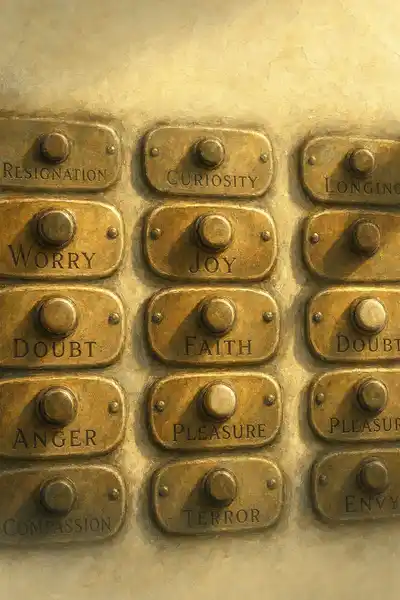
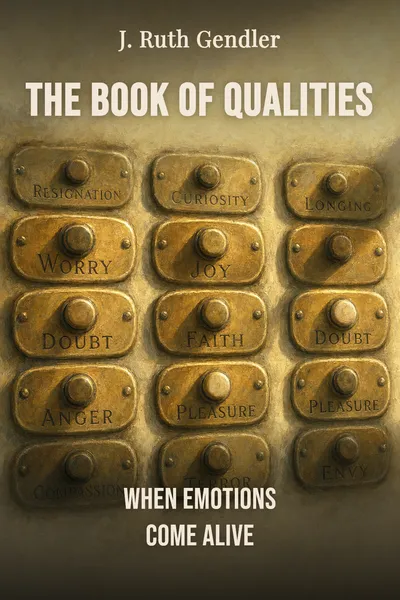
Worry makes lists of everything that could go wrong while she waits for the train. Excitement wears orange socks. Faith lives in the same building as Doubt, and the two of them run into each other in the hallway more often than either would like. These are not metaphors dressed up for a psychology lecture. They are the actual inhabitants of a slim book J. Ruth Gendler published in 1984, called The Book of Qualities, in which roughly seventy human emotions and character traits walk around as fully drawn people with apartments, wardrobes, grudges and hobbies.
Gendler started writing these portraits as a teacher, almost as an exercise, and what came out was neither a poetry collection nor a self-help manual nor a work of clinical psychology, though it borrows the nerve of all three. Each entry is a short prose sketch of a single quality treated as a person we might know. Anger, Beauty, Terror, Pleasure, Compassion, Resignation, Joy -- each gets a page or two, a face, a way of moving through a room. The book has stayed quietly in print for four decades, passed hand to hand more than sold by campaign, the kind of thing someone gives you at exactly the right moment.
There is something disarming about reading your own interior weather described as a cast of neighbors. We tend to speak of feelings as things that happen to us, weather systems we endure. Gendler does the opposite. She gives each one a body and a biography, and in doing so makes the familiar suddenly strange -- and the strange suddenly recognizable.
The question we’re asking : What happens to our emotions when a writer stops explaining them and starts introducing them as people we could meet?What we’ll see : How a book built entirely of personified feelings turns the inner life into a neighborhood we can walk through.
Table of contents
01Chapter 1 — A neighborhood built out of feelings
The premise of The Book of Qualities is deceptively simple, and Gendler never once explains it. She just starts. Anger opens the book, and by the second sentence Anger is a person with a history: intense, quick to leave, prone to slamming doors and then feeling terrible about it. There is no framing device, no narrator stepping forward to say here is what I am doing. The reader works out the rules on the fly, the way you'd figure out the logic of a dream you were already inside.
What holds the collection together is that these personified qualities share a world. They are not seventy isolated allegories filed alphabetically. They know each other. They live near each other. Faith and Doubt are neighbors, and the placement is the whole argument -- Gendler never says faith and doubt are intimate opposites who depend on one another, she just puts them on the same landing and lets us notice. Worry and Anxiety keep company. Excitement and Enthusiasm turn up at the same parties. The community does the theorizing so the sentences don't have to.

02Chapter 2 — The trick of the second person
The engine of the book is a grammatical decision that most readers never consciously register. Gendler almost never says how a quality makes you feel. She says what the quality does, as a person, and lets the recognition arrive on its own. She refuses the whole apparatus of explanation -- no this represents, no here is the deeper meaning. The portrait is the argument, complete in itself.
This restraint is harder than it looks. The temptation, when writing about emotion, is to reach for the abstract noun and pile up qualifiers until the feeling is buried under commentary. Gendler cuts all of it. She writes the way you'd describe a friend to another friend: this is what she's like, this is what she wears, this is the thing she always does at dinner. The emotion becomes gossip about someone we half-know, and gossip is far more memorable than analysis. We lean in.
03Chapter 3 — Portraits that refuse to flatter
It would be easy to assume a book of this kind runs warm and consoling from cover to cover -- a gentle parade of nice feelings gently praised. It doesn't. Gendler gives the difficult qualities the same careful attention as the pleasant ones, and often more nerve. Terror is not softened into a manageable lesson. Cruelty is not redeemed at the last minute. Despair is allowed to be genuinely bleak. The book does not tidy up the harder residents of the psyche, and that honesty is a large part of why it has lasted.
Even the qualities we think we want turn out to be complicated under her eye. Beauty is not simply admired; she carries a certain loneliness, the isolation of being looked at rather than known. Pleasure has an edge of restlessness, a difficulty sitting still. Gendler declines the easy sorting of feelings into good and bad, the moral bookkeeping that most writing about emotion can't resist. Each quality is drawn as a full person, which means each one contains its own shadow. Nobody is only one thing.
04Chapter 4 — What it means to know a feeling by its face
Step back from the individual portraits and something larger comes into view about how Gendler wants us to hold our inner lives. The ordinary way we talk about emotion is possessive and a little accusatory: my anger, your anxiety, I have depression, she is consumed by jealousy. The feeling is either something we own or something that has swallowed us. Either way we're fused to it, and that fusion is uncomfortable -- when I am my anger, there is no room to breathe, no distance from which to look.
Gendler's whole method quietly undoes that fusion. If Anger is a person who lives down the hall, then Anger is not me. He might knock. He might stay too long and drink all the coffee. But he has his own existence, his own comings and goings, and I am the one who decides whether to open the door. Personifying the quality creates exactly the sliver of distance that makes a feeling bearable to look at. This is not so far from what certain contemplative traditions counsel -- meeting an emotion as a visitor rather than an identity -- but Gendler arrives there through imagination rather than instruction.
05Conclusion
Worry is still on the platform, still making her lists, still waiting for a train that will come whether or not she has itemized every possible catastrophe. Gendler leaves her there, unfixed, because that is where she lives. Across four decades, the book has kept its odd, durable appeal precisely because it never tries to rescue us from ourselves. It hands us an introduction instead -- to Faith and Doubt on their shared landing, to Excitement in his orange socks, to the whole crowded building we walk around inside all day.
Related books