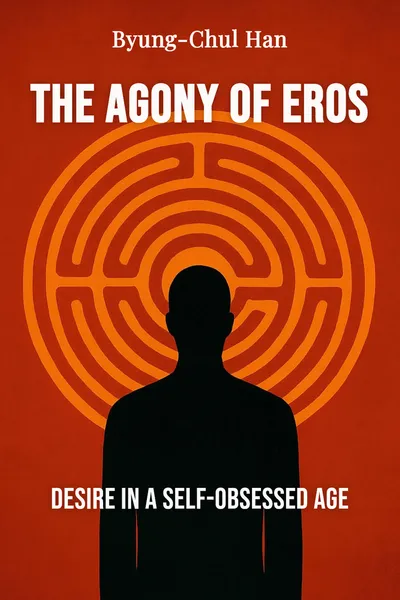
The Agony of Eros
Desire in a self-obsessed age
Description
In 2012, a Korean-born philosopher teaching in Berlin published a slim book, barely a hundred pages, called Agonie des Eros. Byung-Chul Han had already made a name with an even shorter essay on burnout culture, and this one carried the same compressed, almost aphoristic charge. The English translation arrived in 2017 with a foreword by Alain Badiou, which tells you something about the company Han keeps: he writes cultural criticism, but he argues like a metaphysician. The subject here is love. Not romance, not dating, not the mechanics of attraction. Love as an event — the thing that used to knock people sideways.
Han's claim is blunt. Eros, he says, is dying, and it is dying of us. We live in a moment obsessed with the self: with self-optimization, self-display, self-comparison, the endless management of a personal brand. And love, real love, requires the exact opposite. It requires that something outside us — someone genuinely other, not a mirror, not a match, not a projection — be allowed to matter more than we do. In a culture that has learned to swipe everything toward the familiar, that other keeps failing to show up.
What Han does with this is stranger and more ambitious than a complaint about apps or narcissism. He ties the disappearance of the beloved to depression, to pornography, to the way we think, even to why a certain kind of thought has gone quiet. The book is short enough to read in an afternoon and unsettling enough to sit with for weeks.
The question we’re asking : If love demands an encounter with someone genuinely other, what happens to it in a culture that has learned to see only itself?What we’ll see : How a short, sharp book traces the slow vanishing of the beloved — and what Han thinks we lose when nothing outside us can still overwhelm us.
Table of contents
01Chapter 1 — The Other who no longer arrives
Han begins with a word we do not use much: atopia. For him the beloved is atopic — impossible to place, impossible to file under a category, someone who cannot be captured by the coordinates we already have. That unplaceability is the whole point. The other is other precisely because they escape us, because they will not resolve into something we can predict, own, or consume. Love is the experience of being addressed by that strangeness and answering it anyway.
And this, Han argues, is exactly what a self-obsessed culture can no longer tolerate. We have grown extraordinarily good at neutralizing otherness. The dating profile turns a person into a set of filterable attributes. The algorithm learns our type and delivers more of it. Even the language we reach for — compatibility, matching, options — treats the other as something to be evaluated against a checklist we bring with us. Nothing arrives from outside. Everything is pre-sorted to resemble what we already wanted.

02Chapter 2 — Depression, or the self that meets only itself
The most striking move in the book is the link Han draws between the death of eros and the rise of depression. He is picking up a thread from his earlier work: where earlier eras were organized around prohibition and repression — the classic Freudian scene of desire held in check — ours is organized around performance and the imperative to achieve. We are not forbidden things. We are told we can do anything, be anyone, optimize everything. And that freedom, weirdly, is exhausting.
The depressed subject, in Han's reading, is the subject that has collapsed inward. Cut off from any genuine other, it has only itself to relate to — and relating endlessly to yourself is a suffocating business. The narcissist is not someone who loves themselves too much; that is the popular misreading. The narcissist is someone who cannot find the boundary where they end and the world begins, someone for whom everything, including other people, has become a surface on which to see themselves. Nothing is truly outside. And a self with no outside slowly drowns.
03Chapter 3 — Why porn kills eros and theory needs it
Han's chapter on pornography is short and severe. Porn, he argues, is not the intensification of eros but its opposite — its liquidation. Eros keeps something back; it lives on distance, on what is withheld, on the erotic weight of the not-yet-seen. Porn abolishes distance. It exposes everything, displays everything, makes the body fully available and fully consumable. What vanishes in the total exposure is precisely the mystery that desire feeds on. Nakedness, paradoxically, becomes the death of the erotic.
He connects this to a broader tendency he calls the society of transparency. We increasingly demand that everything be visible, immediate, and available on request — bodies, information, other people, ourselves. But transparency is hostile to eros, because eros needs shadow, concealment, the sense of an interior we cannot simply access. When the other is entirely on display, there is nothing left to approach. Consumption replaces encounter. You do not fall for a spreadsheet.
04Chapter 4 — Love as the courage to disappear
Step back from the individual arguments and the book resolves into a single stubborn thesis: love is the one experience left that requires us to stop being the center of our own story. Everything else in late-modern life can be bent toward the self — work becomes self-branding, leisure becomes self-curation, even wellness becomes another form of self-management. Love resists this, and that resistance is exactly why Han thinks it is under threat. It asks for something the culture has stopped rewarding.
What it asks for, in Han's vocabulary, is a kind of self-loss. Eros involves a willingness to be dispossessed — to matter less than someone else, to be changed against your plans, to hand over a measure of control to a person you cannot fully know. This is close to what he means by the negative: the wound, the interruption, the no that opens something instead of closing it. A self that insists on staying intact, protected, and optimized cannot love, because love is precisely the event in which the self is undone and remade. There is a small death in it, and we have organized our whole culture around avoiding small deaths.
05Conclusion
The book closes where it began, with the atopic beloved — the one who cannot be placed, filtered, or reduced to a set of matching attributes. Han never pretends this figure is easy to meet, and he offers no method for finding them. What he offers instead is a way of naming what we feel when love goes missing: not just loneliness, but a flattening of the whole world, a life spent circling a self that has nothing outside it. Eros, for him, is the name of the exit from that circle, and he thinks the exit is being sealed.
Related books