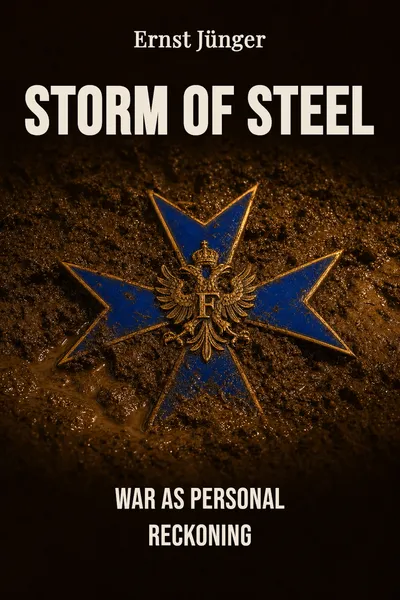
Storm of Steel
War as personal reckoning
Description
In the last days of 1914, a nineteen-year-old German volunteer named Ernst Jünger stepped off a train in Champagne and marched toward the front for the first time. He had run away from school to join the French Foreign Legion the year before, been retrieved by his father, and enlisted the moment war broke out — hungry, by his own account, for something the classroom could not give him. What he found was a landscape of mud, waiting, and sudden noise. His first sight of a wounded man startled him more than any horror that followed, precisely because he had not yet learned what horror looked like at scale.
He would spend most of the next four years in the trenches of the Western Front, wounded roughly fourteen times, decorated with the Pour le Mérite at twenty-three. Through all of it he kept a diary — small notebooks filled in dugouts and field hospitals, recording shell bursts, raids, deaths, and his own sensations with watchful precision. Out of those notebooks came Storm of Steel, first published in 1920 and revised many times across his long life. It became a worldwide bestseller and, more than a century on, remains one of the most disquieting things ever written about combat.
What makes the book endure is not that it condemns the war, and not that it celebrates it. Jünger does neither in the way readers expect. He writes as a man taking his own measure against the largest force he can imagine, treating the whole catastrophe as, above all, a personal ordeal. That posture is what fascinates and what troubles — the sense of a mind observing its own destruction with cold curiosity, and finding, somewhere in the wreckage, exhilaration.
The question we’re asking : How does a soldier turn the mass slaughter of the Great War into a private test of the self — and why does the result still unsettle us?What we’ll see : A young volunteer's notebooks become one of war literature's strangest documents, where sensation outruns judgment and every shell is a question addressed to one man.
Table of contents
01Chapter 1 — The diary that refused to look away
Storm of Steel began as a habit before it became a book. Jünger filled notebook after notebook at the front, jotting the day's events with a reporter's economy — units moved, positions taken, men killed, weather, the color of the sky before a barrage. When he came to shape the material for publication in 1920, he kept that granular, dated texture. The result reads less like a memoir composed in tranquility than like something scraped straight off the trench wall while the guns were still warm.
This is what gives the book its peculiar authority. There is no framing philosophy, no thesis about the meaning of the conflict, no retrospective wisdom smoothing the chaos into a story. We move where Jünger moved — from the relative calm of a quiet sector to the industrial hell of the Somme, from Flanders to the great German offensives of 1918 — and we learn what he learned, at the pace he learned it. The famous title phrase, taken from a poem, names exactly this: not the politics of the war but its physical substance, the weather of steel that a body has to live inside.

02Chapter 2 — Sensation before meaning
Read Storm of Steel expecting an argument and it slips through your fingers. Jünger is not building toward a conclusion about whether the war was worth it. What he is doing, page after page, is registering sensation — and treating sensation as more truthful than any conclusion he might draw. The book is a vast inventory of what the body undergoes: the pressure wave of a near miss, the animal instinct that flings a man flat before the blast, the odd euphoria that arrives after survival.
This is why the book can feel so alien. Most war writing that lasts is organized around loss and asks us to grieve. Jünger grieves too — his account of friends blown apart beside him carries real weight. But the grief never becomes the frame. Alongside it runs something harder to name: a fascination with intensity for its own sake, a conviction that extreme states reveal something about existence that ordinary life keeps hidden. He calls the front a place where life is compressed to its essence.
03Chapter 3 — The self as the real battlefield
For Jünger the Great War was a national struggle, and he never pretended otherwise; he was patriotic, tough, and largely uninterested in questioning the cause. But the war that Storm of Steel actually describes is smaller and stranger than the clash of empires. It is the war between Jünger and his own limits. Every raid he leads, every barrage he endures, every wound he survives is folded into a single experiment: how much can this man take before he breaks, and what will be left of him if he does not?
The trench raid is where this comes into sharpest focus. Jünger volunteered again and again to lead small parties across no man's land at night for objectives that were often trivial in strategic terms. What draws him is not the ground gained but the crossing itself — the moment of stepping into open darkness with death on all sides, and finding out who he is inside it. He describes these ventures with something close to appetite, and he is honest enough not to hide it.
04Chapter 4 — A book that keeps changing shape
Storm of Steel has never sat still in the hands of its readers, and that restlessness is the surest sign of what kind of book it is. It appeared in 1920 into a Germany desperate to make sense of defeat, and it offered no comfort to any camp. Pacifists could not use it, because it does not repent. Nationalists tried to claim it, and Jünger, who moved for a time in the militant right, did little at first to stop them — yet the book itself never fits the propaganda, because its loyalty is to sensation and self, not to slogan.
Set beside the great anti-war works of the same years, the contrast is stark. Where Erich Maria Remarque, in All Quiet on the Western Front, wrote to show that the war destroyed a generation and taught nothing worth keeping, Jünger wrote as though the war had taught him everything — and declined to say whether the lesson was worth the price. This is why each generation reopens the book and argues about it anew. It refuses to hand over the verdict readers arrive wanting.
05Conclusion
The book closes as it began, with Jünger the observer — wounded a final time in 1918, invalided out, decorated, alive against every probability. The notebooks that recorded four years of steel had done their work, and would go on being reworked for the rest of a very long life. What survives is not a story about who won or what it meant, but the granular texture of endurance itself: a young man who kept walking back into the fire to find out what he was made of, and wrote down, without flinching, exactly what he saw.
Related books