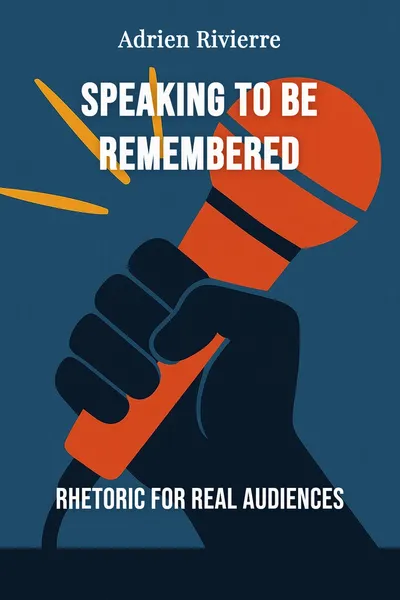
Speaking to Be Remembered
Rhetoric for real audiences
Description
Picture the moment most of us dread: standing up in front of a room, notes in hand, a slide behind us, and watching a few faces already drift toward their phones. We've prepared. We know the material cold. And somehow, twenty minutes later, nobody remembers a word. Adrien Rivierre, a French speaker and coach who has spent years watching people talk to real crowds, opens his book "Speaking to Be Remembered" with exactly this problem. Not the trembling voice, not the dry mouth — the quieter failure. The talk that happens, and then evaporates.
His starting point is almost blunt. Most advice on public speaking treats it as a performance to be polished: breathe, smile, make eye contact, don't say "um." Useful, sure, but it misses the point. Rivierre's claim is that rhetoric was never about the speaker looking good. It was about the listener being moved — and, crucially, about the listener still carrying something away the next morning. The ancients knew this. Cicero knew it. The question is why we forgot it, and what it would take to speak as if the audience actually mattered.
What makes the book worth sitting with is that it refuses the tidy TED-talk formula. Rivierre is after something older and more demanding: a rhetoric built for the messy, distracted, skeptical rooms we actually speak into — a wedding, a board meeting, a classroom, a funeral. People who have other things on their minds, and who will decide in the first few seconds whether to grant us their attention at all.
The question we’re asking : What separates a talk that lands from a talk that's politely forgotten the moment it ends?What we’ll see : A working rhetoric built not for the slide deck but for the restless, real room in front of us — and for the one phrase that stays after everything else is gone.
Table of contents
01Chapter 1 — The room decides, not the script
Rivierre's first move is to shift the center of gravity. We tend to prepare a speech the way we'd write an essay — build the argument, order the points, rehearse the wording. Then we walk in and deliver it at a room that has its own temperature, its own fatigue, its own suspicion. The script was written for an abstraction. The people are specific. And rhetoric, in his reading, has always lived in that gap: it's the art of adjusting to who is actually sitting there, not reciting what we decided at our desk.
This is why he keeps returning to the Greeks and Romans, not as decoration but as practitioners who spoke to crowds that could heckle, vote, or walk out. Aristotle built his whole treatment of persuasion around the audience — what they already believe, what they fear, what will strike them as credible coming from this particular speaker. The appeal was never one-size. A jury, an assembly, a grieving family each required a different entry. The speaker who ignored that difference lost, sometimes literally.

02Chapter 2 — Attention is earned in the first thirty seconds
If the room decides, it decides fast. Rivierre is unsentimental about this: the opening seconds of any talk are where we either win a hearing or lose it, and most speakers waste them. The ritual throat-clearing — thanking the organizers, apologizing for the slides, recapping the agenda — tells the audience nothing is about to happen yet, so they can safely check out. By the time we reach the interesting part, the room has already set its dial to half-listening.
His remedy draws on a very old rhetorical instinct: begin with something that creates a stake. A concrete scene, a sharp question, a number that doesn't fit expectations, a short story that makes the listener want to know how it ends. The point is not to perform a hook for its own sake but to answer, immediately, the question every audience is silently asking — why should I care about this, now? Answer it in the first breath and the rest of the talk is spent with the audience leaning in rather than being dragged along.
03Chapter 3 — The story does what the argument cannot
Here Rivierre makes his most insistent case: if we want to be remembered, we have to stop relying on arguments alone. A well-built argument convinces in the moment and then fades, because reasons are hard to carry. Stories, images and examples lodge somewhere stickier. He points to a simple human fact — we remember what we can picture, and we picture people, places and events far more easily than propositions. The abstract claim "trust must be rebuilt slowly" evaporates. The specific scene of someone rebuilding it does not.
This is not anti-intellectual. The argument still has to be sound; the story is how the sound argument travels. Rivierre describes good speaking as a weaving of the two: a point made, then made visible through a concrete case, so the listener holds both the idea and the picture that carries it. The ancient rhetoricians called part of this craft the use of vivid detail — making the audience feel they are watching the thing happen rather than hearing it described. That vividness is what converts a listener from spectator to participant.
04Chapter 4 — A phrase that outlives the talk
Step back from the techniques and a single ambition organizes the whole book: to leave a trace in another mind. Rivierre's real subject isn't performance at all. It's transmission — the strange, fragile transfer by which something that lived in one person's head ends up living in a stranger's. Everything else, the opening, the story, the pacing, serves that end. A talk succeeds not when it is admired but when a piece of it keeps working in someone after the speaker has sat down and the applause has stopped.
And the sharpest instrument of that transmission, for Rivierre, is the phrase — the compact, well-cut formulation that the listener can carry out of the room intact. We don't remember paragraphs. We remember a line. The art of condensing a whole idea into a sentence short enough to repeat is, in his telling, the summit of rhetoric, not a garnish on top of it. The phrase is the handle by which the audience grips everything that came before, and the form in which they'll hand it to someone else.
05Conclusion
We began with the ordinary dread of the forgotten talk — the one delivered competently and gone by morning. Rivierre's answer threads back through everything: read the room before the script, earn attention in the first breath, let the story carry the argument, and compress the whole thing into a phrase someone can take home. None of it is showmanship. It is, start to finish, an act of attention paid to the people in front of us rather than to our own composure.
Related books