
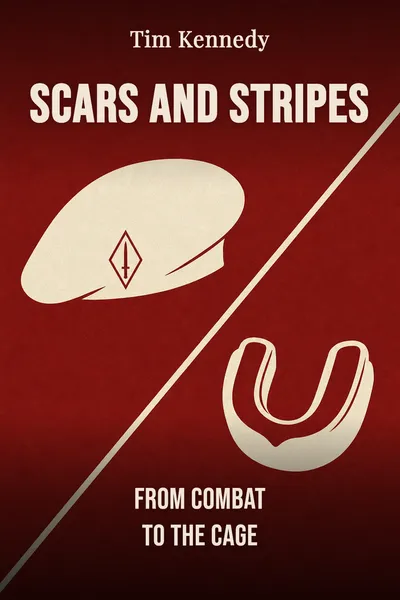
Scars and Stripes
From combat to the cage
Description
Tim Kennedy has jumped out of planes, cleared houses in Afghanistan, hunted men in the Iraqi desert, choked out professional fighters on live television, and, in one of his stranger detours, helped track down fugitives on a cable reality show. In his 2022 memoir Scars and Stripes, he lays all of it out in the same flat, profane, unhurried voice — the voice of someone who has told these stories at enough bars to know exactly where the laugh lands and where the silence should. It reads less like a soldier's careful reckoning and more like a friend across the table who has genuinely done the things other men only claim.
What holds the book together isn't the body count or the fight record. It's a temperament. Kennedy is a Green Beret sniper who also fought in the UFC while still on active duty, a man who seems constitutionally unable to sit still, who treats comfort as a kind of slow death. The memoir tracks him from a restless California kid through Special Forces selection, two wars, a mixed martial arts career squeezed into the gaps between deployments, and a long tail of high-risk hobbies that would each be a lifetime for most people.
Underneath the swagger, the book keeps circling one thing: what it costs to build a life around walking toward the danger everyone else walks away from. Kennedy isn't fearless, and he says so repeatedly. He's something more interesting than that.
The question we’re asking : What does a life spent deliberately seeking out combat, cages, and cliffs actually teach the man living it — and what is he chasing?What we’ll see : We follow Kennedy from a restless boyhood into the Special Forces, the fight world, and the harder truths he pulls out of a life spent walking toward danger.
Table of contents
01Chapter 1 — The kid who kept saying yes
Kennedy grew up in San Luis Obispo, California, the son of a cop, in a household where competence was the currency that mattered. He was the kind of boy who broke bones doing things he'd been told not to do, who found school a poor container for whatever was going on inside him. The memoir doesn't dress this up as a hero's origin. He's honest that a lot of his early drive was just a refusal to be bored, a physical need to test the edge of whatever he was standing near, whether that meant a bike ramp, a fight, or a cliff.
What separates his telling from the usual tough-guy childhood is the absence of self-pity. There's no wound he's trying to explain, no father to blame or impress into submission. He simply liked doing hard things and disliked stopping. That temperament found its first real outlet in martial arts, which gave the restlessness a structure — a place where getting hit and getting back up was the whole point, and where the person across from him was a problem to be solved rather than an obstacle to be endured.

02Chapter 2 — Two wars, one green beret
The heart of Scars and Stripes is Kennedy's deployments, and here the voice tightens. He served as a Special Forces sniper and operator across multiple tours in Iraq and Afghanistan in the years after 2001, and the war chapters carry a specificity the rest of the book only gestures at. He is precise about the weather, the terrain, the weight of gear, the texture of waiting — because in his telling war is mostly waiting, punctuated by moments that rearrange you permanently in the space of a few seconds.
He doesn't glamorize the killing, and he doesn't perform guilt about it either, which is part of what makes the account unsettling to read. For Kennedy the job had a logic: there were people trying to kill his team and the people his team was protecting, and his work was to make sure they didn't. He describes the sniper's particular burden — the patience, the intimacy of watching a target through a scope, the responsibility of a decision made alone. These passages are where the memoir stops being entertaining and starts being something heavier.
03Chapter 3 — The cage as a second front
The detail that makes Kennedy genuinely unusual is that he fought professional mixed martial arts while still serving. He competed in major promotions — Strikeforce and later the UFC — as a middleweight, at one point fighting near the top of his division, all while remaining a soldier who could be deployed. Most fighters organize their entire existence around the next fight. Kennedy was cramming training camps between military obligations, which he describes with the deadpan understatement of a man who genuinely didn't see the arrangement as insane.
He's candid about the friction this created. The military wasn't always thrilled to have an active operator getting punched in the face on pay-per-view, and the fight world couldn't quite understand a man who had a whole other career that outranked it. Kennedy lived in the seam between the two, belonging fully to neither, and the memoir is honest that this cost him in both. His fight record has real high points and real losses, and he doesn't sand down the defeats — the close decisions that went against him, the fights he believed he'd won, the frustration of a scoring system he found maddening.
04Chapter 4 — Fear is the only honest teacher
For all its action, Scars and Stripes is finally a book about fear, and Kennedy's relationship to it is more sophisticated than the tough-guy packaging suggests. He does not claim to be fearless. He argues, over and over in different settings, that fear is information — a signal telling you something real about the situation you're in — and that the mistake most people make is treating the signal as an order rather than as data. His entire life reads as an experiment in receiving the signal, weighing it, and then deciding for himself whether to obey it.
This is the thread that connects the sniper hide, the octagon, and the parachute. In each case the fear is real and the point is not to erase it but to keep functioning while it's screaming. Kennedy suggests that courage isn't the absence of the alarm but the ability to keep making good decisions with the alarm blaring. It's a distinction he seems to have learned the expensive way, watching men who were merely fearless get themselves killed, and watching more careful men survive because they were afraid enough to stay sharp.
05Conclusion
By the end, Scars and Stripes has stopped being a catalogue of adventures and become the self-portrait of a specific kind of man — one who found in war the clearest version of himself and then spent the rest of his life trying to keep that clarity alive by other means. The Green Beret, the UFC fighter, the fugitive-hunter on television: they're all the same person refusing to let the alarm decide for him, refusing the quiet that most people spend their lives chasing.