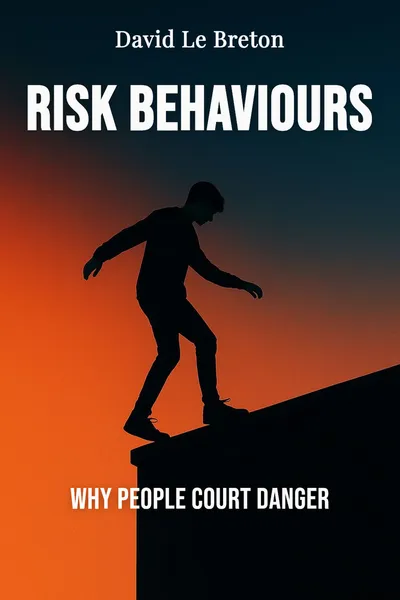
Risk Behaviours
Why people court danger
Description
A teenager stands on a railway bridge at night, waiting for the train, then jumps the parapet with just enough margin. A driver takes a blind curve at a speed he can't quite justify. A young woman cuts her forearm in the bathroom, watches the line of blood, and feels, for a moment, that she exists. None of them is trying to die. That is the strange thing the sociologist David Le Breton keeps returning to. These are not suicides. They are people who put their lives on the table precisely because they want to keep them, and want, above all, to feel them.
Le Breton spent decades studying what he calls conduites à risque — risk behaviours — among adolescents, but also among adults who drive too fast, drink to the edge, climb without ropes, or starve themselves. His wager is that these acts are not simply pathology, recklessness, or a death wish. They are a language. A person who no longer knows how to give meaning to their existence asks the world for an answer through the body, by brushing against the limit and coming back.
That reframing is uncomfortable, because it takes behaviours we usually file under "stupid" or "sick" and treats them as attempts to live more, not less. It asks what a society owes the young when it has removed the old ways of marking that they have crossed into adulthood. And it suggests that the danger we keep trying to stamp out might be doing quiet, necessary work.
The question we’re asking : Why do people knowingly gamble with their own lives, and what are they actually asking for when they do?What we’ll see : How Le Breton turns recklessness into a search for meaning, and follows it back to adolescence and the missing rites of passage.
Table of contents
01Chapter 1 — The wager against emptiness
Le Breton's starting move is to separate the risk behaviour from the death it seems to flirt with. The person who drives at the edge, drinks past sense, or provokes a fight is not chasing an ending. They are chasing an answer. The gesture poses a question to the world — will I survive this? — and survival becomes a verdict. If I come back, then I am allowed to be here. The risk is a way of consulting fate, of asking existence itself to confirm that it wants us.
What makes the question urgent is a particular kind of suffering, one that rarely announces itself as suffering at all. Le Breton calls it le blanc, a whiteness or blankness: the feeling of not being fully alive, of moving through days that don't register, of a self that has gone flat. It isn't dramatic despair. It's the quiet erosion of meaning, the sense that nothing costs anything and therefore nothing counts. Against that fog, danger has one enormous virtue. It is undeniable. Fear, adrenaline, the pounding heart on the way back down — these are sensations no one can argue you out of.

02Chapter 2 — When the body signs the contract
If risk is a question, the body is where it gets asked, because the body cannot lie the way language can. A person can say they feel fine, can perform normality, can even convince themselves. But speed, hunger, cold, blood, the drop below the ledge — these produce sensations that no story can fake. Le Breton's recurring insight is that when words fail to hold a life together, people fall back on the flesh. The body becomes the last available surface on which to write that one exists.
He extends this well beyond the obvious cases. Anorexia, in his reading, is a risk behaviour: a young woman testing how far she can push the boundary between control and collapse, treating hunger as a discipline that proves mastery over a life that otherwise feels unauthored. Self-cutting works similarly — the wound is not primarily a bid for attention but a way of converting an unbearable, formless inner pain into something located, visible, and real. The cut hurts, and the hurt is a relief, because it can finally be seen.
03Chapter 3 — Modern life without the rites
Why now, and why the young especially? Le Breton's answer is historical. Older societies did not leave the passage into adulthood to chance. They staged it. There were rites of passage — ordeals, seclusions, ceremonies — in which a young person was symbolically taken apart and put back together as an adult, watched over by the community and marked as changed. The ordeal was real, sometimes frightening, but it was framed, held, and given meaning by everyone around it. You suffered, and the suffering meant something, and afterward you were someone new.
Modern Western societies, he argues, have quietly dismantled these thresholds without replacing them. Adolescence now stretches for years with no clear line to cross, no moment when the community declares that the child is gone and the adult has arrived. Legal ages are scattered and bureaucratic; they confer no felt transformation. The young are left in a long, ambiguous corridor, told they are almost adults but never told, in any way their bodies can register, that they have arrived.
04Chapter 4 — Ordeal as a way of being born
Step back, and Le Breton's whole argument gathers around a single figure: the adolescent trying to be born a second time. The first birth was given, involuntary, biological. The second — becoming an adult, a self, someone who feels authorized to exist — has to be won, and traditionally it was won through an ordeal witnessed by others. Risk behaviour, in this light, is not the opposite of that ancient work. It is that work, orphaned of its rite.
This reframes what looks like self-destruction as a botched form of self-creation. The teenager courting danger is not, for the most part, rejecting life. They are demanding entry into it — asking for a threshold that no adult institution is willing to stage. Le Breton refuses both the panicked reading (they are sick, stop them) and the dismissive one (they are foolish, they'll grow out of it). Beneath the behaviour is a legitimate hunger: to be tested, to be marked, to be recognized as changed. The problem is not the hunger but the absence of any legitimate way to feed it.
05Conclusion
Return to the teenager on the bridge. Once we stop reading the leap as a death wish, it becomes something stranger and sadder: an attempt to be confirmed. To ask the world a question — am I really here? — and to accept the pounding heart on the far side as a yes. Le Breton's achievement is to make that gesture legible without excusing its cost, to show that the wildest risk can be a defense of life mounted by someone who has lost the ordinary words for wanting it.
Related books