
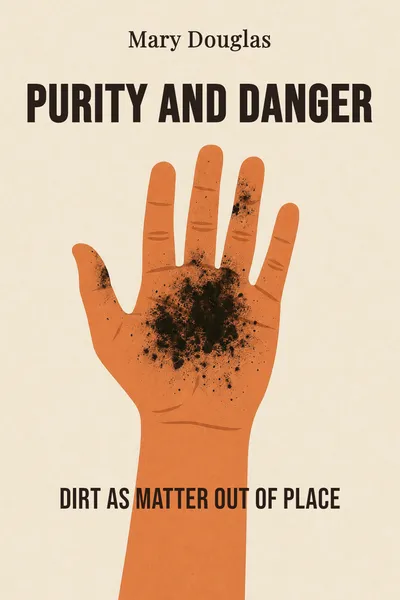
Purity and Danger
Dirt as matter out of place
Description
In 1966, a British anthropologist named Mary Douglas published a slim, strange book called Purity and Danger. She had done her fieldwork among the Lele of what was then the Belgian Congo, filling notebooks with rules about which animals could be eaten, who could touch what, which acts would pollute a village. Plenty of anthropologists before her had catalogued such rules and filed them under primitive superstition — the quaint fears of people who did not yet understand germs. Douglas refused that framing from the first page. The rules, she suspected, were not failed biology. They were doing something else entirely, and something we do too.
Her move was to put a Congolese taboo and a modern revulsion on the same table and ask what they had in common. Shoes on the dining table disgust us; shoes by the door do not. Soup in a bowl is dinner; the same soup on a shirt is filth. The soup has not changed — what has changed is where it sits in relation to a line we have drawn. From this observation Douglas built one of the most quoted sentences in twentieth-century social science: dirt is matter out of place.
That phrase sounds almost too tidy for a book about pollution and the sacred. But Douglas meant it as a key to things that had resisted explanation — why certain foods are forbidden, why certain bodies are treated as dangerous, why societies guard their edges so fiercely. The book argues that disgust is less about hygiene than about order, and that what we call unclean is often simply what will not fit.
The question we’re asking : If dirt is not really about germs, what is the rule against it actually protecting?What we’ll see : How a close reading of taboo turns revulsion into a story about the maps we draw to make sense of the world.
Table of contents
01 Chapter 1 — A kitchen table, a cultural map
Douglas starts with the most ordinary experience she can find, because her whole case depends on us recognising ourselves before we judge anyone far away. Think of the things in a home that are not dirty in any chemical sense and still feel wrong: outdoor clothing on the bed, bathroom items in the kitchen, food on the floor. We clean these away not because they threaten our health but because they violate an arrangement. Cleaning, she notes, is a positive act — us reordering our surroundings to match an idea of how things should be.
The idea we are matching is a classification. Every culture sorts the world into categories — edible and inedible, sacred and profane, inside and outside, male and female, raw and cooked. These boxes feel natural to the people living inside them, the way our own sense of what belongs on a plate feels obvious to us. But they are made, not found, and they vary wildly from one society to the next. What one group eats with pleasure, another treats as unspeakable. The categories do the work of making a shared world legible.

02 Chapter 2 — Dirt is a verdict, not a substance
Once you accept that dirt is relational, a chain of consequences follows. Nothing is dirty in itself; it is only dirty somewhere. Hair on the head is admired and brushed; the same hair in the soup is revolting. Spit in the mouth is unremarkable; spit on the floor, or spat back into a glass and offered to drink, is almost unbearable, though it was inside us a second ago. The substance is identical. The verdict changes with the crossing of a boundary.
Douglas reads pollution rules as the policing of these boundaries, and she is especially interested in the margins — the thresholds where one category shades into another. That is where the danger concentrates. Doorways, the edges of the body, moments of transition like birth and death, the fluids that leave the body and are neither fully inside nor outside: these are the sites a culture hedges with taboo. They are dangerous precisely because they are ambiguous, and ambiguity is a small failure of the map.
03 Chapter 3 — Why the abominations of Leviticus make sense
The most celebrated pages of the book take on a puzzle that had defeated commentators for centuries: the dietary laws of Leviticus. Why may the Israelites eat cattle, sheep and goats but not the pig, the camel, the hare? Generations had reached for explanations — the pig carries disease, the forbidden animals are allegories of vices, the rules are arbitrary tests of obedience. Douglas found all of these unconvincing and proposed instead that the laws are a system, readable through her theory of anomaly.
Her reading hinges on the categories the text itself lays out. Proper creatures of the earth chew the cud and have cloven hooves. Proper creatures of the water have fins and scales. Proper creatures of the air fly with wings. The clean animal fully fits the template of its class. The unclean animal straddles it. The pig has cloven hooves but does not chew the cud; it is a partial member of its category and therefore an anomaly. Shellfish live in the water but lack fins and scales; they belong neither here nor there.
04 Chapter 4 — The thing that belongs to no box
Step back from pigs and doorways and the deeper claim comes into view. Any system of order, by the very act of sorting, produces things it cannot sort. The categories carve the world into clean shapes, and whatever falls across the cut becomes an anomaly — not wrong exactly, but unplaceable. This is not a flaw peculiar to the Lele or to ancient Israel. It is the price of having a scheme at all. The more complete the classification, the more visible and troubling its exceptions become.
Douglas's lasting insight is that anomalies disturb us because they expose the made-ness of our categories. As long as everything fits, the map feels like the territory and we forget we drew it. The creature that straddles two classes, the person who occupies no recognised role, the event that fits no script — each is a quiet reminder that the order we take for granted is a human construction with holes in it. That is unsettling in a way that has little to do with danger and everything to do with meaning.
05 Conclusion
The book that began at a kitchen table ends by rearranging our sense of what disgust is for. Dirt turned out not to be a substance but a judgement — the shadow cast by every attempt to put the world in order. The forbidden pig and the shoes on the table belong to the same logic: both are matter that has wandered across a line we needed to keep clear. What Douglas gave us was not a theory of hygiene but a theory of classification, with pollution as the signal that fires whenever the scheme is breached.
Related books











