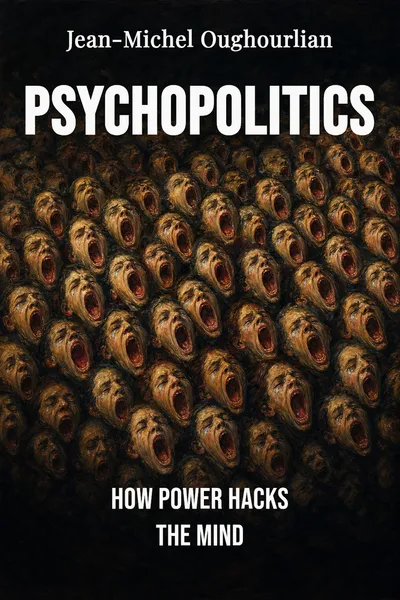
Psychopolitics
How power hacks the mind
Description
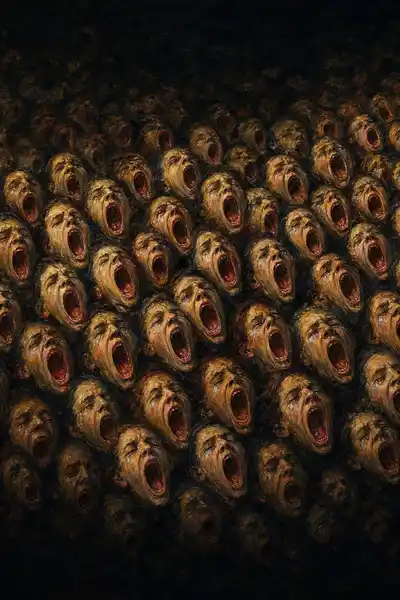
There's a moment that repeats itself in every campaign season, and we've all felt it without naming it. A crowd fills a square, a figure steps up to a microphone, and something moves through the room that no single person decided to feel. The anger sharpens. The hope swells. People who arrived as individuals leave as something else — a body that breathes together. Jean-Michel Oughourlian, a French psychiatrist who spent decades working alongside the thinker René Girard, gave this phenomenon a name and a mechanism in his book Psychopolitics, and the mechanism is stranger than it looks.
Oughourlian's claim, built from neuroscience, clinical practice, and Girard's theory of desire, is that our wants are not our own. We do not choose what we long for from some private inner store; we catch it from others, the way we catch a yawn or an accent. What we call conviction is often contagion. And politics, in his reading, is the oldest and most sophisticated technology ever built for spreading that contagion on purpose — a machine that runs on borrowed desire, rivalry, and the fears a leader learns to feel on our behalf.
The uncomfortable part is that none of this requires deception in the crude sense. The most effective figures aren't lying to a passive audience; they're tuning into something already humming inside us and amplifying it. That's why the book reads less like a manual of dirty tricks and more like an X-ray of the crowd — and of the reader standing inside it.
The question we’re asking : If our desires are borrowed rather than chosen, how exactly does power get its hands on them?What we’ll see : How a psychiatrist traces the invisible wiring that turns private feeling into public force — and where that wiring runs today.
Table of contents
01 Chapter 1 — Desire is always borrowed
Oughourlian starts from a deceptively simple idea he inherited from René Girard: human desire is mimetic. We want things not for their own qualities but because someone else wants them first. The child ignores a toy until another child reaches for it, and suddenly that toy is the only one worth having. Girard called this the mediator — the model whose desire teaches us what to desire. Oughourlian's contribution, as a clinician and a neuroscientist, is to take that literary and anthropological theory and ground it in the body.
The grounding comes partly from the discovery of mirror neurons in the 1990s by a team in Parma led by Giacomo Rizzolatti. These cells fire both when we perform an action and when we watch someone else perform it. Oughourlian reads this as biological confirmation of what Girard had argued from the study of novels and myths: imitation isn't a behavior we occasionally choose, it's the default setting of the nervous system. Before we think, we copy. Understanding, empathy, and desire all pass through the same imitative channel.

02 Chapter 2 — The rival we can't stop copying
The trouble with borrowed desire is what happens when two people want the same thing. If I catch my wanting from you, then you and I are now reaching for the identical object, and the model becomes an obstacle. Girard called this mimetic rivalry, and Oughourlian shows how it scales from the schoolyard to the nation. The closer two rivals are — the more alike, the more they mirror each other — the fiercer the antagonism grows. We don't hate those most different from us; we compete hardest with those we most resemble.
Politics, Oughourlian argues, is largely the management and exploitation of this rivalry. Parties define themselves less by fixed programs than by opposition to a near-twin. The intensity between rival camps often exceeds anything their actual disagreements would justify, because the fuel isn't the issue at all — it's the mimetic doubling. Each side copies the other's tactics, mirrors its outrage, and needs the enemy in order to know who it is. Remove the rival and the identity wobbles.
03 Chapter 3 — Fear, love, and the leader who feels them for us
If a population runs on imitation, the leader's job is to be the model worth imitating. Oughourlian describes charisma not as a mysterious personal glow but as a specific competence: the ability to embody a desire or a fear the crowd already carries, and to feel it more visibly, more intensely, than anyone else. The figure on the stage becomes a kind of emotional amplifier. People don't adopt his positions so much as they synchronize with his affect. He is angry, so they discover their anger; he is confident, so their fear finds a place to rest.
Fear is the raw material power reaches for most often, because it collapses the distance between people fastest. A frightened crowd is an imitating crowd, hungry for a model who seems unafraid. Oughourlian traces how leaders across history have manufactured or magnified threats — an enemy at the gates, an enemy within — not merely to distract but to bind. Shared fear produces shared desire for protection, and the protector becomes the object everyone wants. Love and fear, in his account, are not opposites in politics; they are two settings on the same mimetic dial.
04 Chapter 4 — The screen that made mimicry global
The mechanisms Oughourlian describes are ancient, but he insists they've found an unprecedented accelerant. Before, mimetic contagion needed physical proximity — a square, a church, a marketplace. The crowd had to gather. Digital platforms dissolved that limit. Now the models we imitate arrive continuously, at scale, through screens we carry everywhere, and the feedback loop that once took a rally to build can spin up in hours across millions of people who never share a room.
What worries him about social media isn't primarily the content; it's the architecture. These systems are engineered to surface whatever spreads, and what spreads best is exactly what mimetic theory predicts: outrage, rivalry, the thrill of joining one side against another. A platform optimized for engagement is, functionally, a machine for maximizing the borrowed emotions that bind and divide. Polarization isn't a bug in the design; it's the design's most reliable output. The scapegoat, once a village ritual, becomes a daily global event with a hashtag.
05 Conclusion
Return to the square, the microphone, the crowd breathing as one. What Oughourlian gives us is not a way out of that room — we can't step outside imitation any more than we can step outside the nervous system that runs on it. What he offers instead is a way of standing inside it with our eyes open, noticing the current before it carries us. The desires that feel most fiercely personal, the enemies who seem most obviously deserving, the leaders who appear to say what we already knew: each of these, he suggests, deserves a second look precisely when it feels least in need of one.
Related books