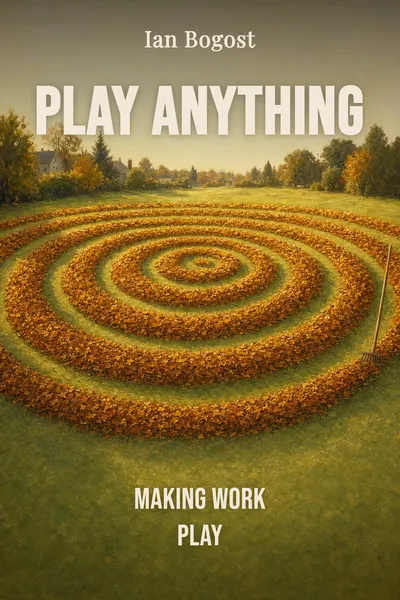
Play Anything
Making work play
Description
Ian Bogost tells a story about walking his four-year-old daughter through a shopping mall. He is in a hurry, irritated, dragging her along a boring stretch of polished floor between one errand and the next. She, meanwhile, is having the time of her life — hopping only on certain tiles, avoiding the seams, turning a dead corridor into an elaborate game with rules he can't see. He is bored by exactly the same environment that she finds inexhaustible. The difference between them isn't the mall. It's what each of them is doing with it.
That small gap, between the exhausted parent and the delighted kid, is the whole engine of Bogost's 2016 book Play Anything. Bogost teaches media studies at Georgia Tech and designs video games, and he came to the subject sideways — not asking how to make life more fun in the self-help sense, but what play actually is, mechanically, once you strip away the balloons and the leisure and the vague promise of "work-life balance." His answer runs against almost everything the wellness industry sells. Play, he argues, has very little to do with freedom, escape, or doing whatever you want.
He builds the case from an unlikely place: boredom, limitation, and the tedious objects we'd rather be rid of. A spreadsheet, a lawn full of leaves, a spouse's annoying habit, a supermarket queue. Bogost's claim is that these are not obstacles to a good life we'll get to later. They are, potentially, the raw material of one right now — if we know how to handle them the way his daughter handled that floor.
The question we’re asking : What is play actually made of, and why might it change how we handle a boring Tuesday?What we’ll see : How a game designer redefines play as attention to constraints — and turns that into a quiet argument about meaning.
Table of contents
01Chapter 1 — The toddler in the mall
Bogost keeps returning to that mall floor because it does something no theory can. His daughter wasn't ignoring the mall to escape into fantasy. She was doing the opposite — paying ferocious attention to what was actually there. The tiles, the grout lines, the spacing of her own steps. She took a fixed, unchosen environment and treated its limits as the material of a game. Bogost was standing in the identical space, treating those same limits as an insult to his schedule.
This reframes what we usually mean by play. We tend to imagine it as a break from reality, a bubble of freedom where the ordinary rules are suspended. Bogost says that's backwards. Play isn't the suspension of rules; it's the embrace of them. A game of soccer is fun precisely because you can't use your hands. Take away the constraint and you don't get more play, you get less — you get a bunch of people idly kicking a ball with no reason to care where it goes.

02Chapter 2 — Fun is not what we think it is
If play is attention to constraints, then fun turns out to be something stranger than pleasure. Bogost is blunt about this: fun is not the same as enjoyment, and it's certainly not the same as feeling good. He defines fun as the novelty that emerges when we manipulate a familiar thing in a new way — when we operate something exactly according to its own limits and discover it can do more than we assumed. Fun is what we find, not what we bring.
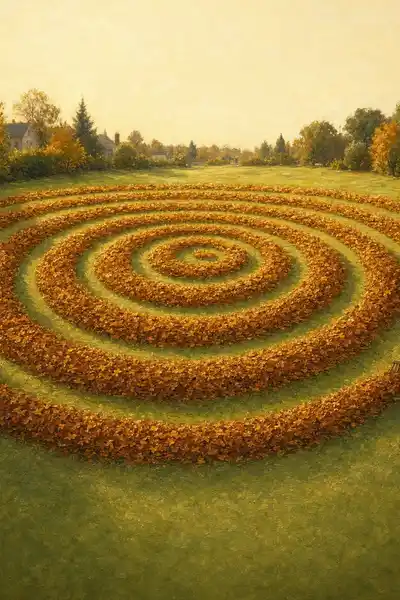
This is why forced fun feels so hollow. The company retreat, the mandatory game night, the vacation booked to guarantee happiness — these often flop precisely because they try to inject fun from outside, as an additive, rather than letting it arise from close engagement with something specific. Bogost points out that raking leaves can be more genuinely fun than a theme park, if you actually give yourself over to the odd physics of leaves, the way they resist, clump, scatter, and refuse to behave. Boredom, in his telling, is not the enemy of fun. It's the doorway to it. Boredom is what you feel just before you start paying real attention.
03Chapter 3 — Constraints, not freedom
The cultural promise Bogost most wants to puncture is the promise of freedom. We are told, constantly, that the good life lies in expanding our options — more choice, more flexibility, fewer rules, the endless open horizon. Bogost thinks this promise makes us miserable, and he thinks games prove why. A game with no rules is not a liberating experience. It's not even a game. It's the empty, restless feeling of a Sunday with nothing structured to do.
Structure, he argues, is what makes anything workable. A poet who can write anything writes nothing; give her fourteen lines and a rhyme scheme and a sonnet appears. The constraint doesn't limit the creativity, it creates the space where creativity can happen. Bogost extends this to the whole apparatus of ordinary life. The rules of a job, the demands of a relationship, the fixed hours of a day — we experience these as cages, but they are also the boundaries that make a game possible in the first place. Without a boundary there's no field to play on.
04Chapter 4 — The trouble with irony
The deeper target of the book, once you step back, is a whole modern posture toward the world. Bogost names it: irony. Not irony as a rhetorical joke, but irony as a stance — the reflex of holding everything at arm's length, refusing to fully commit to anything, staying above it all so nothing can disappoint or embarrass us. It's the shrug that keeps its distance, the meme-tinged detachment that treats sincere engagement as slightly naive. Bogost sees this everywhere in contemporary life, and he thinks it's quietly corrosive.
The problem with irony is that it makes play impossible. You cannot fully play a game you refuse to take seriously. The ironist stands outside the mall floor, too cool to hop the tiles, and so misses the delight that only comes from inside. Detachment feels safe — it protects us from looking foolish, from caring about the wrong things — but the price is a life lived at one remove, never quite touching anything. Bogost's counter-proposal is sincerity, or something he'd rather call it: a willingness to give yourself over to the thing in front of you on its own terms.
05Conclusion
The book ends more or less where it began, in the mall, with a father who has learned to see what his daughter never forgot. The floor didn't change. The errands were just as dull, the schedule just as tight. What shifted was the direction of attention — outward, toward the thing itself, instead of inward toward a fantasy of how much better everything would be elsewhere. Play Anything makes its case not by promising that life will become easier or lighter, but by relocating where joy comes from: not from the world we wish we had, but from the one already pressing in on us, with all its inconvenient tiles and grout lines and rules.
Related books