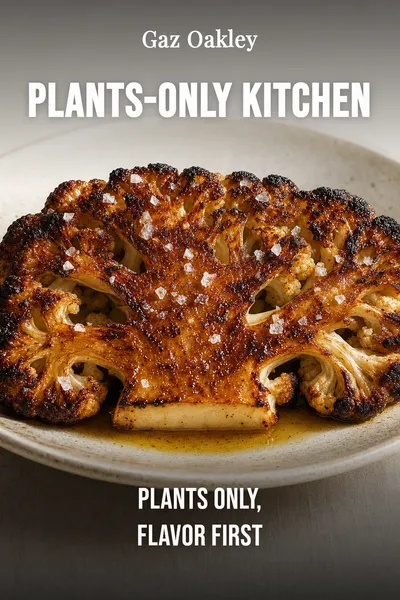
Plants-Only Kitchen
Plants only, flavor first
Description
Somewhere between the second sad salad and the third dinner of pasta with whatever was in the fridge, a lot of people who tried to eat more plants quietly gave up. Not because the food was unhealthy, and not because they stopped believing in the idea. They gave up because it was boring, or fiddly, or asked for a shopping list of things no normal kitchen keeps in stock. Gaz Oakley, a Welsh chef who built an audience under the name Avant-Garde Vegan, wrote his book Plants-Only Kitchen against exactly that experience. His argument, stated plainly across more than seventy recipes, is that the failure was never the plants.
Oakley trained in classical kitchens before going vegan, and it shows in the way he treats vegetables — not as a penance to endure but as raw material to be seasoned, browned, layered and pushed. The subtitle he gave the book, plants only, flavor first, is not a slogan so much as an order of operations. Taste comes before ideology. If a dish doesn't make us want to cook it again on a Tuesday when we're tired, it has failed at the one job that matters, no matter how virtuous the ingredients are.
What makes the book more than another recipe collection is a small design decision that runs through every page. Each recipe carries symbols telling us, before we commit, whether it's high in protein, whether it lands in under fifteen minutes, whether it batch-cooks and keeps. The food is built to be sorted by the life around it, not the other way round. That is the quiet thesis worth pulling apart.
The question we’re asking : How do you build a way of eating that people actually keep, rather than one they admire and abandon?What we’ll see : How Oakley turns plants into food worth returning to, and why the way the book is organized matters as much as what's on the plate.
Table of contents
01Chapter 1 — The problem was never the plants
The premise of Plants-Only Kitchen starts from an honest diagnosis. Most people who drift away from a plant-based diet don't do it over a philosophical crisis. They do it because the food underperformed. Oakley's whole approach assumes the reader is not a convert who will forgive a dull meal for the cause, but an adult who wants dinner to be good. That framing changes everything about how the recipes are written.
His own path informs the tone. Oakley worked in restaurant kitchens from a young age, cooking meat and fish at a high level, before turning vegan in his early twenties. He didn't arrive at plants as a beginner looking for permission; he arrived as someone who already knew how to build a dish and simply swapped the raw materials. So the book carries none of the apologetic register that plant-based cooking sometimes falls into — no sense that we're settling for less, no substitute framed as a sad stand-in for the real thing.

02Chapter 2 — Flavor is a technique, not an accident
If the first move is to stop blaming the vegetables, the second is to say clearly where flavor actually comes from. In Plants-Only Kitchen it is never left to chance. Oakley builds taste the way a trained cook does — with layers, with contrast, with things that take time to develop and things added at the last second for lift. The book is dense with the small mechanics that separate a competent dish from one we crave.
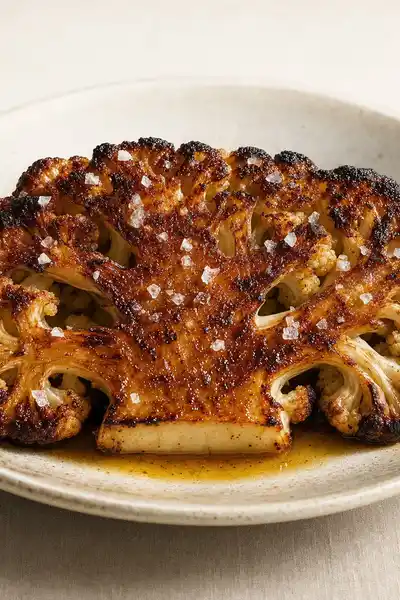
Browning does a lot of the work. Roasting cauliflower until the edges char, caramelizing onions properly rather than sweating them for two minutes, searing mushrooms hard so they release their savoury depth — these are the moves that give plant dishes the roundness people otherwise say they miss. Oakley treats the Maillard reaction, the browning that happens when food meets real heat, as a non-negotiable rather than a nice-to-have. It costs a few extra minutes and returns most of the flavor.
03Chapter 3 — The book that reads your week
The feature that sets Plants-Only Kitchen apart from a straightforward recipe collection is a system of symbols attached to every dish. Before reading a single instruction, we can see whether a recipe is high in protein, whether it comes together in under fifteen minutes, and whether it's built for meal prep and batch cooking. It's a small piece of design that quietly reorganizes how the book gets used.
The logic is that people don't cook in the abstract. They cook inside constraints — a weeknight with twelve free minutes, a Sunday with time to fill the fridge for the week ahead, a training day when protein matters more than usual. Most cookbooks make us read the whole recipe to discover which of those situations it fits. Oakley flags it upfront, so the book can be searched by circumstance. The question stops being what do I feel like cooking and becomes what does today allow, which is the question people actually face.
04Chapter 4 — Cooking as a system, not a sacrifice
Step back from the individual dishes and Plants-Only Kitchen is making an argument about why diets fail and how they might not. The standard model treats eating well as a matter of willpower: we decide to be better and then hold the line until we don't. Oakley's book quietly rejects that. It treats the diet as a system that either fits a life or doesn't, and it engineers for fit rather than resolve.
The two levers it pulls are flavor and convenience, and it's worth noticing that these are usually framed as the rewards you earn after doing the responsible thing. Here they're the mechanism itself. Food that tastes genuinely good is food we want to repeat, and repetition is what a diet actually is. Food that slots into a fifteen-minute window or a batch-cooked Sunday is food that survives contact with a real schedule. Take those two together and adherence stops being a test of character and becomes a property of the design.
05Conclusion
The book comes back, in the end, to that abandoned salad. The person who gave up on plants did nothing wrong; they were simply handed food that couldn't compete with the life around it. Plants-Only Kitchen answers by refusing to make plant food a compromise. It seasons hard, browns everything, reaches for the loud end of the global pantry, and then labels each dish by the circumstance it fits — the rushed night, the training day, the Sunday spent stocking the fridge. Flavor first, always, with the logistics handled so nothing gets in the way of cooking it again.
Related books