Paul Bocuse's French Cooking
Twelve hundred recipes, one master
Description
In the early 1970s, Paul Bocuse already had three Michelin stars over his restaurant in Collonges-au-Mont-d'Or, just north of Lyon, and a face familiar enough to sell newspapers. He was, by then, the most public French chef alive — a man who put his name on the menu and his portrait on the wall and treated the cook as a figure worth watching. So when he sat down to write a cookbook, the expectation was a chef's memoir dressed as recipes: a handful of signature dishes, a few restaurant secrets, some photographs of himself in whites.
What he produced instead was closer to a household encyclopedia. Nearly twelve hundred recipes, organized not around his own celebrity but around the raw materials of a kitchen — the stocks, the sauces, the eggs, the fish, the birds, the vegetables, the tarts. A book that assumes we might want to poach a whole salmon on a Saturday and also boil an egg correctly on a Tuesday. It reads less like a portrait of a great man and more like the working knowledge of a whole cuisine, written down by someone who happened to have mastered it.
That gap — between what a famous chef could have written and what Bocuse actually wrote — is where the book lives. It treats French cooking not as a gallery of masterpieces but as a method anyone patient enough can learn, one preparation at a time.
The question we’re asking : Why would the most celebrated French chef of his era write a twelve-hundred-recipe manual instead of a book about himself?What we’ll see : How Bocuse turned the whole grammar of French cooking into something a home kitchen could actually hold.
Table of contents
01Chapter 1 — A chef writes down what a kitchen already knows
Bocuse came up through a specific tradition. He trained under Fernand Point at La Pyramide in Vienne, the restaurant that formed most of the great postwar French chefs, and before that in a family that had run a riverside inn near Lyon for generations. The cooking he inherited wasn't invented on the spot; it was transmitted, cook to cook, gesture to gesture, over decades. Much of what a French kitchen knew had never been written down at all — it lived in the hands of the people doing it.
The book takes on the job of writing it down. Not the flourishes, not the plating tricks, but the underlying operations: how to clarify a stock, how to truss a chicken, how to fold beaten egg whites into a batter without knocking the air out. These are the things a young cook would once have learned by standing next to an older one for a year. Bocuse's wager is that they can also be learned from a page, if the page is honest about how the work is actually done.

02Chapter 2 — The stock, the roux, the thing before the dish
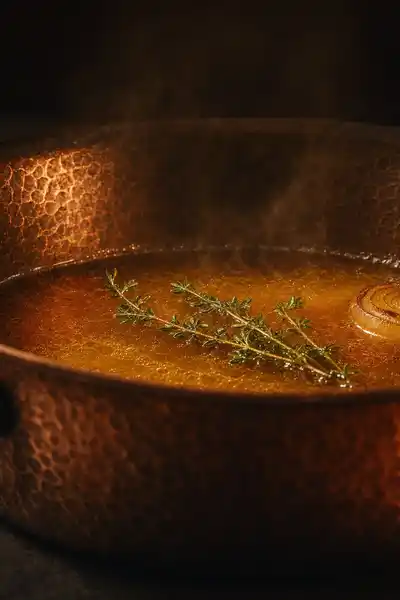
The most revealing thing about the book is where it starts. Not with a signature dish, but with foundations — stocks, court-bouillons, the mother sauces, the basic doughs and batters. Before we are allowed a single finished plate, we are walked through the preparations that sit underneath dozens of them. This ordering is an argument in itself: French cooking is not a list of dishes but a set of building blocks that recombine.
A brown stock, once made, becomes the base for a sauce, which becomes the finish for a braise, which becomes the heart of a dinner. A béchamel learned in one recipe reappears in twenty others. The book teaches these components as components, on purpose, so that a cook who masters ten or fifteen of them can then produce a hundred dishes without learning each from scratch. It is an economy of effort disguised as a long book.
03Chapter 3 — Twelve hundred recipes, one grammar
The sheer number matters. Nearly twelve hundred recipes is more than any single cook would make in years, and Bocuse knows it. The point of covering so much ground is not that we will cook all of it, but that whatever we reach for — a particular fish, a cut of meat, a vegetable in season, a fruit for dessert — the book will already have an answer waiting. It is built to be consulted, not read straight through, the way a dictionary is built to be opened at need rather than memorized.
So the organization follows the ingredient, not the occasion. There are chapters for soups, for eggs, for fish and shellfish, for beef and veal and lamb and pork, for poultry and game, for vegetables, for cheese, for fruit and pastry. Inside each, a single item is treated many ways. A chicken can be roasted, poached, sautéed, fricasseed, turned into a terrine. The book maps the possibilities of each product rather than fixing it to one famous preparation, so the reader learns the ingredient itself, not just a dish that happens to use it.
04Chapter 4 — The peasant table and the three-star plate
Step back from the recipes and the book makes a larger claim about what French cooking is. Bocuse became famous as a leader of what critics called the nouvelle cuisine — lighter, fresher, less buried under heavy sauce — and he could have written a manifesto for it. Instead he wrote something more conservative and more generous: a defense of the whole tradition, from the country stew to the restaurant showpiece, treated as one continuous body of knowledge rather than a battleground between old and new.
In his hands there is no real wall between the humble and the grand. The same care goes into a vegetable soup as into a poached bird for twelve. This reflects where he came from — the Lyonnais bouchon tradition, built on offal, sausage, and honest regional cooking as much as on luxury. The book insists that the peasant table and the three-star plate are made from the same skills, differing in occasion and ingredient rather than in kind. Good technique is good technique everywhere, and a well-made stock does not know whether it will end up in a farmhouse or a dining room.
05Conclusion
The book that could have been a monument to Bocuse turned out to be a monument to the cuisine he served. Nearly twelve hundred recipes, arranged by ingredient and built on a small foundation of shared techniques, add up to something closer to a reference than a memoir. It answers the beginner and the ambitious cook from the same pages, and it treats a boiled egg and a poached salmon with the same steady attention.
Related books