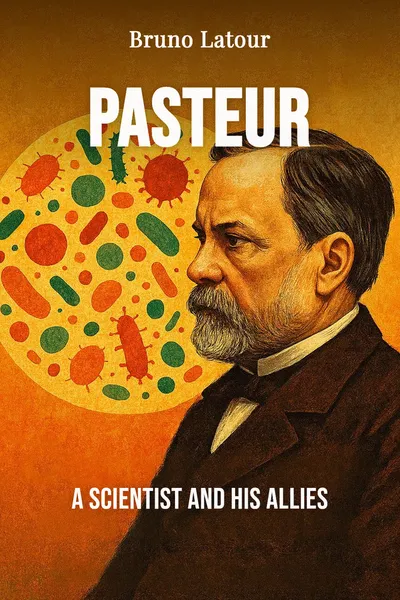
Pasteur
A scientist and his allies
Description
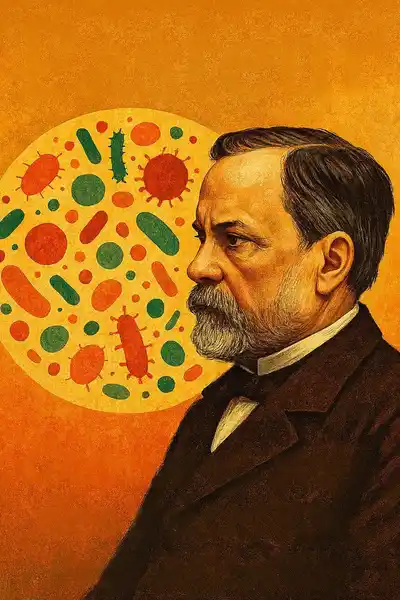
On May 5, 1881, on a farm at Pouilly-le-Fort, southeast of Paris, Louis Pasteur began a public experiment that a farming society had all but dared him to run. Twenty-five sheep would be vaccinated against anthrax; twenty-five would not; then all fifty would be injected with the live disease. The veterinary press had needled him into it, the local agricultural society organized it, and a crowd of farmers, vets, and journalists came to watch. A few weeks later, the vaccinated sheep were grazing and the unvaccinated ones were dead or dying. It looked like a single man's idea meeting the world and winning.
That is the version most of us carry: the lone genius, the microscope, the stubborn truth that prevails against ignorant resistance. It is a satisfying story, and it is almost exactly the story that the philosopher and sociologist Bruno Latour set out to complicate in his book on Pasteur. Latour does not deny that Pasteur was brilliant, or that the microbes were real. He asks a different question. He wants to know how a discovery made in a Paris laboratory managed to reorganize the barns, hospitals, breweries, and ministries of an entire country.
His answer refuses the tidy line from idea to triumph. Nothing about Pouilly-le-Fort was Pasteur acting alone. The hygienists needed him, the farmers needed something, the veterinarians had their own stakes, the microbes had their own demands. What we call "Pasteur's victory" is the moment all those interests were bent into the same direction. Latour rebuilds the whole scene to show what it actually took.
The question we’re asking : How did a discovery made in one Paris laboratory manage to reorganize an entire country — and who else, exactly, did the reorganizing?What we’ll see : How Latour re-reads a famous triumph as something built by many hands, microbes included, rather than won by one.
Table of contents
01Chapter 1 — The hero story we all half-remember
Open almost any account of Pasteur and the shape is familiar. A determined chemist stares down disease, silences his critics, and hands humanity its rescue. The microscope reveals the invisible enemy; the vaccine defeats it; the crowd, once skeptical, converts. It is the structure of a fable, and like most fables it flatters the hero by emptying the room around him. Everyone else becomes an obstacle or an audience.
Latour's first move is to notice how strange this is as an explanation. If the idea alone were strong enough to carry itself, discoveries would spread the day they were made. They do not. Pasteur's germ theory did not win because it was correct in some abstract sense that the truth-loving public eventually acknowledged. Plenty of correct ideas sit inert for decades. Something else has to happen for a laboratory result to become a fact that farms and hospitals actually run on.

02Chapter 2 — The farm at Pouilly-le-Fort was already crowded
Return to the famous field trial and count who is actually present. Pasteur did not wake up one morning and decide to vaccinate sheep in public. The challenge came from a skeptical veterinarian, Hippolyte Rossignol, who essentially goaded him into a demonstration through the agricultural press. The Melun agricultural society staged the event. Local farmers supplied the animals and the stakes, because anthrax was ruining French livestock and someone was going to have to pay for the losses either way. The trial was less a lone experiment than a negotiation with a crowd that had its own demands.
And the animals were not passive props. For the demonstration to work, the anthrax microbe had to be coaxed into behaving predictably — grown, weakened, stored, dosed — in ways that had taken years of laboratory labor to master. Latour is insistent on this point: the microbes are actors in the story, not scenery. They resist, they mutate, they die on the wrong schedule. Half of Pasteur's craft was learning to make them cooperate, and a vaccine is essentially a treaty negotiated with a living thing that does not care about French agriculture.
03Chapter 3 — The lab that reached out and rearranged France
What made Pasteur formidable, in Latour's telling, was less any single experiment than a strategy for extending the laboratory's reach until the whole country ran on its terms. The key was that the lab defined the conditions under which its claims held. A microbe behaves reliably in controlled cultures with sterilized equipment and trained hands. So to make the germ theory true out in the world, you had to make the world a little more like the laboratory — cleaner, more measured, more disciplined about invisible agents.
This is precisely what the hygiene movement was hungry to do, and it is why the alliance was so productive for both sides. The hygienists gave Pasteur an army of reformers already pushing sanitation on cities, hospitals, and armies. Pasteur gave the hygienists what they had lacked: a specific, nameable cause, and the authority of a laboratory to back their campaigns. Neither could have transformed French public health alone. Together they turned a scattering of intuitions about dirt and disease into a program with a scientific spine.
04Chapter 4 — Nobody wins alone, and "alone" was never the setup
Step back from the sheep and the flasks, and Latour is really making an argument about how any scientific fact comes to be believed. The old picture imagines truth as a force that pushes outward from the mind of a discoverer, meeting resistance from ignorance and slowly overcoming it. Latour replaces that image with a much messier one: a fact becomes solid only when enough people, institutions, and things have been enlisted to hold it up. Take away the allies and the fact wobbles.
The engine of this enlistment he calls the translation of interests. Pasteur rarely persuaded anyone by simply demonstrating that he was correct. He persuaded them by convincing each group that its own goal ran through his laboratory. The farmer's interest in living livestock, the hygienist's crusade against filth, the state's need for a healthier population — Pasteur translated each of these into a version that could only be satisfied by adopting his microbes and his methods. "Support me" became indistinguishable from "get what you already wanted."
05Conclusion
Return once more to Pouilly-le-Fort, to the vaccinated sheep grazing while the others fall. It still looks like a single man's triumph, and the folk memory will keep insisting that it was. But the scene only ran the way it did because a whole assembly had been brought into place beforehand — the goading vets, the anxious farmers, the organized society, the microbes trained to weaken on cue, the hygienists ready to broadcast the result. Pasteur's genius was to gather all of them into one field on one afternoon and let their combined weight settle the question.
Related books