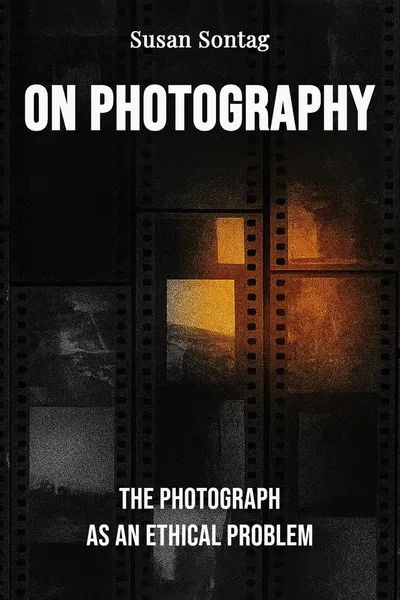
On Photography
The photograph as an ethical problem
Description
In 1973, Susan Sontag published the first of six essays in the New York Review of Books that would become, four years later, a slim volume called On Photography. She had not set out to write a manual or a history. She had set out from a nagging suspicion, one that had been building for a decade of looking at pictures: that the sheer act of photographing the world had quietly changed our relationship to it. The book won the National Book Critics Circle Award in 1977 and has never gone out of print. It remains one of the strangest works of criticism of its century, because it treats the most ordinary gesture in modern life — pointing a device at something and pressing a button — as a moral event worth years of thinking.
What Sontag noticed was that photographs feel innocent. We take them to remember, to share, to prove we were there. Nobody experiences snapping a picture as an aggressive act. And yet, she argued, a camera does something to its subject that a pen or a paintbrush does not: it takes. It appropriates a slice of the visible and carries it off, and it does this whether the subject is a mountain, a stranger, a child, or a person in the middle of unbearable suffering. The gap between how gentle photography feels and what it actually performs is where the whole book lives.
On Photography is not a single argument neatly delivered. It is a set of connected meditations that circle the same object, each essay approaching it from a different door — the tourist, the collector, the surrealist, the moralist. Sontag mistrusted tidy conclusions, and the book resists them. But underneath the wandering there is a steady pressure, a question she keeps returning to and never quite lets go.
The question we’re asking : What does the simple act of taking a picture do to the person taking it, the thing photographed, and our capacity to feel?What we’ll see : Sontag's essays on images, attention, and appetite — and the harder question of what happens when the camera turns toward suffering.
Table of contents
01Chapter 1 — A book that started with an ache of the eye
Sontag was already one of America's sharpest essayists when she turned to photography, known for pieces on camp, on illness, on the war in Vietnam. She was not a photographer and made a point of not being one. Her subject was not how to make good pictures but what pictures do to us once they exist in the enormous quantities modern life produces them in. By the 1970s, she saw, we no longer lived among a few precious images. We lived inside an image environment, an atmosphere of photographs so dense that reality itself had started to feel like a collection of pictures waiting to be taken.
Her opening move is a small allegory. She compares the humans of the image age to the prisoners in Plato's cave, still transfixed by shadows on the wall, still mistaking images for the real. Except that we, unlike Plato's captives, know the shadows are only shadows and love them anyway. We have chosen the cave. We prefer the photograph of the thing, which we can hold and file and revisit, to the thing itself, which passes and will not sit still.

02Chapter 2 — Collecting the world one frame at a time
The figure Sontag returns to again and again is the collector. To photograph, she writes, is to accumulate — to turn experience into something acquirable, storable, and endlessly reviewable. The tourist with a camera is her favorite example. Anxious about all the unstructured time a trip involves, unsure how to simply be somewhere, the traveler photographs. The act converts an uncertain encounter with a foreign place into a task with a product. You have done something; you have the pictures to prove it. The camera, she suggests, is a way of refusing the vulnerability of just looking.
This appetite has a history, and Sontag traces it partly to the surrealists, who loved photography precisely because it snatched things out of their context and made them strange. But the deeper engine is capitalism itself. A society organized around consumption produces citizens who experience the world as a set of images to be acquired, and photography is the perfect instrument for that hunger. Every scene becomes a potential possession. Beauty, poverty, ruin, a famous face — all get flattened into the same collectible currency, equally available, equally consumable.
03Chapter 3 — The camera doesn't intervene, it watches
Here Sontag turns the appetite into an ethical problem, and the metaphors sharpen. To photograph people, she writes, is to violate them, to see them as they never see themselves, to turn them into objects that can be symbolically possessed. Her language is deliberately hard: the camera as a kind of predation, shooting a subject, loading and aiming. She does not mean that photographers are cruel. She means the gesture itself carries an aggression we have trained ourselves not to notice, because the picture that results is so quiet and so useful.
The point becomes sharpest around the photographer's posture toward events. To take a picture is, structurally, to decline to intervene. The person behind the lens has chosen the picture over the act — has decided that recording the moment matters more, or at least comes first. Sontag is careful here; she knows the photograph of the atrocity can be exactly what forces the world to look. But she will not let the photographer off the moral hook. Choosing the frame over the deed is a choice, even when it is the right one, and it implicates the person making it.
04Chapter 4 — The image economy runs on more images
Step back from the individual snapshot and a larger logic appears, the one Sontag is really tracking. A culture saturated with images does not become better informed or more feeling; it develops a tolerance, the way a body develops a tolerance to a drug. Each image delivers a smaller charge than the last, so the appetite demands more, and something more extreme, to register at all. Photography, she argues, teaches us a new relation to reality in which the real is never quite enough on its own — it needs to be confirmed, sharpened, made consumable by being turned into a picture.
This is why she keeps circling back to violence, and it is where the book closes its hardest argument. The photograph of suffering sits at the exact fault line between conscience and consumption. It can be an ethical summons or a piece of entertainment, and the same viewer can flicker between the two in a single second. In a world glutted with such images, the ethical charge is precisely what erodes fastest. What survives is the appetite — the need to see, which slowly detaches from the need to do anything about what is seen.
05Conclusion
On Photography ends the way it began, without a verdict. Sontag had set out from an ache — the feeling that our images had come to stand between us and the world rather than opening it — and she never claimed to cure it. What she offered instead was a way of seeing the seeing: a recognition that the gentlest gesture in modern life, the one nobody thinks twice about, quietly rearranges our appetite, our attention, and our capacity for pity.
Related books