On Killing
How soldiers learn to kill
Description
In 1947, a US Army historian named S.L.A. Marshall published a claim that unsettled the military establishment: in the Second World War, only about fifteen to twenty percent of American riflemen actually fired their weapons at the enemy, even when their own lives were in danger. Marshall's methods have since been contested, but the men who ran the training schools believed him, and they acted on it. Something in the ordinary soldier, it seemed, refused the order to kill — not out of cowardice, but out of a resistance so deep the man himself often didn't know it was there.
Lieutenant Colonel Dave Grossman, an Army Ranger and psychology professor at West Point, took that finding and built a whole discipline around it. His 1995 book gives the field a name — killology — and a stark thesis. Killing another human being is not something most people do easily. There is a powerful, near-universal aversion to it, closer to an instinct than a moral rule. And the great achievement of modern military training has been to engineer that aversion out of the recruit, so reliably that by the Vietnam War the firing rate had climbed past ninety percent.
That is the part most readers already half-expect. What Grossman does next is where the book earns its reputation: he turns the same lens on the living room, the arcade, the screen, and asks whether the techniques armies spent a century perfecting have leaked out of the barracks and into ordinary childhoods.
The question we’re asking : If soldiers are wired to resist killing, how do armies teach them to do it anyway — and where has that lesson gone since?What we’ll see : How a deep aversion gets overridden, what it costs the men who carry it, and why Grossman thinks the override is now running on people who never enlisted.
Table of contents
01 Chapter 1 — The safety catch nobody talks about
Grossman's starting point is counter-intuitive, and he knows it. We assume that in the chaos of battle a soldier's problem is fear — the urge to run. But Marshall's figures, and a scatter of corroborating evidence Grossman gathers from other wars, point to a different obstacle: a large share of men simply would not shoot to kill. They loaded for others, ran messages, tended the wounded, fired over heads, or froze. In the crush of combat, with a target in the sights, most human beings balk.
He argues this is not squeamishness but something built in. Across the animal kingdom, members of the same species rarely fight each other to the death; they posture, bluff, submit. Grossman reads the human reluctance to kill as a version of that — a species-level brake against destroying one's own kind. It sits alongside the well-known fight-or-flight responses, and it explains why so many soldiers, given the choice, quietly opted out of the one thing they had been sent to do.

02 Chapter 2 — How armies switched the killing on
Once the military accepted that men resist killing, it set about solving the problem the way you solve any behavioural one: with conditioning. Grossman's central technical claim is that the training reforms after Korea and before Vietnam borrowed, knowingly or not, the tools of behavioural psychology — the stimulus, the response, the reward — and applied them to the act of pulling a trigger on a human shape.
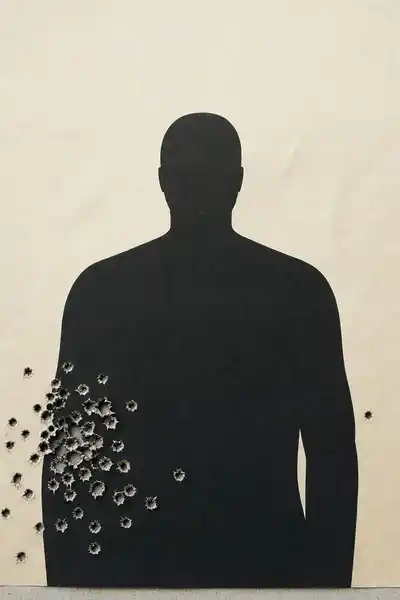
The old rifle range had soldiers firing at round bullseye targets, a task with no resemblance to combat. The new range replaced them with man-shaped silhouettes that popped up at realistic distances, to be engaged in a reflex instant and, crucially, that fell down when hit. Grossman describes this as operant conditioning: the stimulus is a human figure, the trained response is to fire, and the immediate reward is the target dropping. Repeated thousands of times, the sequence bypasses the deliberating mind. When a real figure appears in a real war, the soldier fires before the old aversion can speak.
03 Chapter 3 — The bill that comes due
The conditioning worked on the battlefield. Grossman's next argument is that it does not switch off when the soldier comes home, and that the aversion it overrode does not disappear so much as go underground, resurfacing as damage. A man can be trained past his reluctance to kill; he cannot be trained past the human cost of having killed.
He walks through what he calls the stages of the killing response — a swell of exhilaration in some, followed almost universally by remorse, revulsion, and a long process of rationalisation. Killing at close range, where the victim's face and death are unavoidable, tends to leave the deepest wounds. Grossman gathers testimony from veterans who carried the specific memory of a single enemy for decades, and he sets it against the general trauma of simply being under fire. His claim is that inflicting death, not merely facing it, is a distinct and heavier burden.
04 Chapter 4 — The training we never signed up for
Here Grossman makes the move that turned a military study into a subject of public argument. If the aversion to killing is real, and if armies overcome it through operant conditioning — pairing a human-shaped stimulus with a trained lethal response and an immediate reward — then the technique is not the property of the military. It is a general method. And he claims that late-twentieth-century civilian life had begun running the same method on children who never enlisted.
His case rests on the resemblance. Point-and-shoot video games, he argues, reproduce the modern firing range almost exactly: a human figure appears, the player reacts in a reflex instant, and a hit is rewarded with points, progress, and spectacle. Violent film and television supply the desensitisation the army calls for, stripping the horror from killing through sheer repetition and turning it into entertainment. What soldiers undergo deliberately, under supervision, for a purpose, Grossman says civilian children absorb accidentally, unsupervised, for fun — and starting far younger.
05 Conclusion
The book comes back, in the end, to the soldier at the rifle range, firing at a figure that falls when hit. That small piece of engineering — stimulus, response, reward — is what turned Marshall's reluctant fifteen percent into Vietnam's ninety, and it is the thread Grossman follows all the way from the barracks to the living room. His argument holds together because it refuses to treat killing as either natural or unthinkable. It is neither. It is a behaviour, resisted by something deep in us, and installable by anyone who knows the technique.
Related books