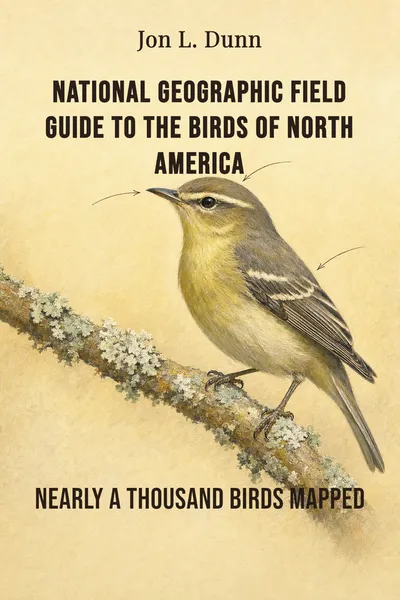
National Geographic Field Guide to the Birds of North America
Nearly a thousand birds mapped
Description
There is a particular kind of book that spends its life outdoors. It rides in a jacket pocket, gets rained on, has its spine cracked open one-handed while the other hand holds binoculars. The National Geographic Field Guide to the Birds of North America, first published in 1983 and steered across its editions by Jon L. Dunn, is exactly that kind of book. It was built to be used at the moment a small brown shape lands on a wire and refuses to hold still. Everything about it — the trim size, the layout, the paintings rather than photographs — is an answer to one urgent, recurring problem: what is that, and how would we know.
The scale of the thing is easy to underestimate. Across its editions the guide has covered well over 990 species — nearly the full roster of birds recorded on the continent, from the ones that visit a suburban feeder every morning to the rarities that turn up once a decade blown off course by a storm. Each of those species gets its portrait, its field marks, a few lines on how it behaves and where it nests, and a small colored map showing where on the continent it can be expected. It is less a book to be read than a book to be consulted, again and again, in the field.
What makes it worth slowing down over is not that it lists a lot of birds. It is what the listing requires. To tell nearly a thousand species apart, on the wing, in bad light, you need a whole apparatus of looking — and behind that apparatus sits a century of argument about how the living world should be divided at all.
The question we’re asking : How does a single portable book teach us to tell nearly a thousand birds apart — and what has to be decided before it can?What we’ll see : We follow the guide from its design on the page to the marks, the maps, and the quiet act of classification that holds it all together.
Table of contents
01Chapter 1 — A book built to be carried, not shelved
The first decision a field guide makes is physical. This one fits in a hand. That constraint shapes everything else: there is no room for long prose, so the text is compressed into short, load-bearing lines, and the real work is done by the plates. The guide favors painted illustrations over photographs, and the choice is deliberate. A photograph shows one bird in one instant of light; a painting can show the bird as the species typically looks, with the key marks lit and legible, and can place several similar species side by side in the same posture so the eye can compare them directly.
The layout answers the way birding actually happens. Related and confusable species sit together on facing pages, painted at matching angles, so that the differences that matter — a wing bar here, a pale eye-ring there — line up for comparison instead of being scattered across the book. Text, illustration, and range map for a given group are kept within reach of each other, because in the field there is no time to flip back and forth. The design assumes a reader who is mid-decision, not mid-study.

02Chapter 2 — How a bird gives itself away
The heart of the guide is the field mark — the specific, checkable feature that separates one species from another. This is the tradition the American illustrator Roger Tory Peterson made famous earlier in the twentieth century: instead of describing a bird exhaustively, point to the handful of things that actually tell it apart from everything it could be confused with. The National Geographic guide inherits that logic and pushes it across nearly a thousand species, many of which look, to an untrained eye, almost identical.
Plumage is the obvious place to look, but the guide teaches a reader to look precisely. Not just 'streaky brown,' but where the streaks are, whether the breast has a central spot, whether the outer tail feathers flash white in flight. Field marks are often small and specific: the color of the legs, the pattern around the eye, the exact shape of a bill. The guide's paintings are arranged to make these marks jump out, and its text names them plainly, so the reader learns what to check rather than staring hopelessly at the whole bird.
03Chapter 3 — Where a bird belongs, drawn on a map
Every species in the guide comes with a small colored map of North America, and these maps do more work than their size suggests. They translate a bird's life into geography: the areas where it breeds, the areas where it spends the winter, the zones it merely passes through on migration, and the places it stays year-round. A glance tells a reader whether the bird in front of them is at home, on holiday, or hopelessly lost. For a great many identifications, that context is the deciding vote.
The maps encode the fact that most North American birds are not fixed in place but move on a schedule. A species may nest across Canada, migrate the length of the continent, and winter in the tropics, and the map shows those separate territories in separate colors so the reader can match what they see against the calendar. This is why the guide's range maps and its seasonal notes work as a pair. A bird found well outside its mapped range is either a misidentification or a genuine rarity — and telling those two apart is one of the more satisfying things birding offers.
04Chapter 4 — The quiet argument about what a species is
It is tempting to treat a field guide as a neutral inventory, as if the birds arrived pre-sorted and the book merely wrote them down. They did not. Behind the clean plates sits taxonomy — the science of naming and grouping organisms — and taxonomy is a live, contested, moving thing. The order in which the guide presents its families, the decision to treat two populations as one species or as two, the very count of nearly a thousand: all of it reflects choices that a committee of ornithologists makes, revises, and sometimes reverses.
This is why the guide keeps appearing in new editions rather than settling into a final form. Species get 'split' when closer study shows that what looked like one bird is really two, and 'lumped' when two apparent species turn out to interbreed freely and are better understood as one. Genetic evidence has accelerated this churn in recent decades, rearranging family trees and reshuffling the sequence in which birds are listed. A number like 990-plus is therefore not a fact of nature but a snapshot of a running conversation, accurate to the moment its edition went to press.
05Conclusion
Come back to the small brown shape on the wire. The guide's whole design converges on that instant: painted plates that line up the near-identical species, terse notes on how the bird moves and sounds, a colored map that says whether it belongs here at all. What began as a problem of pure looking turns out to be a problem of knowing what to look for, and the book's real gift is that it teaches the eye rather than just answering the question. Nearly a thousand species, each reduced to the few marks that give it away, and each placed in the geography and season where it makes sense.
Related books