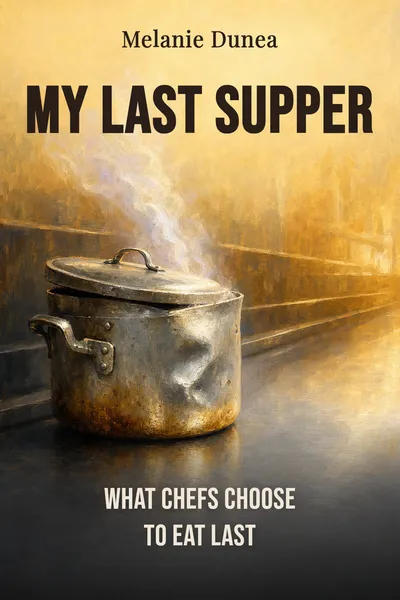
My Last Supper
What chefs choose to eat last
Description
Around 2007, the photographer Melanie Dunea started asking the most accomplished cooks on the planet a question that has no correct answer. If this were your last meal on earth, what would it be? Where would you eat it, who would be at the table, what music would play, and who would cook it? She put the question to roughly fifty chefs — the people whose restaurants earn stars, break records, and set the terms of how the rest of us eat out — and photographed each of them in whatever pose their answer seemed to require. The result, published as My Last Supper, is a book that looks like a glossy collection of portraits and reads like something closer to a confessional.
What makes the project land is the mismatch between the question and the people answering it. These are cooks who have spent careers refining foie gras, deconstructing the tomato, plating dishes that take a brigade of twenty to assemble. And when asked what they would actually want at the end, most of them do not reach for their own signatures. They reach backward — toward a mother's roast chicken, a bowl of pasta eaten standing up, a sandwich, a piece of bread and butter. The gap between what these chefs cook and what they would choose to eat is the whole subject of the book.
Dunea's camera treats each answer as a scene rather than a menu, and the portraits are half the argument. Anthony Bourdain in a cloud of cigarette smoke, Ferran Adrià suspended mid-thought, Gabrielle Hamilton unguarded — the images insist that a last meal is never just food. It is a person, a memory, and a table.
The question we’re asking : When people who cook for a living imagine their final meal, why do so many of them turn away from their own art?What we’ll see : A photographer's simple question, the plates that recur across fifty answers, and what the choices reveal about the people who feed us.
Table of contents
01Chapter 1 — The question that stops a chef cold
The premise of My Last Supper is deceptively light. Dunea did not ask chefs to name their best dish or defend their cuisine. She asked five questions, and they read almost like a party game: What would your last meal be? Where would you have it? With whom? What music would be playing? And who would cook it? The lightness is the trap. A chef can answer a question about their restaurant on autopilot, having done it a thousand times in interviews. This one cannot be answered that way, because it is not about the work. It is about what the work has always been in service of.
The chefs who appear across the book are, by any measure, the people at the top of the profession as it stood in the late 2000s. Ferran Adrià of elBulli, then widely called the most influential cook alive. Daniel Boulud, Eric Ripert, Lidia Bastianich, José Andrés, Scott Conant, Gabrielle Hamilton, Mario Batali, Jacques Pépin. Anthony Bourdain, who by then was less a working chef than the profession's loudest voice. These are not people short on opinions about food. And yet the question forces a pause you can almost feel on the page.

02Chapter 2 — What the plate keeps coming back to
Read the answers in sequence and a pattern emerges that the chefs themselves probably did not coordinate. The food they choose is, over and over, simpler than the food they are famous for making. The men and women who built reputations on complexity ask, at the end, for the uncomplicated. Roast chicken appears again and again — it is almost a running theme, the dish that so many of these cooks name as the one they would want cooked for them. Bread and butter. A perfect tomato. Pasta, plainly dressed. The kind of food that requires no brigade and no reservation.
The reason is not modesty. It is memory. When a chef names roast chicken, they are rarely naming the abstract dish. They are naming a specific chicken, from a specific kitchen, cooked by a specific person, usually a parent or grandparent, usually decades ago. The last meal, for people who have eaten everything, tends to be the first meal — the one that formed the palate before technique arrived to complicate it. Lidia Bastianich's answers reach toward the Istrian tables of her childhood. The Italian and French chefs return to family cooking that predates their careers entirely.
03Chapter 3 — The scene around the table matters more than the food
Dunea's five questions do a clever thing: only one of them is about food. The other four are about setting, company, sound, and the hands that cook. And in answer after answer, those four end up carrying more weight than the dish itself. Ask a chef what they would eat and you get a plate. Ask who would be there and you get a life. The book is arranged so that the meal is almost always the least revealing part of the response.
The company question produces the most emotion. Chefs name late parents they would want back at the table, spouses, children, old friends, mentors long dead. The last meal becomes a way of naming the people whose absence would make any meal incomplete. Some name colleagues and rivals, wanting to go out in the noisy company of the trade. Others want only intimacy — one person, one quiet room. The food recedes and the table fills, and it becomes clear the meal was never the point of the meal.
04Chapter 4 — When cooking is the profession, eating is the confession
Step back from the individual answers and My Last Supper becomes a portrait of a specific kind of person: the one who has turned feeding others into a life's work. For most people, the last-meal question is a fun hypothetical. For a chef, it cuts closer, because food is not a treat they enjoy on weekends — it is the material of their labor, their identity, their public reputation. Asking a chef about their final meal is asking them to separate the food they perform from the food they need. The book's real subject is that separation.
What surfaces in that gap is a quiet vulnerability that professional life usually hides. On the job, these cooks are authorities — decisive, exacting, in command of every element on the plate. The last-meal question returns them to the position of the child being fed, the diner with no responsibilities, the person who simply wants to be taken care of one final time. The great flattener here is not death but appetite. Strip away the stars and the accolades, and what remains is a human being who wants roast chicken, made by someone they loved, in a room full of the right people.
05Conclusion
Melanie Dunea set out to make a photography book and ended up making something more like a collective self-portrait of a profession. Fifty of the most celebrated cooks in the world, asked to imagine the end, mostly declined to show off. They named the chicken, the pasta, the bread, the tomato — and then filled the table with the people they missed. The portraits are lavish; the answers are tender. The distance between the two is where the book lives.
Related books