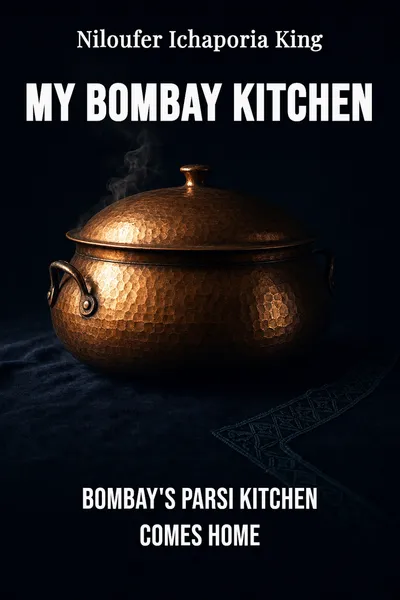
My Bombay Kitchen
Bombay's Parsi kitchen comes home
Description
There is a dish the Parsis call dhansak, a thick lentil stew cooked with meat and browned rice, that most Indian restaurant menus flatten into one more curry. In My Bombay Kitchen, Niloufer Ichaporia King stops us there and says: not so fast. Dhansak is a Sunday dish, a mourning dish, a dish with rules about when you eat it and when you don't. She grew up in Bombay in a Parsi household where food carried this kind of quiet grammar, and she left to become an anthropologist in California — which is roughly the vantage point from which she wrote the book, looking back at a kitchen she could no longer walk into.
The Parsis are Zoroastrians whose ancestors sailed from Persia to the west coast of India more than a thousand years ago, fleeing religious persecution. They settled, prospered, and built one of the most distinctive food cultures in the subcontinent — Persian bones, Gujarati flesh, a splash of the British and the Portuguese who passed through Bombay. King's book, published in 2007, is the first serious English-language account of how this community actually eats at home. It won a James Beard award. But awards undersell what it is doing.
Because a community of this size — a few tens of thousands, and shrinking — does not get a second chance at being written down. King knew the recipes were living in the heads of aunts and cooks who were not going to be here forever, and that a cuisine held only in memory is a cuisine one funeral away from disappearing. So she wrote it the way she cooks: precisely, personally, without pretending she is neutral about any of it.
The question we’re asking : How does a thousand-year-old immigrant cuisine survive when the community that carries it is small and getting smaller?What we’ll see : How a Persian-Indian home kitchen took shape in Bombay, what fills its pantry, and why one anthropologist felt she had to get it onto the page.
Table of contents
01Chapter 1 — A cuisine that arrived by boat
The origin story the Parsis tell about themselves is also a food story. When their ancestors landed in Gujarat around the tenth century, the local ruler is said to have sent them a vessel of milk filled to the brim, meaning there was no room for newcomers. The Parsi leader stirred in a spoonful of sugar and sent it back: we will sweeten your society without displacing anyone. Whether or not it happened, King uses it because it says something true about how the cuisine works. It sweetened what was already there rather than replacing it.
What arrived on those boats was Persian: a love of dried fruit and nuts folded into savory dishes, meat cooked with fruit, rice treated as an event rather than a side. What they found in India was chili, coconut, tamarind, jaggery, the whole Gujarati vocabulary of sweet and sour and hot at once. The Parsi kitchen is the place these two met and stayed married for a millennium. You taste it in a dish like patra ni machhi, fish smeared with a bright green coconut-and-coriander chutney and steamed in a banana leaf — Indian technique, but with a delicacy that feels imported.

02Chapter 2 — The pantry that tells the story
Open a Parsi pantry and you can read the whole history off the shelves. King spends real time here, because she knows that ingredients are where a cuisine keeps its secrets. There is dhana jeera, a house blend of ground coriander and cumin that goes into almost everything, the way a French kitchen reaches for a mirepoix. There is jaggery, the dark unrefined sugar that gives Parsi cooking its characteristic deep sweetness. And there is vinegar, more of it than an Indian kitchen usually holds, a Persian and Portuguese inheritance that shows up in the sweet-sour dishes the community loves.
Some of what she describes is genuinely hard to find outside a Parsi home. Vasanu, an intense winter tonic of ghee, nuts, and warming spices, eaten in cold weather to fortify the body. Malido, a rich semolina sweet made for religious occasions. She writes about these not as curiosities but as working parts of a calendar — foods tied to seasons, to prayers, to the days when the community remembers its dead. A pantry, in her telling, is also a religious and emotional instrument.
03Chapter 3 — Cooking as an act of memory
My Bombay Kitchen is a cookbook, but King writes it as someone who is also grieving a little. She left Bombay, built a life as an anthropologist and cook in the San Francisco Bay Area, and the book carries the double vision of the emigrant — she can see the cuisine clearly precisely because she stepped outside it. The recipes are threaded with memory: a particular aunt's hand, a wedding feast, the exact texture her mother wanted from a dish. She is not reciting formulas. She is trying to hold onto people through what they cooked.
This is where her training shows. An anthropologist knows that food is never only food — it is kinship, religion, status, the shape of a household's year. So she tells us when a dish is eaten, and by whom, and why. Dhansak is not served at celebrations because it belongs to periods of mourning; to make it for a happy occasion would be a small error of feeling. Sev, the sweet vermicelli, appears at auspicious moments. The wedding menu, the New Year table, the food set out on days when families remember the dead — each has its own logic, and King treats that logic as part of the recipe.
04Chapter 4 — A small community, a whole way of eating
Step back from the recipes and My Bombay Kitchen becomes a case study in how minority food cultures actually survive — or don't. The Parsis are one of the world's smallest religious communities, numbering only in the tens of thousands in India and declining with each generation, in part because of low birth rates and strict rules about who counts as Parsi. A cuisine attached to a shrinking community faces a specific kind of mortality. It does not die in a dramatic event. It thins out, one household at a time, as the aunts who knew the proportions by feel stop cooking.
Food like this rarely has the institutions that protect other cuisines. There is no national restaurant scene built around it, no state promoting it as heritage, no chain exporting a standardized version. It lives almost entirely in home kitchens, transmitted by watching and tasting rather than by writing. That is what makes it vivid and also what makes it fragile — the moment the last person who cooks it from memory is gone, the knowledge is gone with them, because nobody wrote down how much jaggery was enough.
05Conclusion
So we come back to that plate of dhansak, the one the restaurant menu got wrong. By the end of the book, we understand why it matters that it is a mourning dish and not a Tuesday dish — because that detail is exactly the kind of thing that survives only in a home, and only if someone bothers to say it out loud. King bothered. She took a cuisine that lived in the hands of aunts and cooks and prayer calendars and got it down on paper, ghee and jaggery and eggs-on-everything intact, before the hands that held it were gone.
Related books