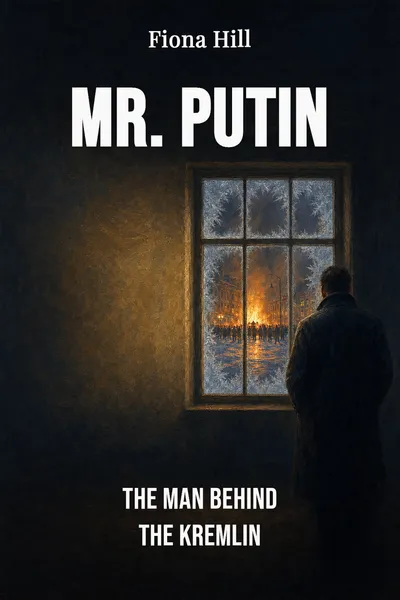
Mr. Putin
The man behind the Kremlin
Description
In the winter of 1999, a man almost nobody outside Russia could name became acting president of a country with thousands of nuclear warheads. Vladimir Putin had run the FSB, the successor to the KGB, for barely a year. Before that he had been a mid-level official in St. Petersburg, and before that a KGB officer in Dresden, watching East Germany collapse from a provincial posting. Boris Yeltsin handed him the keys on New Year's Eve, and much of the world spent the next decade assuming this grey, careful functionary was a placeholder. He was not.
Fiona Hill, who spent years studying Russia as an intelligence analyst and later advised three American presidents, wrote her book with a colleague, Clifford Gaddy, precisely because that early misreading kept repeating itself. Every few years the West would decide it had finally understood Putin — a reformer, a pragmatist, a wounded nationalist, a madman — and every few years he would do something that made the label collapse. Hill's wager is that the problem was never a lack of information. It was that we kept looking for a single Putin, when the man had deliberately built himself out of several.
So her book is less a biography than a manual for reading one. It works backward from behavior to the identities that produce it, treating Putin as someone who has spent a lifetime managing how others see him. The aim is not to like him or to condemn him, but to make his moves legible before they happen rather than after.
The question we’re asking : How do you actually understand a leader who has spent his whole life making sure you can't?What we’ll see : How Hill reconstructs Putin from his origins, his KGB training, and the overlapping identities he wears, and why reading the man means reading Russia itself.
Table of contents
01Chapter 1 — The boy from Leningrad who studied himself
Hill starts where Putin himself starts: the postwar Leningrad of communal apartments, rats in the stairwell, and a childhood that Putin has retold so often it has hardened into official myth. That is the first thing she notices. Most of what we know about Putin's early life comes from Putin, chiefly a set of interviews he authorized around 2000 and published as First Person. The stories are vivid — the scrawny kid who chased a rat into a corner and learned that a cornered creature fights back, the street brawler who found discipline in judo. But Hill treats them not as facts so much as a self-portrait Putin chose to paint at the exact moment he needed Russians to trust an unknown.

02Chapter 2 — The KGB never really let go
The single most important fact about Putin, in Hill's account, is not that he served in the KGB but that he never stopped thinking like it. He joined in the mid-1970s, was posted to Dresden in the mid-1980s, and watched from there as the Soviet bloc came apart. When crowds surrounded the KGB building, he reportedly called Moscow for instructions and was told that Moscow was silent. That silence — the center failing to hold, no one answering — marked him. Hill argues it became the thing he organizes his rule against: never again a vacuum at the top, never again a state that cannot defend itself.
The KGB gave Putin more than a worldview; it gave him a method. Hill describes the operative's habits that persist in the president: the recruitment of people through their weaknesses, the accumulation of kompromat, the assumption that everyone has a hidden motive and a price. Loyalty is tested, not trusted. Information is leverage. The world is divided into those you handle and those who handle you. A case officer does not persuade; he finds the lever and pulls it.
03Chapter 3 — Six identities in one man
The core of Hill's book is an argument that Putin cannot be understood as one thing because he is deliberately several. She lays out a set of overlapping identities — the Statist, the History Man, the Survivalist, the Outsider, the Free Marketeer, the Case Officer — each real, each activated when it serves. The mistake the West made, over and over, was to fix on one and expect it to explain everything.
The Statist believes the strong state is the only thing standing between Russia and chaos; the memory of the 1990s, when the country nearly dissolved, is his founding trauma. The History Man reaches for Russia's past — its tsars, its wartime sacrifice, its imperial reach — to give the present meaning and to justify restoring lost influence. The Survivalist, shaped by hunger stories and the Leningrad siege, hoards resources and prepares for scarcity, treating the economy as a strategic reserve to be controlled rather than freed. These are not masks over an empty face. They are genuine convictions that coexist.
04Chapter 4 — Reading Putin means reading Russia
Step back from the man and Hill's method reveals its larger claim: you cannot separate Putin from the country he governs, because he has spent two decades fusing the two. The consolidation she traces — control of television, the neutralizing of independent oligarchs, the hollowing of opposition, the harnessing of the security services and the energy economy — was not only about holding power. It was about making Russia legible to one reader and illegible to everyone else. The state became an extension of the operative's habits, and understanding it requires the same reading against the grain that understanding Putin does.
This is why the book resists the comfort of a verdict. Hill does not tell us Putin is mad or rational, doomed or ascendant. She tells us that his enduring popularity among many Russians, despite stagnation and repression, makes sense once you see that he offers them the Statist's promise — order after chaos, a country that stands up rather than falls apart. The West's recurring surprise, from Crimea onward, came from expecting a Russia that thinks in the West's categories. Putin thinks in his own, and he has built a system that thinks with him.
05Conclusion
The grey functionary of New Year's Eve 1999 turned out to be one of the most consequential figures of the century, and the West spent much of that time playing catch-up with a man it kept misreading. Hill's contribution is not a new secret about Putin but a way of holding the ones we already have. Instead of a single explanation that collapses at the next surprise, she offers a set of identities that move and combine, and a habit of asking which one is acting now.
Related books