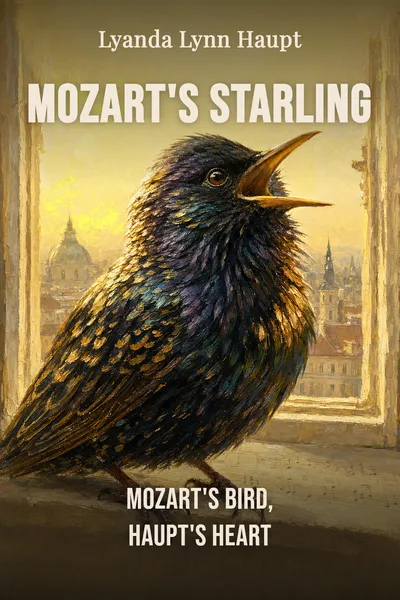
Mozart's Starling
Mozart's bird, Haupt's heart
Description
On May 27, 1784, Mozart walked into a Vienna pet shop and walked out with a starling. We know this because he kept a household expense book, and there, in his own hand, sits the price — thirty-four kreuzer — beside a few bars of music. The notation is a near-copy of a theme from the piano concerto he had finished only weeks earlier, the one in G major, K. 453. Beside it, Mozart wrote a single approving word: schön. Beautiful. The bird, it seems, had learned his tune. And it had improvised on it, sharpening one note, turning a phrase slightly wrong in a way that struck the composer as right.
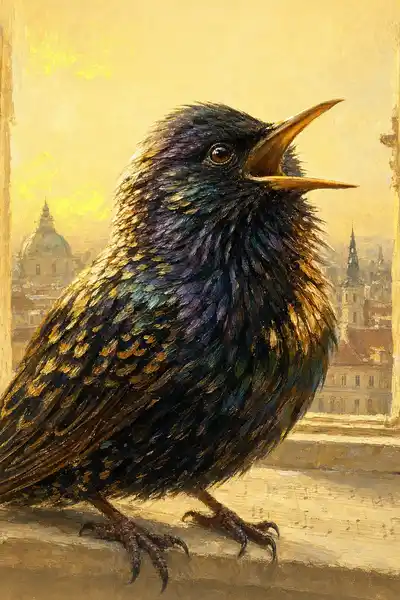
For three years that starling lived in Mozart's rooms. When it died in June 1787, he held a funeral in his garden, veiled mourners and all, and wrote a poem for the grave. This is the kind of anecdote biographers usually file under charming and move past. Lyanda Lynn Haupt, a naturalist who had spent a career watching birds, could not move past it — partly because starlings are, in her professional world, the birds you are not supposed to love. They are invasive, aggressive, everywhere. So she did something a scholar rarely does. She got a starling of her own, raised it from a featherless chick, and named it Carmen.
What followed was two years of living beside a small, loud, startlingly clever animal — and a book that braids Carmen's daily antics with Mozart's forgotten pet, asking what a bird might have to do with a mind that made some of the most beautiful music we have. It is a strange pairing, a dead genius and a live songbird in a Seattle house, and Haupt lets the strangeness sit rather than explaining it away.
The question we’re asking : What did a starling actually give Mozart — and what does raising one teach us about where music, and inspiration, come from?What we’ll see : How a naturalist trained to disdain a bird ended up living with one, and reading Mozart's household through its eyes.
Table of contents
01Chapter 1 — A composer buys a bird
The entry in Mozart's expense book is the whole seed of the book. On one line: Vogel Stahrl, a starling, thirty-four kreuzer. Below it, the melody the bird apparently sang back to him, transcribed, with the alterations noted. Where Mozart's concerto had a G natural, the starling held a G sharp; where the rhythm was crisp, the bird drew a fermata over a note, holding it. Haupt lingers on this because it raises a question nobody can fully answer. Did the starling learn Mozart's theme from hearing him play it — the concerto was written weeks before the purchase — or is the whole thing a coincidence a delighted composer chose to read as music?
She doesn't force a verdict, and that restraint is part of the pleasure. What she can say, as someone who has listened to a great many starlings, is that the bird's version is exactly the kind of thing starlings do. They are mimics of an unusual sort. They don't merely copy; they sample, layer, and recombine, weaving car alarms and other birds' songs and human whistles into long, meandering improvisations. A starling that had lived in a room where Mozart worked would, without any doubt, have absorbed his music the way it absorbed everything else.

02Chapter 2 — The naturalist who was supposed to hate them
Starlings arrived in North America through one of history's more misguided acts of enthusiasm. In the early 1890s, a group in New York — often associated with a man named Eugene Schieffelin — released several dozen European starlings in Central Park, part of a fashion for importing the birds mentioned in Shakespeare. From that small founding population the species spread across the continent, and today they number in the hundreds of millions. They compete with native birds for nesting cavities, foul buildings, and swarm crops. To a working naturalist, the starling is a problem with feathers.
Haupt knew all this intimately, which is what makes her turn so honest. When she decided to raise one, she was crossing a line drawn by her own training. She went out to a barn where starlings were being culled, took a nestling that would otherwise have died, and brought the pink, blind, squawking thing home in a berry basket. She fed it a slurry every forty minutes. She let it imprint on her family. And she felt, the whole time, the low guilt of a specialist consorting with the enemy.
03Chapter 3 — What a starling actually does all day
Much of the book is spent close to Carmen, watching. Starlings, Haupt learns and shows, are extraordinary vocal learners. Their syrinx — the avian voice box — is built to produce two independent streams of sound at once, which is why their song can seem to fold in on itself, one melody running under another. In the wild they sing in loose flocks, and their murmurations, those vast shape-shifting clouds at dusk, are coordinated by simple rules each bird follows relative to its nearest neighbors. Watching a murmuration, she writes, is watching improvisation made visible.
Carmen's talents were smaller and stranger. She mimicked the microwave beep so precisely the family kept walking to the kitchen. She learned phrases and deployed them, if not with meaning, then with something like timing. She stole shiny objects and hid them. She recognized individual people and greeted them differently. None of this is anthropomorphic wishful thinking — corvids and parrots and starlings are among the animals whose cognition genuinely troubles the old, tidy line between human and beast.
04Chapter 4 — The company we keep to make things
Step back from the two birds and a larger claim comes into focus, one Haupt builds without ever stating it as a thesis. We tend to imagine creative genius as something sealed and solitary — the composer alone at the keyboard, drawing music out of some private wellspring. Mozart's starling is a small dent in that picture. Here was one of history's supreme creators sharing his working rooms, for years, with a chattering animal that improvised on his themes, and grieving it when it died. The muse, in this telling, had feathers and stole food off the table.
Her point is not that the starling made Mozart's music; that would be absurd, and she doesn't say it. It is that making things happens inside relationships and surroundings, not in a vacuum. The world a person lives among — its noises, its companions, the creatures that share the house — feeds the imagination whether or not the person notices. Mozart's daily life included a bird whose entire being was devoted to listening and remixing. It is not nothing that he chose to keep it, buried it with ceremony, and wrote it a poem.
05Conclusion
When Carmen died, after roughly two years, Haupt buried her in the garden and felt the disproportion of the grief the way Mozart must have — more than a small bird should be able to summon. The expense book that started everything is still there, thirty-four kreuzer and a few bars of music and the word schön, evidence that a working genius stopped one May afternoon to write down a bird's rough draft of his own tune and found it beautiful. She had set out to explain that anecdote and ended up living her way into it instead.
Related books