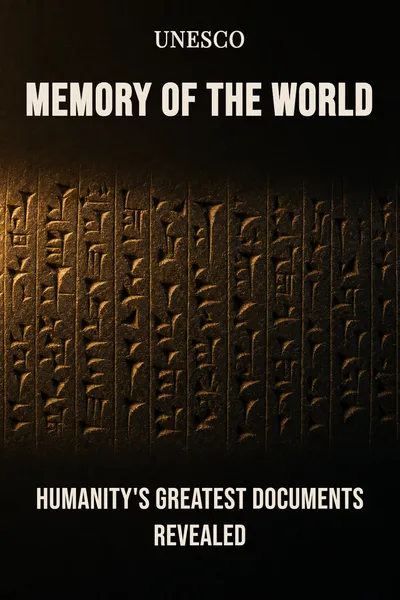
Memory of the World
Humanity's greatest documents revealed
Description
In 1992, with libraries burning in Sarajevo and archives rotting in tropical basements from neglect, UNESCO started a list. Not of buildings or coral reefs or national parks — of documents. Paper, parchment, film reels, clay tablets, sound recordings. The program was called Memory of the World, and its premise was almost stubbornly plain: the record of what humanity has thought and done is scattered, fragile, and easier to lose than anyone likes to admit. The book that carries the program's name, published by UNESCO with HarperCollins, is the glossy public face of that quieter, decades-long effort.
The volume gathers items inscribed on the Memory of the World Register, and the range is deliberately vertiginous. A law code carved into stone in Babylon around 1700 BC sits a few pages from a twentieth-century jazz score. There are Beethoven manuscripts and colonial ledgers, the diary of a girl in Amsterdam and the negatives of photographs that changed how wars were seen. Each entry comes with high-quality reproductions and a short account of why the wider world, not just one nation, has a stake in its survival.
What makes the book more than a coffee-table parade of treasures is the logic underneath it. Inscription on the Register is not a beauty contest. An item earns its place by mattering across borders — by shaping law, science, faith, art, or the historical record for people who never held it. The book is, in effect, a running argument about which fragments of the past the future cannot afford to forget, told through the objects themselves.
The question we’re asking : How does a program decide which documents belong to all of humanity, and what do those choices reveal about memory itself?What we’ll see : An unlikely list born in the 1990s, the sweep of what it protects across nearly four thousand years, and the quiet stakes hidden in the word "heritage."
Table of contents
01Chapter 1 — A register for the paper that outlives us
The Memory of the World Programme launched in 1992, and its timing was not an accident. The end of the Cold War had reopened old archives; conflict in the Balkans was destroying others in real time. UNESCO's insight was that the world had elaborate machinery for protecting cathedrals and wetlands, and almost nothing for protecting the written and recorded trace of human activity. A manuscript is not a monument. It can be moved, sold, censored, flooded, or simply forgotten in a box until the paper turns to dust. Nobody was keeping watch.
The response was a Register — a list of documentary heritage judged to have significance beyond a single country. The word documentary is broader than it sounds. It covers manuscripts and printed books, of course, but also maps, musical scores, photographs, film, and audio recordings. The clay tablet and the magnetic tape belong to the same family here: both are attempts to fix something fleeting so that someone later can read it back.

02Chapter 2 — From Hammurabi's stone to a jazz manuscript
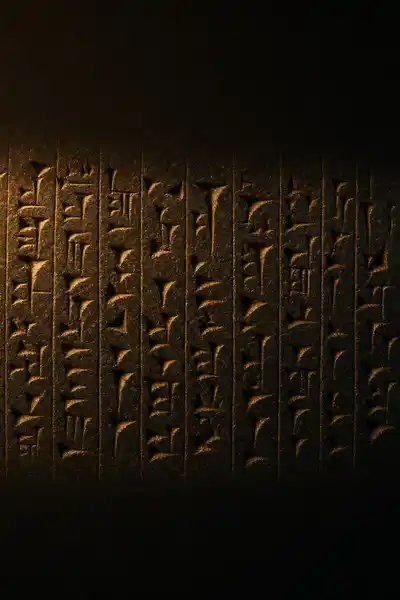
The book's chronological span is its most immediate pleasure. It reaches back to roughly 1700 BC, to legal texts from Mesopotamia — the world of Hammurabi's Babylon, where rulers had their codes cut into durable material precisely so that they would last. That impulse, to make a record that resists time, runs straight through the whole collection. Nearly four thousand years separate the oldest entries from the newest, yet they share a single motive: someone wanted to be understood by people not yet born.
Between those poles the range is enormous. There are sacred and scholarly manuscripts that carried religions and sciences across centuries. There are the working papers of composers, where crossed-out bars show a famous piece still being decided. There are archives of empire and administration — the unglamorous paperwork through which power actually operated, and through which its subjects can now be partly recovered. And there are photographs and recordings from the modern era, when the documentary record suddenly became mechanical, mass-produced, and newly vulnerable.
03Chapter 3 — What a document is worth when the ink fades
The heart of the book is not the images but the short essays beside them, which each try to answer one question: why does this matter to the world? The answers rarely stay within one nation's story. A document inscribed on the Register is there because its influence leaked across borders — because a scientific text seeded ideas elsewhere, a legal charter became a template, a photograph altered how distant publics understood an event they never witnessed.
This is where the program's definition of value becomes clear. It is not market value; some of the most significant items would fetch little at auction. It is not beauty, though many are beautiful. The value is evidentiary and connective: the document is proof of something, and it links people who would otherwise have no shared record. When the book explains an unremarkable-looking archive, the significance usually lies in what it lets us reconstruct — a community, a crime, a migration, a way of thinking that would otherwise be a blank.
04Chapter 4 — The fragility we keep forgetting
Step back from the individual treasures and the book makes a larger claim about memory: it does not take care of itself. We tend to imagine the past as something that simply accumulates behind us, a growing archive we can consult whenever we choose. Memory of the World is built on the opposite assumption — that the past is constantly leaking away, and that what reaches us is only the portion someone chose, or happened, to protect. The Register is an admission that forgetting is the default and remembering is the effort.
That reframing changes what the book is doing. It is not really a catalogue of humanity's greatest documents in the way a museum shows its finest paintings. It is an argument about infrastructure — about the unglamorous, ongoing work of copying, storing, cooling, cataloguing, and digitizing that stands between civilization and amnesia. The famous manuscripts get the photographs, but the deeper subject is the whole precarious system that lets any document reach a reader across centuries.
05Conclusion
The book closes the loop it opened in Sarajevo. A program born watching archives burn ends up producing a beautiful object whose whole purpose is to make the invisible labor of preservation visible — to put Hammurabi's stone and a jazz score and a girl's diary in the same volume and let their survival speak. The treasures are real, and the reproductions do them justice. But the thread running under every page is that none of them were guaranteed to reach us, and their peers, in vast numbers, did not.
Related books