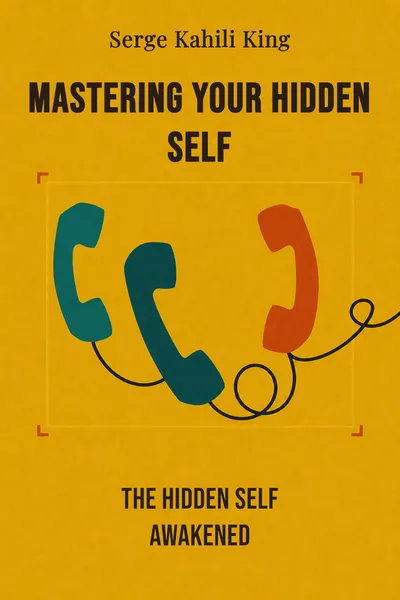
Mastering Your Hidden Self
The hidden self awakened
Description
In the late 1970s, a former missionary's son who had grown up between California and West Africa sat down to write out a system he called Huna. His name was Serge Kahili King, and he claimed the material came to him through a Hawaiian lineage — an adoptive teacher, a set of practices, a way of naming the parts of a person that Western psychology tended to lump together or ignore. The book that followed, Mastering Your Hidden Self, wasn't pitched as scripture or as science. It was pitched as a manual: here is how the mind actually works, here is what you can do about it, starting tonight.
The premise is disarmingly simple. Most of us go through life assuming we are one continuous "I" — the voice that plans, worries, decides. King argues that this voice is only one tenant in the house. Underneath it runs a second self that never sleeps, remembers everything, and quietly runs the machinery of habit, emotion, and the body. Above it sits a third self, higher and quieter, that we rarely consult. Nothing works, King says, until the tenant who talks learns to talk to the tenant who acts.
That framing puts the book squarely in a long tradition of practical mysticism — the kind that cares less about belief than about results. King wanted readers to try things and watch what changed. Which raises the obvious question about any system that promises to hand you the controls to your own inner life.
The question we’re asking : What does Serge Kahili King mean by the "hidden self," and why does he think reaching it is the whole game?What we’ll see : How Huna divides the person, why it treats the subconscious as an ally rather than a problem, and what it asks us to actually do about it.
Table of contents
01 Chapter 1 — The three selves living under one roof
The backbone of Mastering Your Hidden Self is a model King borrows from what he presents as Hawaiian tradition: a person is not one self but three, working together or working at cross-purposes. He uses the old terms and then translates them into plain language, which is characteristic of the whole book — nothing stays exotic for long.
The first is the conscious self, sometimes called the middle self. This is the part that reads these sentences, makes plans, argues with itself in the shower. It reasons, it chooses, and it likes to think it is in charge. King's gentle correction runs through every chapter: it is in charge of far less than it believes.
The second is the subconscious, the hidden self of the title, and for King it is the real workhorse. It holds memory, runs the body, generates emotion, and executes the habits we never decided to keep. Crucially, he describes it as childlike — literal, loyal, eager to please, and easily confused by mixed signals. It does not reason the way the conscious mind does. It responds to feeling, repetition, and vivid images.

02 Chapter 2 — The subconscious as a servant, not a saboteur
Much of twentieth-century pop psychology treated the subconscious as a basement full of trouble — repressed wounds, sabotaging urges, things best left to a professional with a couch. King takes the opposite tack, and it's the move that gives the book its warmth. The hidden self, in his telling, is not out to get us. It is a devoted servant that has simply been badly briefed.
Consider how he reframes a familiar failure. Someone wants to quit a habit, declares it firmly, and relapses within a week. The conventional reading is weakness or self-sabotage. King's reading is a communication error: the subconscious was handed a command wrapped in fear and self-criticism, and being childlike, it absorbed the fear rather than the command. Tell a loyal child "don't you dare fail again" and you have taught it, mostly, the word fail.
03 Chapter 3 — Energy, intention, and the art of persuading yourself
Once the three selves are in place, King turns to method, and here the book earns its subtitle. Awakening the hidden self, for him, is not an insight to be had once but a skill to be practiced. The two levers he keeps returning to are energy and intention — and the techniques for working them are deliberately concrete.
Energy, which he ties to the Hawaiian idea of mana, is treated as something you can sense, gather, and direct. His exercises are physical and unfussy: deliberate breathing to raise your charge, attention to where the body feels tight or open, simple visualizations that give the subconscious something vivid to work with. The claims are large, but the instructions stay small enough that a skeptical reader can test them without signing up to a worldview.
04 Chapter 4 — A homegrown map for anyone who feels split
Strip away the Hawaiian vocabulary and King is describing an experience nearly everyone recognizes: the sense of being at least two people who don't fully agree. One of us resolves; another one shows up late, eats the cake, hits snooze. What Mastering Your Hidden Self offers is not the discovery of that split — we all feel it — but a usable map of it, with named territories and marked routes between them.
That's worth sitting with, because it explains why systems like this keep reappearing across wildly different traditions. Freud drew a similar line between the ego and the vast machinery beneath it. Cognitive therapy talks about automatic thoughts running below deliberate ones. Athletes and performers speak of getting the "thinking mind" out of the way. King's three selves are one more version of a very old intuition: the part of us we don't directly control is the part that does most of the work, and peace comes from partnership rather than conquest.
05 Conclusion
King's wager, laid out over these pages, is that the self we usually call "I" is the smaller partner in the arrangement — and that once we accept this, the goal shifts from control to cooperation. The three selves, the childlike subconscious, the levers of energy and intention: all of it serves one aim, which is to get the talking self and the acting self onto the same page, speaking a language both can understand.
Related books