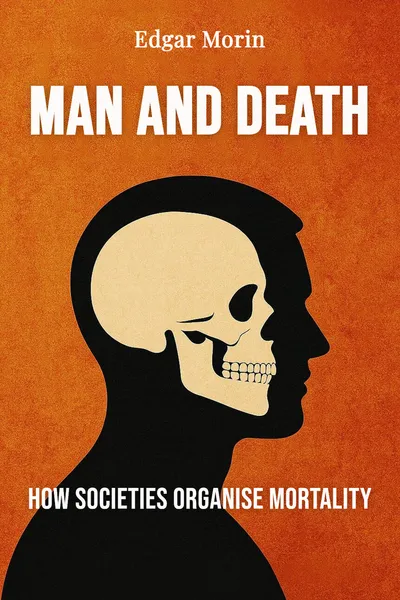
Man and Death
How societies organise mortality
Description
In 1951, a young French sociologist named Edgar Morin published a strange, ambitious book. He was not yet thirty, and the book crossed lines that academic disciplines preferred to keep separate. It gathered prehistory, anthropology, mythology, biology and folklore under a single question that most scholars found too vast, or too morbid, to touch head-on. The book was called Man and Death, and its wager was simple: that the way a society handles its dead tells us more about what it believes, fears and hopes than almost anything else it produces.
Morin's starting point is a fact so familiar we forget how odd it is. Human beings bury their dead. They have done so for tens of thousands of years, painting graves with ochre, laying out food, weapons and ornaments beside a body that will never use them again. No other animal does this. Somewhere in our deep past, mortality stopped being a mere event and became a problem — something to be answered, softened, argued with. Every culture since has built its own answer, and those answers, laid side by side, form a kind of hidden history of the species.
What makes the book unsettling is that it does not stop at the ancient tombs. Morin follows the thread all the way to his own century, where the great collective rituals have thinned out and dying has quietly moved from the home to the hospital. The consolations that once organised whole civilisations no longer hold the same grip. And yet the old refusal has not disappeared — it has only changed costume.
The question we’re asking : Why does the one animal that knows it will die spend so much of its energy refusing to accept it?What we’ll see : How human societies across time have tried to answer death — and what our own era does with an answer it no longer quite believes.
Table of contents
01Chapter 1 — The one animal that knows it will die
Morin opens with what he calls the fundamental trauma. Somewhere in prehistory, a creature emerged that could grasp, in advance, the certainty of its own end. This is not the same as an animal fleeing a predator. A gazelle avoids death without conceiving it; a human being carries the idea around, unbidden, on ordinary afternoons. Consciousness gave us many gifts, and one wound: the knowledge that we, personally, will one day stop.
The evidence Morin leans on is the grave itself. Long before writing, before cities, before agriculture, our ancestors were treating their dead with deliberate care. Bodies were positioned, coloured with red ochre, surrounded by objects meant to accompany them somewhere. You do not go to that trouble for a thing you consider simply gone. The burial is an argument — a physical claim that death is not the last word, that something continues, that the bond with the dead is not fully severed.

02Chapter 2 — Two ancient answers: the double and the return
Across an enormous range of cultures, Morin finds the same two great consolations recurring, in different dress. The first is the idea of the double. When someone dies, something detachable is thought to leave the body — a shadow, a breath, a spirit that mirrors the living person. You can see the intuition forming in everyday experience: the reflection in water, the shadow on the ground, the figure who visits in dreams the night after a burial. The dead seem to persist, half-visible, and the double gives that persistence a name and a home.
The second answer is the promise of return. Life is read as cyclical, like the seasons or the moon: what dies comes back, in the same form or another. Death becomes a passage rather than a wall. In this framing, mourning is real but provisional, because the departed are somewhere in a cycle that will eventually bring life around again. Morin traces how this maps onto agrarian rhythms, where the buried seed and the buried body rhyme with each other and where regeneration is the most vivid thing a community witnesses each year.
03Chapter 3 — When the individual becomes irreplaceable
The great shift Morin charts is the slow birth of the individual. As long as a person is chiefly a member of a group, their death is a manageable subtraction: the clan endures, the ancestors receive one more, and life goes on with little metaphysical crisis. But as societies grow more complex and the single self grows more distinct, death changes meaning. It stops being the loss of an interchangeable part and becomes the annihilation of a unique, irreplaceable person. The horror sharpens precisely as the individual gains value.
This is where the collective doubles of the archaic world no longer suffice. A faint, shared survival among the ancestors does not console someone who now experiences themselves as a singular, once-only being. Morin reads the great salvation religions as an answer scaled up to meet this new demand. They promise not a blurry persistence but a personal one — the same soul, the same identity, carried across death and held accountable, judged, rewarded. Immortality becomes individual, and enormously more precious.
04Chapter 4 — A civilisation that looks away
When Morin turns to his own century, he describes not a triumph over death but a peculiar retreat from it. The old collective rituals — the wake, the long public mourning, the whole neighbourhood absorbing a loss — have thinned. Dying has moved out of the home and into the hospital, out of the community and into the care of specialists. Death has become, in a strange way, indecent: a private embarrassment to be handled quickly, quietly, offstage. The modern West, Morin argues, has not stopped fearing death; it has stopped talking about it.
What makes this striking is that it arrives just as the confident answers weaken. The salvation religions that once organised the whole drama of dying no longer hold their former grip over large parts of society. But the underlying refusal that Morin traced back to the first graves has not vanished with them. It simply lacks its old forms. Deprived of shared ritual and of a secure afterlife, the individual faces the fact more nakedly than ever — and, characteristically, looks away.
05Conclusion
Man and Death ends more or less where it began, at the graveside, but with the whole span of human history now stretched between the first burial and the modern hospital room. The consolations have changed almost beyond recognition — from the shadowy double and the turning seasons to the judged individual soul, and finally to progress and the promise of medical rescue. What never changes is the double gesture underneath: a creature that fully grasps its own ending and, in the same breath, refuses to accept it.
Related books