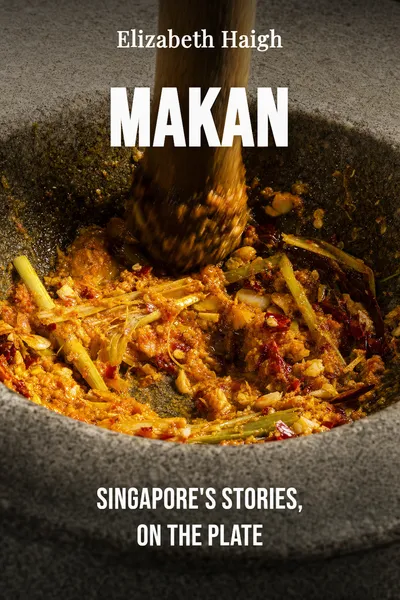
Makan
Singapore's stories, on the plate
Description
In Singapore, the first question a friend asks isn't how you're doing. It's whether you've eaten yet. Have you makan already? The word is Malay, it means to eat, and in the mouth of a Singaporean it carries far more than the act itself — it's a greeting, an invitation, a way of saying I've thought about you. Elizabeth Haigh, who grew up between Singapore and England and later earned a Michelin star in London, took that word as the title of her book because it holds the whole thing at once: the food, the care behind it, and the country that speaks through both.
Makan is a strange kind of book, and deliberately so. It's a cookbook, yes — full of recipes for chicken rice, laksa, beef rendang, kaya toast, the dishes eaten at hawker stalls and family tables across the island. But it reads as much like a memoir. Between the ingredient lists sit stories about Haigh's grandmother, her mother, the smells of a kitchen she half-remembers, and the quiet worry that some of it might not survive another generation. The recipes are the reason the stories get told, and the stories are the reason the recipes matter.
What makes the book worth sitting with is the culture it opens onto — Nyonya cuisine, the food of the Peranakan people, descendants of Chinese traders who settled among the Malays centuries ago and cooked something that belonged fully to neither. It's a food built from mixture, patience, and pounded spice paste. Haigh writes it down partly out of love and partly out of fear that, unwritten, it slips away.
The question we’re asking : How does a plate of food carry a whole culture — and what happens when someone decides to write it down before it fades?What we’ll see : A personal journey through the flavors, family kitchens and mixed heritage of Singapore, told by a cook who refuses to let them be forgotten.
Table of contents
01Chapter 1 — The word that means more than eating
Every food culture has a word it can't quite translate, and for Singapore that word is makan. On paper it's simply the Malay verb for eating. In practice it does the work of an entire social grammar. You greet people with it, you gather people around it, you measure affection by it. A grandmother who doesn't say she loves you will instead pile your bowl higher than you can finish, and everyone at the table understands exactly what has been said.
Haigh builds her book on this idea rather than on technique. She grew up hearing the question — have you eaten? — as the default expression of concern, and she treats it as the key to why Singaporean cooking feels the way it does. This is food made to be shared, in a place where people of different origins live pressed close together, and where the hawker centre, the open-air court of food stalls, functions as a kind of common ground. You sit at a plastic table, elbows near a stranger's, and eat dishes that trace back to China, India, Malaysia and beyond, all within a few steps of each other.

02Chapter 2 — A grandmother's kitchen, half-remembered
The emotional centre of Makan is not a stall or a restaurant but a kitchen, and specifically the women who ran it. Haigh returns again and again to her grandmother and her mother, to the sound and smell of cooking that filled her childhood before life carried her to England. These aren't tidy memories. They come in fragments — a particular spice hitting hot oil, the weight of a stone mortar, the way a dish was tasted and adjusted by instinct rather than measurement.
That imprecision is the whole difficulty, and Haigh is honest about it. The cooking she inherited was never written down. It lived in the hands of women who learned by watching, who cooked by feel, who added a bit more of this until it was right and would have laughed at the idea of a teaspoon. When those women age, or pass, the recipes threaten to go with them. Haigh describes the quiet panic of realizing that the flavors of her upbringing existed nowhere but in fading memory and a few pairs of hands.
03Chapter 3 — Nyonya, or the taste of an in-between people
The deepest current in the book runs through Nyonya cooking, the cuisine of the Peranakans. Their history is itself a recipe for mixture: Chinese traders settled in the Malay world centuries ago, married locally, and over generations produced a distinct culture — Straits-born, neither wholly Chinese nor wholly Malay, with its own dress, language and, above all, food. The men were called Baba, the women Nyonya, and it was the Nyonya kitchen that gave the culture its most lasting expression.
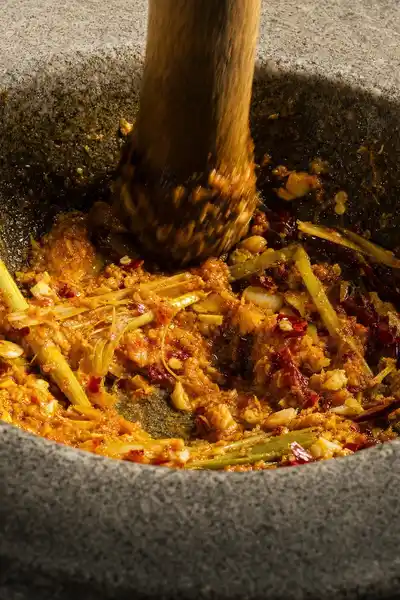
Haigh's own heritage runs through this world, which is why the food carries such weight for her. Nyonya cooking is what happens when Chinese ingredients and methods meet Malay spices and techniques and refuse to stay separate. It's built on the rempah, the spice paste pounded from fresh ingredients — chillies, shallots, garlic, lemongrass, galangal, candlenuts, shrimp paste — laboriously worked by hand until it releases everything it holds. That paste is the foundation of dish after dish, and making it properly is slow, aromatic, and unforgiving of shortcuts.
04Chapter 4 — When a recipe becomes an archive
Step back from the individual dishes and Makan reveals what it's really doing. It's an act of preservation dressed as a cookbook. Cultures that pass their knowledge through the body rather than the page are the most vulnerable, because they depend on continuity — on someone always being there to watch, learn and repeat. Break the chain once, through migration or distraction or simple time, and the knowledge doesn't just weaken. It disappears completely, leaving nothing to consult.
Haigh writes from the fault line of exactly that break. She left Singapore, built a life and a career abroad, and found herself the custodian of a food tradition that her surroundings did nothing to sustain. The recipe, for her, becomes an archive — the only form in which instinct-based cooking can outlive the people who hold it. Writing it down changes it, flattens some of its improvisation into fixed amounts, but it also gives it a chance. A written recipe can cross a border, wait in a drawer, and be woken up by a grandchild who never met the woman who first made it.
05Conclusion
Makan closes the loop it opens with its title. The book begins with a greeting — have you eaten? — and ends up arguing that the greeting itself is worth protecting, along with everything it stands for: the shared table, the grandmother's kitchen, the pounded spice paste of a mixed and half-forgotten people. Haigh gives us recipes we can actually cook, but she never lets us forget that each one arrived carrying a family and a history behind it, and that she wrote it down because no one else might.
Related books