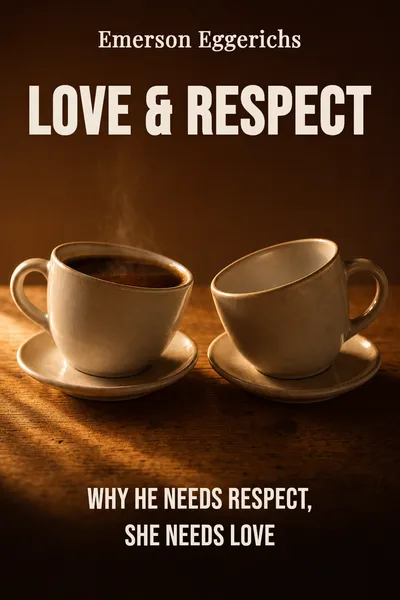
Love & Respect
Why he needs respect, she needs love
Description
A husband and wife are in the car, again, circling the same fight they had last month and the month before. She says he doesn't seem to care about her, that he's cold, that he tuned out the moment she started talking about how her day went. He says she's always criticizing, that nothing he does lands, that she talks to him like he's a disappointment. Neither one is lying. Both walk away convinced the other is the problem. This scene, in one variation or another, is where Emerson Eggerichs began — not as a theorist, but as a pastor in East Lansing, Michigan, watching couples he cared about wear each other down over conflicts that never seemed to resolve.
Eggerichs spent nearly twenty years as senior pastor of Trinity Church before he and his wife Sarah launched what became the Love and Respect conferences, which they've since taken across the country. His book, published in 2004, became a fixture on Christian bestseller lists and sold well past a million copies. The claim at its center is unusually specific for a marriage book: that the recurring conflict most couples get trapped in isn't a clash of good versus bad, but a mismatch of needs. He argues she is wired to need love the way she needs air, and he is wired to need respect the same way — and that each keeps withholding exactly what the other is starving for.
It's a book with a clear intellectual address. Eggerichs roots the whole framework in a single line from the New Testament, and he reads decades of couples' conflicts through it. Whether or not the reader shares his starting point, the mechanism he describes — two people misreading each other because they're fluent in different emotional languages — is worth following all the way through.
The question we’re asking : Why do so many couples get stuck circling the same fight, and what does Eggerichs think each partner is actually missing?What we’ll see : How one pastor built an entire model of marriage around a mismatch in what a husband and a wife each most need to feel.
Table of contents
01 Chapter 1 — The couple stuck in the same argument
The starting observation is almost mundane, which is part of why it lands. Eggerichs noticed, across years of counseling, that couples rarely fought about the thing they thought they were fighting about. The surface topic — the in-laws, the money, the tone of a text message — kept changing, but the emotional shape of the conflict stayed identical. She felt unloved. He felt disrespected. And each reacted to that feeling in a way that confirmed the other's worst read of them.
He gives it a name and a shape. When she feels unloved, she tends to react in ways that come across to him as critical or contemptuous — she pushes, she corrects, she lets him know he's falling short. When he feels disrespected, he tends to react in ways that come across to her as cold and withdrawn — he goes quiet, he leaves the room, he shuts the conversation down. Her protest against feeling unloved reads to him as an attack on his competence. His retreat from feeling disrespected reads to her as proof he doesn't care.

02 Chapter 2 — A verse hiding in plain sight
The whole framework hangs on a single sentence, and Eggerichs makes no attempt to hide it. In the fifth chapter of Paul's letter to the Ephesians, after a longer passage about marriage, comes a closing instruction: each husband should love his wife as himself, and the wife should respect her husband. Eggerichs had read it, taught it, and preached on it for years. What struck him, eventually, was the asymmetry he'd been skating past. The command to the husband is to love. The command to the wife is to respect. Two different words, aimed at two different people.
Most readers, he suggests, flatten that difference. We assume love and respect are roughly the same thing pointed in two directions, or that respect is just a subset of love. Eggerichs takes the wording at face value and asks why Paul would tell the husband one thing and the wife another. His answer is that the verse encodes a difference in need — that Paul is naming what each partner most requires and is least likely to receive by default.
03 Chapter 3 — The Crazy Cycle, and how it feeds itself
Eggerichs gives the whole mechanism a deliberately unglamorous name: the Crazy Cycle. Without love, she reacts without respect; without respect, he reacts without love; and the two feed each other in a loop that neither started and neither can end alone. The name is doing real work. It reframes the fight not as a moral failing on either side but as a system — a thing that runs on its own once it's switched on, dragging two well-meaning people along with it.
His prescription follows directly from the diagnosis. Because the cycle is powered by withholding, the way out is to give the other person what they need before you've received what you need. He asks the husband to notice the moments his wife feels unloved and to move toward her — with time, attention, closeness, the small signals of care she reads as love. He asks the wife to notice when her husband feels disrespected and to communicate respect for who he is and what he does, even in the middle of disagreement. The point isn't that the other spouse has earned it. The point is to stop feeding the loop.
04 Chapter 4 — When a marriage runs on goodwill
Step back from the verse and the vocabulary, and the deeper claim of the book is about difference itself. Eggerichs is arguing that most marital conflict isn't a contest between a reasonable spouse and an unreasonable one. It's two people of goodwill missing each other because they're paying in different currencies — she offering and expecting the coin of love, he offering and expecting the coin of respect, each puzzled that the other doesn't seem to value what's being handed over.
That reframe has consequences beyond his particular Christian framing. The moment a couple accepts that the other person is not withholding out of malice but reaching out in a language they don't quite recognize, the whole emotional temperature of the conflict drops. The critical comment stops being contempt and becomes a clumsy bid for closeness. The retreat into silence stops being coldness and becomes a wince. You can disagree entirely with Eggerichs about scripture, or about whether love and respect really sort so neatly by gender, and still find the underlying move useful: assume goodwill, then translate.
05 Conclusion
Return to the couple in the car. On Eggerichs's reading, nothing about their situation requires a villain. She isn't cruel and he isn't cold; they're two people who've each concluded, wrongly, that the other stopped trying. The fight repeats because each is waiting for a signal in a language the other doesn't naturally speak — and the whole book is an argument that someone has to translate first, without waiting to be translated to.
Related books