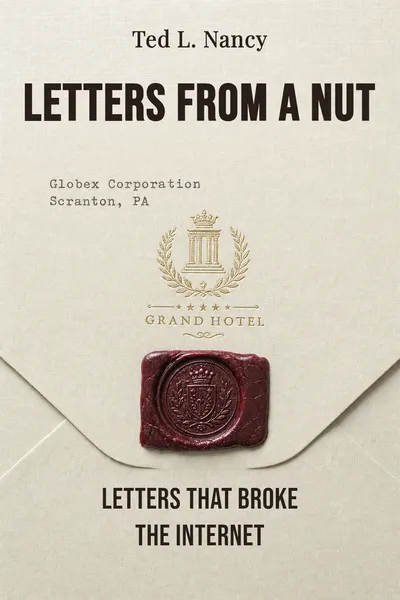
Letters from a Nut
Letters that broke the internet
Description
Sometime in the early 1990s, a stranger who signed his letters "Ted L. Nancy" began mailing polite, single-page requests to hotels, airlines, cereal companies, and the occasional celebrity. The requests were, without exception, deranged. He wanted to know whether a hotel would object if he arrived dressed as a giant hot dog. He asked whether a restaurant could accommodate his pet ant. He inquired, in the calm register of a man asking about parking, about the etiquette of wearing a suit made entirely of cheese. And then he waited for the mail to come back.
It did. That is the part that turns a private joke into a book. Corporations answered him. Customer-service departments, legal teams, and hotel managers took the letters at face value, reached for their most measured tone, and replied. Some declined gently. Some tried to help. A few wrote back at length, clearly straining to sound normal while addressing a man who had asked whether he could bring his own toilet. Collected and published in 1997 with a foreword by Jerry Seinfeld, the correspondence became "Letters from a Nut" — a slim volume of provocations and the baffled answers they drew out.
The comedy lives in the gap between the sender and the responder, and the book knows exactly where that gap is. Long before viral screenshots and reply-guy threads, this was correspondence engineered to break something loose — a small, patient act of mischief conducted entirely through the postal service, letterhead against letterhead.
The question we’re asking : What makes a stack of absurd letters and their polite replies funny enough to fill a book?What we’ll see : How one anonymous writer turned corporate courtesy into a stage, and why the straightest possible answer became the punchline.
Table of contents
01Chapter 1 — A pen name and a stack of stamps
The premise is almost aggressively simple. A man calling himself Ted L. Nancy writes letters to the sort of institutions that receive thousands of pieces of mail a year and have trained staff to answer them: hotels, airlines, food manufacturers, sports teams, the offices of famous people. He puts a return address in Los Angeles, folds the page, licks the stamp, and sends it off. The book is the residue of that routine, reproduced letter and reply, side by side.
The identity of the writer stayed hidden for years, which was part of the appeal. "Ted L. Nancy" was clearly a pseudonym, and the guessing became its own small sport — the leading suspicion pointed to comedian and writer Barry Marder, a friend of Jerry Seinfeld's. Seinfeld wrote the foreword and vouched for the letters as the funniest thing he had read in years. The anonymity mattered less than the method, though. What the reader gets is not a personality but a machine: a man who will write to anyone about anything, so long as it is preposterous.

02Chapter 2 — The requests nobody could quite refuse
What Nancy asks for is the engine of the whole thing, and the requests are calibrated with more care than they first appear. They are absurd, but never merely random. Each one is pitched at exactly the register of an ordinary customer inquiry — a special dietary need, an accessibility question, a slightly unusual accommodation — and then pushed one full step past the possible. He does not ask for something impossible in an obvious way. He asks for something a diligent employee might feel obliged to check on before saying no.
That is the cruelty and the elegance of it. A hotel exists to say yes to guests. A company exists to keep customers happy. So when a man writes, very politely, to ask whether the establishment can store his collection of used bandages, or whether he may check in wearing a full suit of armor for religious reasons, the recipient is caught between the reflex to accommodate and the growing suspicion that something is wrong. The letters exploit the institutional instinct toward helpfulness, turning courtesy into a trap the responder walks into with the best intentions.
03Chapter 3 — The replies that made the joke
A collection of one man's absurd letters would be a mildly amusing pamphlet. What makes it a book is that the letters get answered, and the answers are funnier than anything the sender could have invented. The genius of "Letters from a Nut" is that it is only half-written by Ted L. Nancy. The other half is composed, unwittingly, by hotel managers, legal departments, and public-relations staff doing their jobs as professionally as they can under impossible circumstances.
The replies fall into a few recognizable species. Some responders play it completely straight, answering the deranged question with genuine information, as though the request were routine — suggesting either heroic composure or the possibility that they never actually read what was in front of them. Others write with visible strain, their sentences hedged and careful, clearly aware that something is off but too institutionally cautious to say so. And a few respond with unexpected warmth, offering to help this obviously troubled correspondent as best they can, which is somehow the most affecting result of all.
04Chapter 4 — A whole tradition of the deadpan straight face
Step back from the individual gags and "Letters from a Nut" turns out to be a study in a very particular comic mechanism: the straight man is not a person but an institution. Nearly all comedy needs a foil, someone who takes the ridiculous seriously so the ridiculousness can register. Nancy's foil is the impersonal machinery of the modern service economy — the customer-relations desk, the legal boilerplate, the manager trained never to be rude to a paying guest. The book demonstrates, letter by letter, that this machinery cannot help playing the straight man, because being unflappably polite is its entire job.
This places the book inside a longer lineage than its jokey cover suggests. It belongs to a tradition of the deadpan hoax letter running back at least to the humorist who wrote as Henry Root in Britain in the late 1970s, needling the famous and powerful with absurd correspondence, and it points forward to every later prankster who has baited a corporation into a straight-faced reply. What unites them is a refusal to break character. The comedy depends entirely on the sender never letting on, so the recipient has no choice but to treat the madness as sincere.
05Conclusion
The letters keep coming throughout the book, and the pleasure never quite wears off: a preposterous request, folded into a courteous page, answered by a stranger doing their level best to be helpful. Ted L. Nancy remained a mask for years, the joke's authorship less important than its method. What he assembled was not really a book of his own writing so much as a collaboration with hundreds of unwitting correspondents, each contributing a single reply to a conversation they did not know was a bit.
Related books