Leonardo Da Vinci
The mind that knew everything
Description
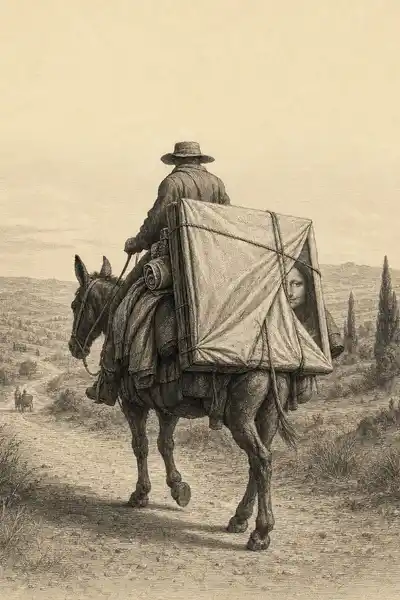
Around 1503, in a workshop in Florence, a man in his early fifties began a portrait of a merchant's wife named Lisa del Giocondo. He never delivered it. He carried the panel with him for years, through Milan, through Rome, and finally into France, still touching it up, still unsatisfied. When Leonardo da Vinci died at Amboise in 1519, the painting we now call the Mona Lisa was still in his possession. It had never been paid for, never been handed over. It was, in a sense, unfinished — like most of what he made.
This is the paradox that runs through Frank Zollner's exhaustive study of the man: the artist whose name became a synonym for genius left behind a startlingly small body of finished work. Fewer than twenty paintings can be securely attributed to him. Several are damaged, a few were never completed, and one — The Last Supper — began to deteriorate almost as soon as he set down his brush, because he insisted on experimenting with a technique the wall could not hold. Against that thin output stand thousands of pages of notes, sketches, diagrams, and observations that almost nobody saw in his lifetime.
Zollner, an art historian who has spent decades cataloguing the paintings and the drawings, sets out to place the myth back inside the life that produced it. The Leonardo he reconstructs is not a lone visionary floating above his century but a working artist, apprenticed and hustling for commissions, shaped by the politics and patronage of Renaissance Italy. The interesting question is not whether he was a genius. It is how a man who finished so little came to stand for knowing everything.
The question we’re asking : How did a painter who completed barely a dozen works, and whose scientific notebooks stayed unpublished for centuries, become the emblem of the mind that knew everything?What we’ll see : From a Florentine workshop to the anatomist's table to the pages nobody read, the making — and the long afterlife — of a reputation.
Table of contents
01Chapter 1 — The apprentice who never quite finished
Leonardo was born in 1452 in or near the Tuscan town of Vinci, the illegitimate son of a notary and a woman of modest standing. That illegitimacy mattered: it barred him from the university and from his father's profession, and it steered him instead toward a craft. In his teens he entered the Florentine workshop of Andrea del Verrocchio, one of the busiest studios in the city, where apprentices learned painting, sculpture, metalwork, and the mechanics of staging altarpieces and pageants. Zollner is careful to keep Leonardo inside this world of guilds and contracts. Whatever he became, he began as a hired hand.
The gifts showed early. In Verrocchio's Baptism of Christ, the young Leonardo is generally credited with the kneeling angel on the left and part of the landscape, and the passage is softer, stranger, more atmospheric than anything around it. But even then a pattern set in. Commissions came, and commissions stalled. The Adoration of the Magi, begun around 1481 for a monastery outside Florence, was abandoned when he left for Milan. Saint Jerome was never finished either. Leonardo, it seems, was often more absorbed by the problem than by the delivery.

02Chapter 2 — One eye on the canvas, the other on the body
What made Leonardo's painting different, Zollner argues, was that he refused to separate looking from understanding. To paint a smile convincingly, he wanted to know the muscles beneath the skin that produced it. To render a hand at rest, he studied the bones and tendons that gave it shape. The result was a body of anatomical work that went far past what any painting required — dissections of corpses, drawings of the heart and its valves, studies of a fetus in the womb, cross-sections of the skull rendered with an accuracy that would not be matched for generations.
The technical innovations in the paintings flow from this same hunger to observe. Zollner dwells on sfumato, the smoky blending of tone that dissolves the hard outline into gradations of shadow, giving faces their living softness. In the Mona Lisa, the corners of the mouth and eyes are deliberately left indistinct, so the expression seems to shift as we look — a direct application of what Leonardo had learned about how the eye perceives edges and light. The famous ambiguity is not mystical. It is optical, and it was engineered.
03Chapter 3 — The notebooks nobody read
The scale of what Leonardo wrote down is hard to overstate. Thousands of surviving pages record his thinking on water and its currents, on the flight of birds, on gears and pulleys, on the geometry of proportion, on machines for war and for spectacle. He designed flying contraptions, an armored vehicle, systems of canals, an ideal city. He wrote in a distinctive mirror script, right to left, which has fed centuries of speculation about secrecy — though Zollner notes it was likely just the natural hand of a left-hander, not a code.
The crucial fact, and the one Zollner keeps returning to, is that almost none of this circulated. Leonardo published nothing. He drafted treatises on painting and on other subjects but never brought them to press. The notebooks were dispersed after his death, passing through the hands of his pupil Francesco Melzi and then scattering across collections in a tangle that took centuries to reconstruct. His engineering ideas influenced almost no one at the time, because almost no one saw them. Whatever he anticipated, he anticipated in private.
04Chapter 4 — A mind we keep reinventing
Step back from the paintings and the notebooks, and a larger point emerges from Zollner's book: the Leonardo we revere is partly a construction of the centuries that came after him. The title of universal genius, the man who supposedly mastered every domain, was not a verdict his own age reached. It was built gradually, as the scattered notebooks were rediscovered, deciphered, and read against later scientific achievements that made his sketches look prophetic. Each generation found in him what it was looking for.
This is why the myth has proven so durable and so elastic. The nineteenth century, hungry for heroic individuals, cast him as the solitary titan. The twentieth, fascinated by technology, seized on the flying machines and the anatomical precision. Our own moment, anxious about the gap between disciplines, holds him up as the answer to over-specialization — the whole mind we supposedly lost. Zollner's careful cataloguing quietly resists all of this by insisting on the documented Leonardo: the contracts, the unfinished panels, the working artist embedded in his time.
05Conclusion
The panel Leonardo carried to France and never delivered now hangs behind glass in Paris, the most visited painting on earth, studied by crowds who mostly cannot say why it moves them. The answer, in Zollner's telling, is bound up with everything the man could not let go of: the smile blurred at the edges because he had learned how the eye reads shadow, the surface reworked over years because the investigation refused to close. The unfinished quality that frustrated his patrons is precisely what keeps the picture alive.
Related books