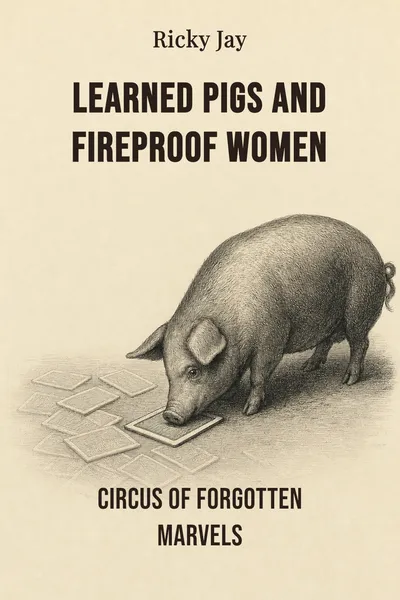
Learned Pigs and Fireproof Women
Circus of forgotten marvels
Description
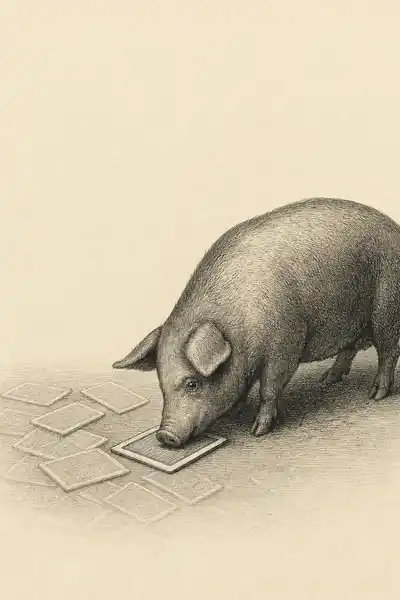
In the London of the 1780s, a pig walked into a room, studied a scatter of alphabet cards on the floor, and picked out letters with its snout to spell a spectator's name. It answered questions about the time of day. It did arithmetic. Crowds paid to see it, essayists wrote about it, and Robert Southey grumbled that the animal had received more attention than any English poet of the age. The pig was billed as the Learned Pig, and for a few seasons it was one of the most famous performers in Britain — an event, a talking point, a genuine celebrity with four trotters.
The pig is where Ricky Jay begins, and the pig tells us what kind of book this is. Jay was a sleight-of-hand magician of near-legendary skill and, on the side, one of the great collectors and historians of popular performance. Learned Pigs and Fireproof Women, published in 1986, is his gathering of the strange people and stranger animals who once filled fairgrounds, theaters, and drawing rooms: fasting men, fire-eaters, memory prodigies, armless calligraphers, conjurers who swallowed swords and stones. Most of them are gone now, not just dead but erased, their names surviving in a handbill or a single line of a diary.
What Jay does with these figures is neither mockery nor nostalgia. He treats them as professionals — people who found something a body or a mind could be trained to do, and turned it into a living in front of a paying crowd. He is a performer writing about performers, which changes everything about the telling. The tricks are examined from the inside, the careers followed with real sympathy, and the eccentricity is taken seriously as craft rather than displayed as a sideshow of the page.
The question we’re asking : Who were the vanished marvels of popular entertainment, and why does a working magician bother to recover them?What we’ll see : A parade of trained pigs, fasting men, and fireproof women, and a magician's argument for why their strangeness deserves to be remembered as craft.
Table of contents
01Chapter 1 — The pig that could spell
The Learned Pig was probably trained by a Scotsman named Samuel Bisset, or by a successor who inherited or copied the act, though the paper trail is thin enough that Jay is careful not to overclaim. What matters is the effect. The animal appeared to read, count, and answer, and audiences in the 1780s were divided between those who thought it a miracle of animal intelligence and those who thought it a fraud — with almost nobody landing on the correct, and more interesting, answer in between.
That answer is training, cueing, and patience. A pig cannot read, but a pig can be conditioned to respond to a signal its handler gives without the crowd noticing: a shift of weight, a small sound, a movement of the hand near the right card. The animal walks the line of cards and stops when cued. The genius is not in the pig, exactly, and not quite in a trick either. It is in the years of quiet work that make the impossible look effortless, and in the showmanship that keeps every eye on the snout and none on the trainer.

02Chapter 2 — When the freak was the star
From the trained animal Jay moves to the trained, or simply extraordinary, human body. His cast includes fasting men who claimed to go weeks without food under public watch, fire-eaters and fire-resisters, sword swallowers, stone eaters, water spouters, and the fireproof women who gave the book half its title. Some possessed genuine unusual capacities; many combined a real physical knack with careful preparation, misdirection, and a good deal of nerve.
The fireproof performers are a case study in how much of the marvel is method. Handling hot iron, walking through flame, or holding a coal on the tongue relies on real principles — the way moisture protects skin for an instant, the poor conductivity of certain materials, the brief windows in which heat has not yet transferred. A performer who understood these things could do genuinely dangerous things safely, and dress the knowledge as magic or invulnerability. Jay explains enough to make the feats intelligible without ever draining the astonishment; he wants the reader to understand and still marvel.
03Chapter 3 — The magician as historian
The book is impossible to separate from the man writing it. Ricky Jay came out of the world of professional conjuring, apprenticed to older masters, steeped in the lore and the technique of an art that hides its own history on purpose. That inheritance shapes every page. He is not an outsider peering at eccentrics; he is a practitioner reconstructing the working lives of people in his own trade, several centuries back.
This changes what he can see. An academic historian might describe a memory artist's performance from the outside — the man who could repeat a hundred random words, or reproduce a page after one glance. Jay recognizes the machinery: the mnemonic systems, the plants, the rehearsed routines that let a good act look like a supernatural gift. He knows which feats are real training and which are dressed-up tricks, and he tells the reader which is which, because a magician's respect for the craft includes an unwillingness to let a bad explanation stand.
04Chapter 4 — Why the marvelous had to be forgotten
Step back from the individual acts and a pattern emerges from Jay's chronicle: popular spectacle is built to be disposable. The learned pig, the fireproof woman, the forty-day faster all thrived on novelty, and novelty by definition cannot last. An act was hot for a season or two, spawned imitators who diluted it, and then dropped out of fashion when the next marvel arrived. The economics of wonder are the economics of the perishable, and the performers understood this better than anyone.
That built-in obsolescence is compounded by a kind of respectability filter. History remembers what elites decide is worth remembering — the poet Southey resented, the theater, the concert hall. The fairground, the pleasure garden, and the drawing-room curiosity fell below the threshold. Nobody preserved the papers because nobody thought them serious. A performer could be genuinely famous in his lifetime, mentioned by major writers, drawing paying crowds for years, and still leave almost no durable trace, precisely because his art was popular rather than prestigious.
05Conclusion
The Learned Pig died, or was retired, or was quietly replaced by another pig; the record does not say. The fireproof women and the fasting men followed their acts into obscurity, leaving behind the playbills and stray mentions that Jay spent a lifetime hunting down. What his book gathers is not a freak show but a lost profession — hundreds of people who discovered what a body, an animal, or a trained mind could be made to do in front of a crowd, and who did it well enough to be paid and forgotten.
Related books