Learn Chess Tactics
Forks, pins, winning combinations
Description
There is a particular moment familiar to anyone who has played chess with a bit of ambition and lost. The position looked fine. Both sides had roughly equal material, the pieces were developed, nothing seemed wrong. Then the opponent played a single quiet move, and suddenly a knight was attacking the queen and the rook at once, or a bishop had pinned a defender to the king, and within two moves a piece was gone for nothing. The game was effectively over, and the losing player often could not say exactly when it had slipped away.
John Nunn, an English grandmaster who was once among the strongest players in the world and who trained as a mathematician before chess became his profession, spent much of his second career trying to close that gap for improving players. His book Learn Chess Tactics is built on a simple observation: most games between amateurs are decided not by deep strategic understanding but by tactics — short, forcing sequences that win material or deliver checkmate. And tactics, unlike the murkier parts of the game, can be taught. They come in a small number of recognizable shapes.
That is the promise, and also the trap the book sets out to avoid. Knowing what a fork is does not mean spotting one across the board with three seconds left on the clock. Nunn's wager is that recognition can be built the way a muscle is built — through graded, deliberate repetition of the patterns until the eye finds them without being told to look. What follows is how those patterns work, and why seeing them is a skill rather than a gift.
The question we’re asking : Why do so many chess games turn on a single tactical shot, and can the ability to see it coming actually be trained?What we’ll see : How the essential tactical patterns work, why they keep deciding games, and how Nunn turns knowing them into seeing them.
Table of contents
01Chapter 1 — The move that decides the game
Nunn begins by separating two things that beginners tend to blur together. There is strategy — the slow business of where to place pieces, which pawns to advance, how to plan over ten or twenty moves. And there is tactics — the sharp, short sequence, usually a handful of moves, that forces a concrete result: a captured piece, a decisive gain, a mate. Strategy sets the table. Tactics eat the meal. And in the games most of us actually play, it is tactics that hand out the results, because a single overlooked shot outweighs an hour of patient maneuvering.
What makes a tactic work, in Nunn's framing, is force. A tactical move usually leaves the opponent with no good reply — a check, a capture, a threat so severe it cannot be ignored. That forcing quality is what lets us calculate at all. When the opponent's answers are limited to two or three, we can see to the end of the line. When a position is quiet and every reply is possible, calculation drowns. So the tactician learns to hunt specifically for the forcing move: the one that takes the opponent's choices away.

02Chapter 2 — One piece, two targets
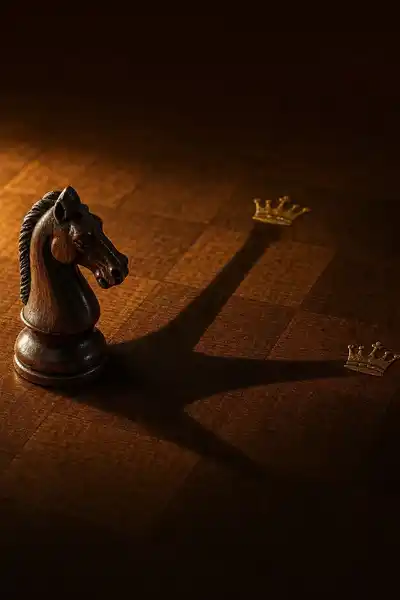
The fork is where Nunn starts, because it is the purest expression of what a tactic does. A single piece attacks two enemy pieces simultaneously, and since the opponent can only save one, material is lost. The knight is the classic forking piece — its odd, jumping movement lets it hit two targets that cannot defend each other, and it cannot itself be captured by the pieces it forks. A knight that lands on a square attacking both the king and the queen is one of the most brutal shapes in the game, and it is often available to a player who has simply learned to look for it.
But every piece can fork. A pawn can attack two pieces at once and win one of them for almost nothing. A queen, a rook, a bishop — each can catch two targets on the right day. Nunn works patiently through these because the recognition is different for each: a knight fork looks nothing like a bishop fork, and the eye has to be trained separately on each shape before it fuses them into a general instinct for the double attack. The underlying logic is always the same. Create a single threat the opponent cannot answer without conceding another.
03Chapter 3 — When a piece cannot move
Individual patterns win pieces. Combinations win games. Nunn's middle chapters push past the single motif into the sequences where several tactics link together, each forcing move setting up the next. A combination might begin with a sacrifice — deliberately giving up material — that looks reckless until we see the fork waiting three moves later, once the opponent has been forced onto exactly the squares we needed. The sacrifice is not generosity. It is the price paid to arrange the pieces for the shot that follows.
This is where calculation becomes the real subject. Recognizing that a combination might exist is the beginning; proving that it works means calculating the forced line to its end and checking that the opponent has no escape. Nunn is careful here, because this is where amateurs stumble. They see the beautiful first move, play it, and only then discover the refutation. The discipline he teaches is to calculate before committing — to follow each forcing move, imagine the opponent's best defense, and confirm the result before the piece leaves the hand.
04Chapter 4 — From pattern to calculation
Step back from the forks and pins, and what Nunn is really teaching is a theory of how a certain kind of skill gets built. He does not appeal to talent, and he does not treat chess vision as something a person either has or lacks. His method assumes the opposite: that the ability to see a combination is a trained response, assembled from thousands of small recognitions, the same way a reader stops sounding out letters and simply reads. The tactical eye is not born. It is drilled into place.
This is why the book is mostly exercises. Nunn understood something that cognitive research on expertise has since made explicit — that experts do not calculate more than novices so much as they see more, because their memory is stocked with recurring patterns they recognize on sight. The grandmaster looking at a board is not brute-forcing every move; large chunks of the position are already familiar shapes that suggest their own solutions. What separates the strong player from the weak one is less raw calculating power than a larger library of remembered patterns.
05Conclusion
Return to that losing moment — the quiet move, the sudden fork, the piece gone before anything seemed to have happened. Nunn's whole book is an argument that the moment was never really sudden. The shot was on the board the whole time; the losing player simply had not trained their eye to find it, while the winner had. The gap between the two was not intelligence or intuition. It was patterns seen, and patterns missed.
Related books