Last Chance to See
Racing extinction with Adams
Description
In 1985, the Observer sent Douglas Adams — the man who had made a comic religion out of the number forty-two — to Madagascar to look for a nearly extinct lemur called the aye-aye, in the company of a zoologist named Mark Carwardine. Neither of them had any real business being there. Adams knew nothing about zoology and had a talent for being spectacularly useless in the field. The trip was a one-off, a magazine assignment with an expiry date. But something stuck. A few years later the two of them set off again, this time deliberately, to find some of the rarest animals left on the planet before they were gone for good.
The result, published in 1990, was Last Chance to See — part travelogue, part comedy, part quiet act of mourning for creatures most people had never heard of and would now likely never meet. Adams and Carwardine went to New Zealand for a fat, flightless, hopelessly trusting parrot called the kakapo. To the Yangtze for a river dolphin. To Indonesia for the Komodo dragon. To Zaire for the northern white rhino, and to Mauritius, where the dodo had already shown everyone how this story tends to end.
What makes the book strange, and durable, is the tone. Adams refuses to write the solemn nature documentary the subject seems to demand. He is funny about airports, about bureaucracy, about condoms improvised into waterproof microphone covers. And then, without warning, he is devastating. The comedy is not a way of avoiding the seriousness. It is how the seriousness gets in.
The question we’re asking : Why does the funniest writer of his generation end up producing one of the most affecting books ever written about extinction?What we’ll see : A reluctant traveller, a handful of animals running out of time, and a form of comedy that turns out to be the most honest way to grieve.
Table of contents
01Chapter 1 — A comic novelist walks into a rainforest
Adams was, by his own cheerful admission, the wrong man for the job. He was the author of The Hitchhiker's Guide to the Galaxy, a Cambridge English graduate who liked hotels, good food and functioning plumbing, and who approached the physical world with the confidence of someone who had never once been asked to sleep in it. Carwardine was the opposite: a working zoologist who knew exactly what they were looking at and why it mattered. The book runs on the friction between them. One man supplies the expertise; the other supplies the bewilderment, which turns out to be the reader's way in.
The structure is simple. Each chapter is a journey to one animal in one place, and the getting-there is at least half the story. Flights are missed, permits evaporate, officials require bribes in currencies that do not exist, boats leak, and the equipment they need is always in the one town they have just left. Adams treats each disaster as material. A malfunctioning tape recorder, a lost visa, a night spent in a hut with something breathing nearby — all of it gets the full comic treatment, sentence by carefully built sentence.

02Chapter 2 — The animals that forgot how to survive us
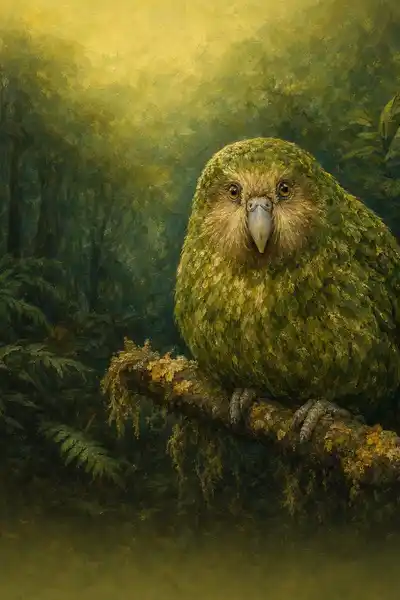
The kakapo is the book's beating heart, and the perfect Adams animal. It is a large green parrot from New Zealand that cannot fly, has no idea how to defend itself, and freezes when frightened — a strategy that worked beautifully for millions of years on islands with no predators, and became a death sentence the moment ships arrived carrying cats, rats and stoats. The kakapo's courtship is a masterpiece of comic futility: the male digs a bowl in the earth and booms into it all night to attract females who, by the 1980s, were almost all somewhere else, or gone. Adams finds this both hilarious and unbearably sad, and refuses to choose between the two.
This is the pattern he keeps finding. Again and again the animals are endangered not because they are weak but because they were superbly adapted to a world that no longer exists. The Komodo dragon, terrifying and ancient, survives on a few Indonesian islands as a kind of living relic. The Yangtze river dolphin, the baiji, was going blind and deaf in a river turned into a highway of engine noise and pollution. The manatee, the rhino, the aye-aye — each had built a life around assumptions about the planet that humans had since quietly cancelled.
03Chapter 3 — The comedy is the argument
It would have been easy, and forgettable, to write this book straight. The 1980s had no shortage of earnest appeals for the whale and the panda, and most of them slid off the reader like rain off a coat. Adams understood something about how attention works. Guilt exhausts people. A lecture makes them defensive. But a genuinely funny sentence disarms you, and while you are laughing, the true thing slips past your guard. His humour is not decoration on top of the message. It is the delivery system.
Consider how he handles scale. Rather than reciting population figures, he lets the absurdities carry the weight — the sheer bureaucratic and logistical madness required to protect a single species, the mismatch between the animals' quiet dignity and the human circus assembled around them. When he describes the effort to save the kakapo, one bird at a time, on predator-free islands, guarded and monitored like heads of state, the comedy of the situation and the desperation of it are the same thing. You cannot laugh at one without feeling the other.
04Chapter 4 — What it costs to lose a thing that only exists once
Step back from the individual animals and the book is really about a single, unbearable property of extinction: it does not reverse. Everything else in modern life feels provisional, editable, recoverable. A species is not. When the last kakapo booms into an empty bowl and no one answers, a specific arrangement of the world — a way of being alive that took millions of years to assemble — is deleted permanently, and no amount of money, will or regret brings it back. Adams keeps circling this. It is the one loss that admits no undo.
That irreversibility is why the humour matters so much. Adams treats extinction the way we treat any truth too large to look at directly: he approaches it sideways, through comedy, because head-on it is simply too much. The dodo becomes the book's presiding ghost precisely because it is already finished. It is the answer key. Everything Adams and Carwardine are chasing is somewhere on the same road the dodo already walked to the end, and the only question is how far along.
05Conclusion
Adams died in 2001, at forty-nine, more than a decade after the journeys that made this book. In the years since, the story has kept writing its own bleak epilogue. The baiji, the Yangtze river dolphin he travelled to see, was declared functionally extinct in the mid-2000s — the first cetacean humans are known to have driven off the planet. The northern white rhino is down to a handful of individuals, none of them able to breed naturally. Some of the animals in the book are now, exactly as he feared, things you can only read about.
Related books