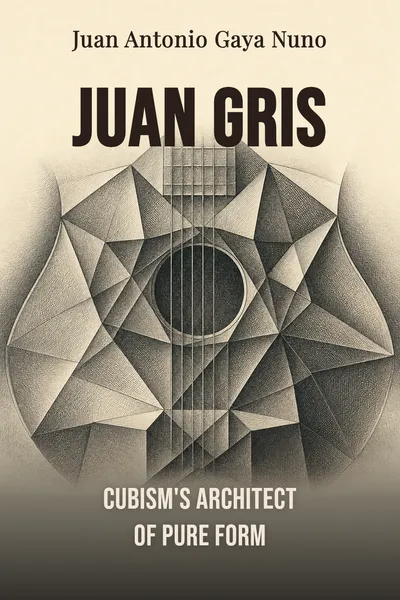
Juan Gris
Cubism's Architect of Pure Form
Description
In the autumn of 1906, a twenty-year-old Spaniard named José Victoriano González arrived in Paris from Madrid, having sold what little he owned to pay for the trip, and moved into a ramshackle studio building in Montmartre where a fellow Spaniard already lived. The building was the Bateau-Lavoir. The other Spaniard was Pablo Picasso. The young man took a new name — Juan Gris — and, for his first years in France, earned his living drawing satirical illustrations for humor magazines, watching from the next room as Picasso and Georges Braque tore painting apart. He did not pick up oils seriously until around 1911, when the demolition was already well under way.
That late start matters, because Gris was never one of the men who broke the window. He was the one who walked into the room afterward and asked how the light now fell. By 1912 he was exhibiting a portrait of Picasso built out of shimmering facets, and within a couple of years he had turned Cubism from an act of destruction into something closer to an act of construction — measured, lucid, almost mathematical. Juan Antonio Gaya Nuño, the Spanish art historian who devoted a study to him, reads Gris as the movement's most deliberate mind, the painter who gave a rebellious grammar its syntax.
He died in 1927, barely forty, after fewer than sixteen years of mature work. The brevity is part of the story: an oeuvre with almost no waste, no long decline, no scattering into other styles. What Gaya Nuño sets out to do is take the measure of a painter often filed as the third man of Cubism, and argue that the filing gets him wrong.
The question we’re asking : What did Juan Gris add to a movement that Picasso and Braque had seemingly already invented?What we’ll see : How a Madrid outsider turned the loose language of Cubism into a rigorous method — and why that discipline still reads as its own kind of daring.
Table of contents
01Chapter 1 — From Madrid to the Bateau-Lavoir
Gris was born in Madrid in 1887 and trained, briefly, at the School of Arts and Manufactures — an engineering-flavored education that Gaya Nuño treats as no accident. Before he ever thought of himself as a painter, he had been taught to think in diagrams, ratios and constructions. He drifted instead toward illustration, and when he crossed into France in 1906 it was with a cartoonist's eye and no money. For five years he drew for periodicals like L'Assiette au Beurre, sharp line work that paid the rent while, a few doors down the corridor, the century's most consequential argument about form was taking place.
The proximity to Picasso was decisive and complicated. Gris admired the older man enormously, and Picasso, by most accounts, regarded the younger Spaniard with a wariness that never quite softened. What Gris absorbed from the Bateau-Lavoir was not a set of tricks but a permission — the sense that a painted object no longer had to pretend to sit in a single window of space. He came to Cubism, Gaya Nuño stresses, as a reader rather than a co-author, which freed him to see its logic more coldly than the men who had improvised it.

02Chapter 2 — The method behind the picture
Gris said the thing about himself more clearly than any critic could: he began, he explained, with an abstract arrangement and worked toward the concrete object, rather than beginning with the object and abstracting from it. A cylinder in a composition might become a bottle; a rectangle might resolve into a newspaper. The order of operations was inverted, and Gaya Nuño returns to this reversal again and again as the key that unlocks the paintings. The canvas was solved like an equation, and the still life was its answer.
This is why his surfaces feel governed rather than felt. He organized many pictures around underlying proportional systems, dividing the canvas with a geometry he trusted more than his impulse. The famous account of his interest in the golden section and in careful mathematical division may be somewhat tidied by later admirers, but the instinct is unmistakable on the wall: nothing floats by accident, every plane answers to another. Gaya Nuño calls this an architecture, and the word is exact — the picture is engineered before it is painted.
03Chapter 3 — A palette nobody else could hold
If method is one half of Gris, color is the other, and Gaya Nuño treats it as the quality that most sharply separates him from his companions. While analytic Cubism had drained painting toward brown and grey, Gris kept his Spanish inheritance of strong color and disciplined it into the structure. Deep blues, ochres, blacks and a particular chalky, luminous grey recur across the work, never splashed but always placed, each hue doing structural labor rather than merely describing a surface.
The subjects, meanwhile, almost never left the table. A guitar, a bottle of Bordeaux, a newspaper, a compotier of fruit, a checkered cloth, a window giving onto rooftops — the vocabulary is narrow on purpose. Gris was not interested in variety of motif; he was interested in the endless variety of ways a fixed set of objects could be reorganized. The still life was his laboratory precisely because it held the subject constant while the structure changed, and Gaya Nuño reads the repetition as concentration rather than poverty of invention.
04Chapter 4 — The shortest career, the clearest logic
Step back from the individual canvases and a larger claim comes into view, the one Gaya Nuño's study is really built to make: Gris matters because he showed that Cubism was not, at heart, an act of vandalism against the past. The standard story casts the movement as a rupture, a violent snapping of the thread that ran from the Renaissance through Cézanne. Gris complicates that story. His work is saturated with order, proportion and craft — the very values the new painting was supposed to have thrown out — and yet it is unmistakably Cubist. He makes the movement look less like a revolt and more like an inheritance.
This is why the label of third man sells him short. Picasso and Braque were inventors, and invention is thrilling; but a language needs more than its first speakers. It needs someone who can demonstrate that the new grammar is capable of clarity, of structure, of being reasoned rather than merely felt. Gris was that someone. He took a set of intuitions that Picasso himself could not fully explain and turned them into a method that could be stated, examined and, in principle, taught. He gave the movement its theory by embodying it.
05Conclusion
Juan Gris died at Boulogne-sur-Seine in May 1927, not yet forty-one, worn out by the heart and kidney trouble that had shadowed his last years. Kahnweiler mourned him, and so, in his guarded way, did Picasso, who attended the funeral. The oeuvre he left behind is small by the standards of a long life but almost startlingly consistent — a body of work with a single, tightening argument running through it from the first faceted portrait to the last serene harlequin.
Related books