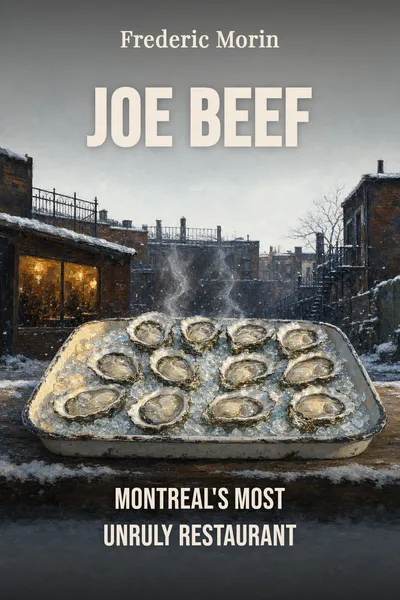
Joe Beef
Montreal's most unruly restaurant
Description
In 2005, two cooks named David McMillan and Frédéric Morin opened a small restaurant on rue Notre-Dame in Little Burgundy, a working-class corner of southwest Montreal that most guidebooks skipped. The place had roughly two dozen seats, a menu written on a mirror in chalk, and a name borrowed from a nineteenth-century tavern keeper, Charles McKiernan, who fed the city's dockworkers and stray animals and went by Joe Beef. There was a garden out back, a smoker, and eventually a train-car obsession that spilled onto the walls. The two men had both worked in serious kitchens and had, in their own words, grown tired of the rules that came with them.
What they built instead was a restaurant that behaved like nobody's idea of a good business plan. It served foie gras on a doubled-down sandwich, oysters by the dozen, lobster spaghetti heavy enough to end a conversation. It didn't take many reservations, didn't chase stars, didn't scale. And yet within a few years it was being called one of the best restaurants in Canada, drawing pilgrims from New York and Tokyo to a block where the metro didn't quite reach. The eccentricity wasn't a marketing costume. It was the whole point.
Morin's book, written with McMillan and Meredith Erickson, reads less like a cookbook than like a house tour given by someone who lives there. It is full of recipes, but also of tangents about oysters, absinthe, gardening, and the peculiar romance of a city that speaks two languages and drinks like it means it. What holds it together is a stubborn idea about what a restaurant is for.
The question we’re asking : How did a cramped, unruly wine bar in an overlooked Montreal neighborhood turn indulgence and disobedience into a culinary institution?What we’ll see : We follow the founding, the philosophy, and the deep local roots of Joe Beef — and where its refusal to behave leads.
Table of contents
01Chapter 1 — A wine bar with fifty seats and no interest in behaving
Before Joe Beef, McMillan and Morin had done their time in the machinery of fine dining. They knew the choreography — the tasting menus, the tweezers, the ambient hush that tells diners to lower their voices. When they took the lease on Notre-Dame, the plan was smaller and more selfish. They wanted a place they'd actually want to eat in. That meant good wine, a lot of it, and food that didn't apologize for being food. The dining room was tight enough that the kitchen and the tables shared the same air, and the noise was a feature, not a flaw.
The neighborhood mattered. Little Burgundy in 2005 was not a destination. It had a history — a Black community, jazz clubs, the old Windsor rail yards — but by the time the two cooks arrived, much of that had faded into quiet blocks and shuttered storefronts. Rent was cheap because nobody was fighting over it. Morin describes the choice as partly economic and partly temperamental: they wanted to be left alone to do their thing, and an ignored street was the ideal place to do it.

02Chapter 2 — The pleasure of doing exactly what you want
The dishes that made Joe Beef famous were, on paper, absurd. Foie gras layered into a sandwich. Lobster spaghetti rich enough to feel like a dare. Smoked meat, oysters by the platter, marrow bones, an entire vocabulary of pleasure with no interest in restraint. Morin frames these not as provocations but as the honest expression of what the cooks actually craved. If a plate was good, they served it, and if the way to make it good was to add more butter and another glass of wine, then that was the recipe.
There was skill under the indulgence, which is the part outsiders sometimes missed. Both men had trained in demanding kitchens, and the technique never disappeared — it just stopped announcing itself. A dish could look like a thrown-together tavern plate and still rest on precise cooking, careful sourcing, and years of judgment about heat and timing. The eccentricity was permitted because the fundamentals were solid; the joke worked because the cooking was real.
03Chapter 3 — Little Burgundy on a plate
For all its swagger, Joe Beef is deeply rooted in the specifics of where it sits. Morin devotes real attention to the suppliers — the oyster men, the farmers, the foragers, the fishmongers — who make the food possible. These are not decorative credits. The book treats them as collaborators, people whose knowledge of a coastline or a season ends up on the plate as directly as anything the kitchen does. The relationships are personal, built over years, and sometimes eccentric in their own right.
Montreal itself is a character. The city's split identity — French and English, formal and rowdy, European in its cafés and North American in its portions — shapes the whole sensibility. Joe Beef cooks like a place that grew up between two culinary traditions and decided it didn't have to choose. There's French technique and Québécois heartiness, a fondness for oysters and for smoked meat, a bilingual mess that could only come from this particular city. Morin writes about Montreal with the affection of someone who can't imagine the restaurant existing anywhere else.
04Chapter 4 — When a restaurant refuses to become a brand
Step back from the recipes and the anecdotes, and Joe Beef makes an argument about what a restaurant can be — one increasingly out of step with the industry around it. In an era when a successful room becomes a template to be copied, franchised, licensed, and turned into a line of frozen dumplings, Joe Beef stayed put. It didn't open ten branches or slap its logo on a sauce. Its refusal to scale is not laziness; it's a position. Some things, the book quietly insists, only work in one place, at one size, with the same people in the room.
That position rests on a distinction between a restaurant built to be lived in and a restaurant built to be exported. A brand is designed to be reproducible; its whole value lies in being the same everywhere. Joe Beef is the opposite — its value lies in being irreproducible, tied to a specific block, a specific city, a specific pair of friends and their obsessions. Take it out of Little Burgundy and it stops being itself. The eccentricity that looks like a marketing hook is actually the thing that makes it un-copyable.
05Conclusion
Charles McKiernan fed dockworkers and stray animals out of a Montreal tavern in the 1800s, and more than a century later two cooks borrowed his name for a cramped room on an overlooked street and turned indulgence into an institution. The book returns, again and again, to that continuity — the idea that Joe Beef didn't invent Montreal's appetite for generous, unruly hospitality so much as inherit it and refuse to tidy it up. The foie gras sandwiches, the lobster spaghetti, the garden and the bees and the wall of railway ephemera are all expressions of the same stubbornness: a place made entirely to its makers' own measure.
Related books