Jerusalem
Jerusalem on a plate
Description
In 1968, in the same divided city, two boys were growing up on opposite sides of a line. Yotam Ottolenghi was born that year in West Jerusalem, the Jewish side, to a family with German and Italian roots. Sami Tamimi arrived a year earlier in the Muslim quarter of the Old City, in the Arab east. They lived a few miles and an entire political universe apart, and they never met as children. Decades later they met in London, in a professional kitchen, two exiles from the same place who discovered they had eaten many of the same dishes growing up — often under different names, each certain the dish was theirs.
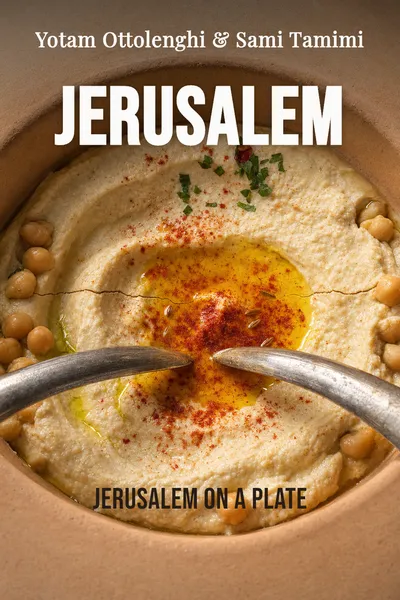
Out of that recognition came a restaurant empire, and in 2012 a book simply titled Jerusalem: 120 recipes, photographed in the city's markets and kitchens, gathered from Jewish, Muslim, Christian, Armenian, Palestinian and a dozen migrant traditions that have layered over one another for centuries. It won nearly every cookbook prize going and became one of the most loved food books of its decade. But it was never only a book of recipes. It was two men returning to a home that both claims them and disowns them, and trying to plate what that feels like.
A cookbook about Jerusalem is a strange, almost provocative object. This is a city where the ownership of a hilltop can trigger a diplomatic crisis, where the naming of a dish becomes a claim of nationhood. To cook it — to put its food on a single table without arbitrating whose it is — is a quiet act with loud implications.
The question we’re asking : What does it mean to write a shared cookbook about a city that agrees on almost nothing?What we’ll see : Two childhoods on opposite sides of a wall, the recipes that carry that history, and the argument over a bowl of chickpeas that no one can win.
Table of contents
01Chapter 1 — Two boys, one city, opposite sides
The book opens with a map and a confession. Jerusalem, Ottolenghi and Tamimi write, is not one city but many overlaid on the same stones — and the food follows the same logic. There is no single Jerusalem cuisine, there are dozens, brought by people who arrived over centuries and cooked what they remembered from somewhere else. Sephardi Jews expelled from Spain, Ashkenazi Jews from Eastern Europe, Palestinian Arab families rooted for generations, Armenians, Greeks, North Africans, Kurds, Yemenis. Each carried its larder into the same narrow streets, and the flavors bled into one another whether anyone approved or not.
Ottolenghi grew up in the west, in a secular, book-lined Jewish household where the kitchen mixed his mother's central-European instincts with the Mediterranean produce of the place. Tamimi grew up in the east, in the Old City, the son of a father who cooked, in a Muslim Palestinian family where the daily rhythm ran on olive oil, spices bought loose from the souk, and dishes that took a whole morning. Both were, in different ways, out of step with their surroundings — Tamimi a gay teenager in a conservative quarter, Ottolenghi restless in a country whose politics wore him down. Both eventually left.

02Chapter 2 — The recipes that refuse to pick a side
The 120 recipes are the argument made edible. There are Palestinian classics like maqluba, the upside-down rice-and-vegetable dish flipped dramatically onto a platter at the table, and musakhan, chicken roasted with sumac and mounds of onions on flatbread. There are Ashkenazi dishes carried from Poland and Lithuania, sweet-and-sour fish and slow-braised meats. There are Sephardi and North African plates heavy with cumin, cinnamon and preserved lemon. And there are the vegetables — roasted, charred, dressed with tahini and pomegranate — that made Ottolenghi's name and quietly reorganized how a generation of home cooks thought about a meal.
What the authors keep insisting on is that these dishes do not stay in their lanes. A recipe they file as Palestinian has a near-twin on the Jewish side; a spice mix one community swears by turns up, barely altered, three streets over in another. They write about za'atar, sumac, tahini and rose water not as exotic decoration but as the shared grammar of the whole city. The book's most repeated move is to name a dish honestly — this is where we ate it, this is who cooks it — and then admit, in the next line, that the neighbors cook it too.
03Chapter 3 — Hummus, and the argument nobody wins
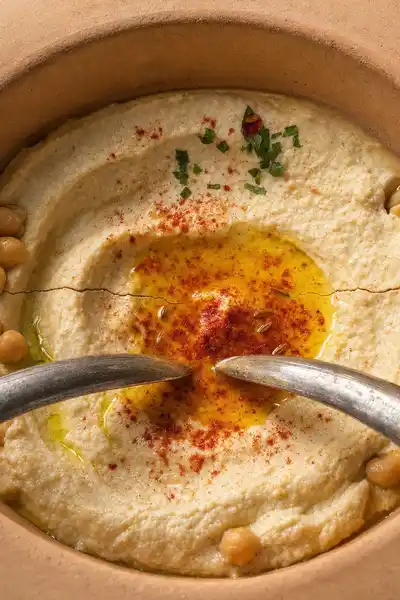
Then there is hummus. Ottolenghi and Tamimi devote real space to it, and they do so knowing it is a minefield. In Jerusalem — and across the wider region — the question of whose hummus is whose has become a proxy for the question of whose land is whose. Israelis and Palestinians, Lebanese and others, have all laid claim to the chickpea paste, and the claims are not casual; there have been public feuds, record-breaking vats made to score national points, genuine anger over a bowl of blended legumes.
The authors do not pretend to settle it. They walk through the technique with obvious love — dried chickpeas soaked overnight and cooked soft, good tahini folded in generously, lemon and garlic, the surface flooded with olive oil — and they note, plainly, that hummus in Jerusalem is eaten by everyone, claimed by everyone, and older than any of the modern arguments about it. To ask who invented it, they suggest, is to ask a question the food itself finds absurd.
04Chapter 4 — A city you can only cook, never own
Step back from the recipes and Jerusalem is really a book about ownership, and about its limits. Everything else in the city is contested down to the meter — the holy sites, the neighborhoods, the roads, the right to call a street a home. Ottolenghi and Tamimi's wager is that food is the one inheritance that resists being owned. You can claim a dish, you can cook it, you can love it fiercely, but you cannot fence it off. It has already been eaten, altered and passed along by too many hands.
This is why the book carries a weight most cookbooks do not. The two authors are living proof of the argument: a Jewish man from the west and a Palestinian man from the east, who could not have shared a table as boys, building a life and a body of work on the shared flavors of the place that separated them. They are careful never to sentimentalize this. They do not claim that hummus brings peace, or that cooking heals anything structural. The conflict is real and the book does not resolve it.
05Conclusion
The two boys who grew up on opposite sides of one city ended up cooking from the same book. Ottolenghi and Tamimi never resolve Jerusalem's contradictions, and they are honest enough not to try. What they do instead is lay 120 dishes on a single surface — Palestinian and Jewish, Armenian and Yemeni, Sephardi and Ashkenazi — and let the reader see that the flavors were always intertwined, whatever the borders insisted.
Related books